Post Office FD vs Bank FD: Which Is Better in 2026?
06 August 2026 · Saurabh Mukherjee
A detailed comparison of Post Office FD and Bank FD in 2026, covering interest rates, safety, tax benefits, tenure flexibility, liquidity, premature withdrawal rules and which option may suit different investors.
Quick Overview
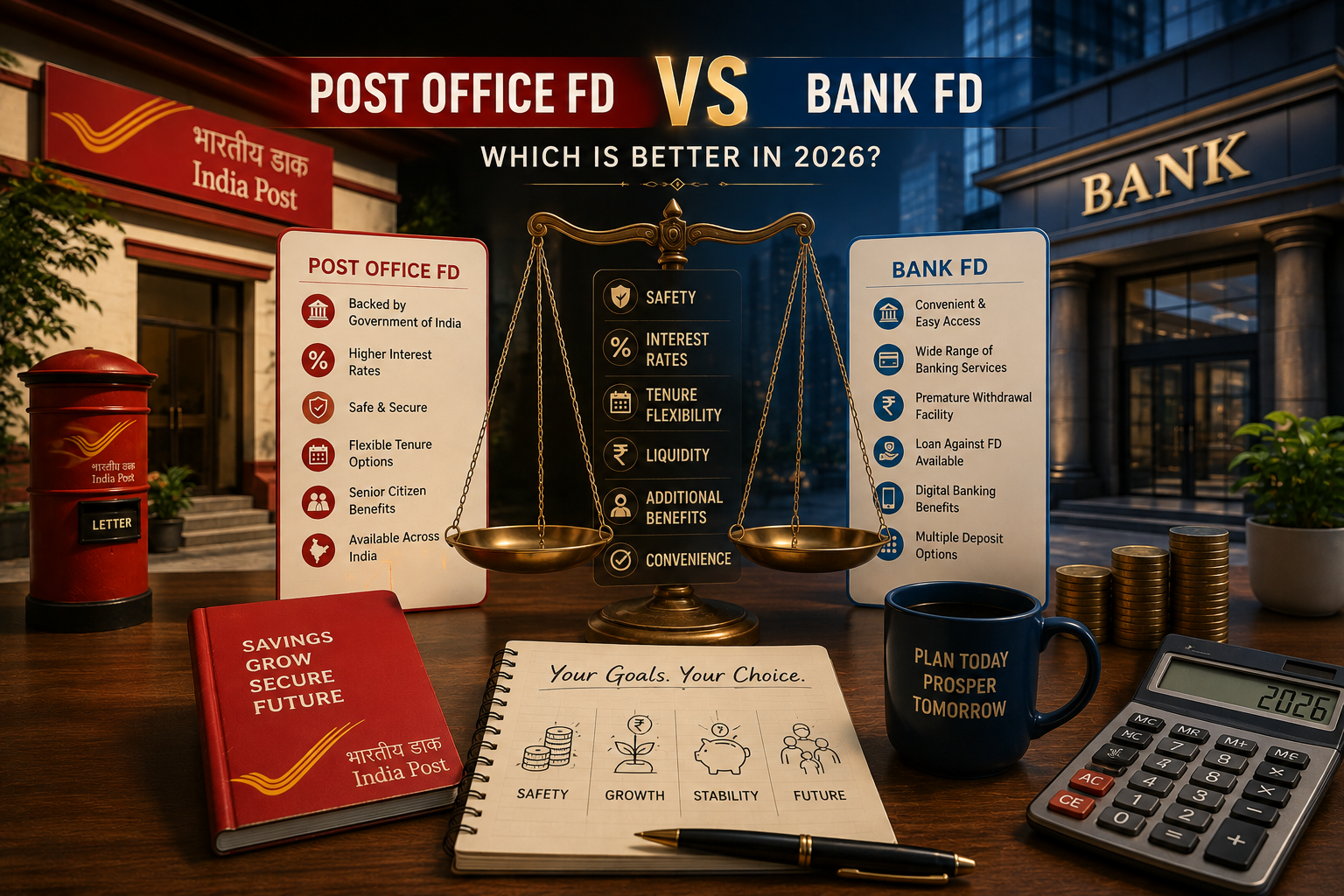
Both Post Office FD and Bank FD are popular fixed-income options in India, but they are not exactly the same.
A Post Office FD, officially known as the Post Office National Savings Time Deposit Account, is a government-backed small savings product available in fixed tenures of 1 year, 2 years, 3 years and 5 years. For the period 1 January 2026 to 31 March 2026, Post Office FD interest rates range from 6.90% p.a. to 7.50% p.a., with the highest rate available on the 5-year tenure.
A Bank FD is offered by banks and usually provides more flexibility in tenure, payout options, online access and premature withdrawal features. Bank FD rates vary across banks, customer category, tenure and deposit amount.
In simple terms, Post Office FD may suit investors who prefer government-backed simplicity, while Bank FD may suit investors who want more flexibility, digital convenience and wider tenure options.
Quick Comparison
| Factor | Post Office FD | Bank FD |
|---|---|---|
| Issuer | India Post under government-backed small savings scheme | Bank |
| Common Tenures | 1 year, 2 years, 3 years and 5 years | Flexible tenures, ranging from a few days to several years |
| Interest Rate | 6.90% p.a. to 7.50% p.a. for 1 Jan 2026 to 31 Mar 2026 | Varies by bank, tenure, customer type and deposit amount |
| Highest Rate | 7.50% p.a. for 5-year tenure during the stated period | Depends on the bank and special tenure rates |
| Tax Benefit | 5-year deposit may qualify under Section 80C | 5-year tax-saving FD may qualify under Section 80C |
| Interest Payout | Annual payout; interest calculated with quarterly compounding | Monthly, quarterly, annual or cumulative options may be available |
| Premature Withdrawal | Allowed after 6 months, subject to scheme rules | Usually allowed with penalty, depending on bank rules |
| Digital Access | Available through post office channels and eligible digital services | Usually strong online and mobile banking access |
| Suitable For | Investors seeking government-backed simplicity | Investors seeking flexibility, convenience and multiple payout options |
What Is a Post Office FD?
A Post Office FD is a fixed deposit-like product offered under the National Savings Time Deposit Account scheme. It allows investors to deposit a lump sum amount for a fixed tenure and earn interest at a government-notified rate.
Post Office FD is available for the following tenures:
1 year
2 years
3 years
5 years
The minimum deposit amount is Rs 1,000, and further deposits can be made in multiples of Rs 100.
The 5-year Post Office FD is especially relevant because it may qualify for tax deduction under Section 80C of the Income Tax Act, subject to applicable limits and conditions.
What Is a Bank FD?
A Bank FD is a fixed deposit offered by a bank. Investors deposit money for a chosen tenure and earn interest at a rate fixed at the time of booking.
Bank FDs are popular because they are easy to open, widely available and usually accessible through net banking and mobile banking.
Bank FDs may offer:
Flexible tenures
Monthly, quarterly, annual or cumulative payout options
Senior citizen rates
Special tenure rates
Sweep-in or flexi FD facilities
Premature withdrawal options
Tax-saving FD for 5-year tenure
Bank FD rates vary across banks. Private banks, public sector banks, small finance banks and foreign banks may offer different rates for the same tenure.
Interest Rate Comparison
For the period 1 January 2026 to 31 March 2026, the Post Office FD rates are:
| Tenure | Interest Rate | Effective Period |
|---|---|---|
| 1-Year Post Office FD | 6.90% p.a. | 1 January 2026 to 31 March 2026 |
| 2-Year Post Office FD | 7.00% p.a. | 1 January 2026 to 31 March 2026 |
| 3-Year Post Office FD | 7.10% p.a. | 1 January 2026 to 31 March 2026 |
| 5-Year Post Office FD | 7.50% p.a. | 1 January 2026 to 31 March 2026 |
Bank FD rates are not uniform. They change depending on:
Bank
Tenure
Deposit amount
General citizen or senior citizen status
Special deposit schemes
Callable or non-callable FD structure
Rate revision date
| Factor | Post Office FD | Bank FD |
|---|---|---|
| Rate Setting | Rates are notified periodically for small savings schemes | Rates are decided by individual banks |
| Rate Change Impact | New deposits follow the applicable rate for the period | New deposits follow the bank's latest rate card |
| Special Tenure Rates | Limited to standard 1, 2, 3 and 5 year tenures | Banks may offer special tenures with higher rates |
| Senior Citizen Premium | No separate senior citizen premium in the standard Time Deposit rate card | Many banks offer higher rates to senior citizens |
Interest Rate Takeaway
If you want a simple government-backed rate card, Post Office FD is easier to understand. If you want to search for the highest available FD rate across banks, Bank FDs may offer more options, especially through special tenures or senior citizen rates.
Before investing, always compare the latest rate card from official sources.
Safety Comparison
Safety is one of the biggest reasons investors compare Post Office FD and Bank FD.
Post Office FD is part of the government-backed small savings framework. This makes it attractive for conservative investors who prioritise safety and stability.
Bank FDs are issued by banks. Their safety depends on the bank’s financial strength, regulatory oversight and applicable deposit insurance protection.
| Factor | Post Office FD | Bank FD |
|---|---|---|
| Backing | Government-backed small savings product | Issued by the respective bank |
| Credit Risk | Generally considered low due to government backing | Depends on the bank; regulated banking framework applies |
| Deposit Insurance | Not evaluated like bank deposit insurance; backed by scheme structure | Eligible bank deposits are covered under deposit insurance up to applicable limits |
| Investor Preference | Often preferred by investors seeking government-backed savings | Often preferred by investors seeking convenience and flexibility |
Safety Takeaway
Post Office FD may appeal more to investors who want a government-backed savings product. Bank FDs may also be suitable for conservative investors, but the choice of bank matters.
Tax Benefits
Both Post Office FD and Bank FD can offer tax-saving options, but only for specific 5-year deposits.
Post Office FD Tax Benefit
The 5-year Post Office Time Deposit may qualify for deduction under Section 80C of the Income Tax Act, subject to applicable limits and conditions.
Bank FD Tax Benefit
A 5-year tax-saving Bank FD may also qualify for deduction under Section 80C.
However, interest earned on both Post Office FD and Bank FD is generally taxable as per the investor’s income tax slab.
| Tax Factor | Post Office FD | Bank FD |
|---|---|---|
| Section 80C Benefit | Available on 5-year Post Office FD, subject to limits | Available on 5-year tax-saving Bank FD, subject to limits |
| Tax on Interest | Generally taxable as per income tax slab | Generally taxable as per income tax slab |
| TDS | Tax rules should be checked based on applicable provisions | TDS may apply if interest exceeds applicable threshold |
| Best For | Investors seeking 5-year government-backed tax-saving deposit | Investors seeking tax-saving FD with bank access and digital convenience |
Tax Takeaway
Tax benefit should not be the only reason to choose either option. Investors should calculate the post-tax return, especially if they are in a higher income tax bracket.
Liquidity and Withdrawal Rules
Liquidity means how easily you can access your money before maturity.
Post Office FD Premature Withdrawal
Post Office FD premature withdrawal is allowed only after 6 months from the date of deposit, subject to conditions.
If a 1-year Post Office FD is closed after 6 months, the interest rate applicable may be the same as the Post Office Savings Account rate.
For 2-year, 3-year and 5-year Post Office FDs closed after 1 year, the interest rate may be adjusted according to scheme rules.
Bank FD Premature Withdrawal
Bank FDs usually allow premature withdrawal, but banks may charge a penalty or offer a lower applicable interest rate. Rules differ from bank to bank.
| Factor | Post Office FD | Bank FD |
|---|---|---|
| Early Withdrawal | Allowed after 6 months, subject to scheme rules | Usually allowed, subject to bank rules |
| Penalty or Rate Adjustment | Interest may be reduced based on tenure completed | Penalty or lower applicable rate may apply |
| Flexibility | Less flexible than many bank FDs | More flexible in many cases |
| Best For | Investors who can stay invested for the chosen tenure | Investors who may need easier premature access |
Liquidity Takeaway
If liquidity is important, Bank FD may be more convenient. If you are comfortable holding until maturity, Post Office FD can still be a strong option.
Tenure Flexibility
Post Office FD has fixed tenure choices: 1 year, 2 years, 3 years and 5 years.
Bank FDs are more flexible. Many banks allow deposits for tenures ranging from a few days to 10 years, depending on the bank’s rules.
| Factor | Post Office FD | Bank FD |
|---|---|---|
| Available Tenures | 1, 2, 3 and 5 years | From a few days to several years, depending on bank |
| Short-Term Parking | Limited short-term flexibility | More short-tenure options |
| Special Tenures | Not available in the same way as bank specials | Banks may offer special tenure rates |
| Goal Matching | Suitable for standard fixed goals | Better for customised investment timelines |
Tenure Takeaway
If your financial goal exactly matches 1, 2, 3 or 5 years, Post Office FD may work well. If you need a specific tenure, such as 6 months, 15 months or 18 months, Bank FD may be more suitable.
Senior Citizen Comparison
Senior citizens often compare Post Office FD and Bank FD because interest income can be an important part of retirement planning.
Bank FDs may offer additional senior citizen rates. Some banks also offer special senior citizen deposit schemes for select tenures.
Post Office FD does not have the same separate senior citizen rate structure for the Time Deposit scheme. However, senior citizens may also evaluate other government-backed schemes such as the Senior Citizen Savings Scheme.
| Factor | Post Office FD | Bank FD |
|---|---|---|
| Senior Citizen Premium | No separate senior premium in standard Time Deposit rates | Many banks offer additional senior citizen rates |
| Regular Income Options | Annual interest payout | Monthly, quarterly or annual payout may be available |
| Alternative Scheme | Senior Citizen Savings Scheme may be considered if eligible | Senior citizen FD schemes may be available |
| Suitable For | Senior citizens seeking government-backed savings | Senior citizens seeking payout flexibility and higher senior rates |
Senior Citizen Takeaway
Senior citizens should compare Bank FD senior rates, Post Office FD rates and Senior Citizen Savings Scheme before choosing.
Post-Tax Return Comparison
The headline interest rate does not show the full return. Investors should calculate post-tax returns.
For example, if an investor earns 7.00% interest but falls in a higher tax slab, the actual post-tax return may be much lower.
| Factor | Why It Matters |
|---|---|
| Income Tax Slab | FD interest is generally taxable as per slab |
| TDS | Bank FD interest may be subject to TDS if thresholds are crossed |
| Section 80C Benefit | Only eligible 5-year deposits may provide deduction |
| Inflation | Real return may be lower if inflation is high |
| Premature Withdrawal | Early closure can reduce effective returns |
Post-Tax Takeaway
A higher interest rate does not always mean a better investment. The better comparison is post-tax return after considering liquidity, safety and tenure.
Who Should Choose Post Office FD?
Post Office FD may be suitable for investors who:
Prefer government-backed savings products
Want simple fixed tenure options
Are comfortable with 1, 2, 3 or 5 year deposits
Want the 5-year tax-saving option
Do not need monthly interest payout
Are comfortable with scheme-based premature withdrawal rules
Prefer conservative fixed-income allocation
Post Office FD may not be suitable for investors who:
Need flexible tenure options
Want monthly payout
Want quick digital convenience
Need frequent premature withdrawal flexibility
Want to compare multiple special tenure rates
Who Should Choose Bank FD?
Bank FD may be suitable for investors who:
Want flexible tenure choices
Prefer online and mobile banking access
Want monthly, quarterly or cumulative payout options
Are senior citizens looking for additional rates
Want sweep-in or flexi FD features
Want to compare rates across multiple banks
Need easier premature withdrawal options
Bank FD may not be suitable for investors who:
Want only government-backed small savings schemes
Do not want to compare multiple rate cards
Prefer standardised tenure and rate structures
Final Verdict
There is no single winner between Post Office FD and Bank FD.
Post Office FD may be better for investors who prioritise government-backed simplicity, standard tenure options and the 5-year tax-saving deposit.
Bank FD may be better for investors who want flexibility, digital convenience, wider tenure choices, payout options and senior citizen rate benefits.
For many investors, the better approach may not be choosing only one. A conservative fixed-income portfolio can include both Post Office FD and Bank FD based on goals.
For example:
Emergency fund: Bank FD or sweep FD
5-year tax-saving allocation: Post Office FD or Bank Tax Saver FD
Retirement income: Bank FD, SCSS or other income options
Conservative savings: Post Office FD
Flexible short-term goal: Bank FD
Before investing, compare the latest interest rates, tax rules, withdrawal conditions and post-tax returns.
Disclaimer: This article is for educational and informational purposes only and should not be treated as investment advice or a recommendation to invest. Interest rates, tax rules and scheme conditions may change. Investors should verify the latest official information and consult a qualified financial advisor before making investment decisions.
FAQs
1. Which is better: Post Office FD or Bank FD?
Post Office FD may be better for investors who want a government-backed savings product with simple tenure options. Bank FD may be better for investors who want flexible tenure, digital access, payout choices and senior citizen rate benefits.
2. Is Post Office FD safer than Bank FD?
Post Office FD is a government-backed small savings product, which appeals to conservative investors. Bank FDs are issued by banks and are subject to banking regulation and applicable deposit insurance rules. The choice depends on investor preference and the selected bank.
3. What is the Post Office FD interest rate in 2026?
For the period 1 January 2026 to 31 March 2026, Post Office FD rates range from 6.90% p.a. to 7.50% p.a. The 1-year rate is 6.90%, 2-year rate is 7.00%, 3-year rate is 7.10% and 5-year rate is 7.50%.
4. Which Post Office FD gives the highest interest rate?
The 5-year Post Office FD offers the highest rate of 7.50% p.a. for the period 1 January 2026 to 31 March 2026.
5. Does Post Office FD have tax benefits?
Yes, the 5-year Post Office Time Deposit may qualify for deduction under Section 80C, subject to applicable limits and conditions.
6. Does Bank FD have tax benefits?
Yes, 5-year tax-saving Bank FDs may qualify for deduction under Section 80C, subject to applicable limits and rules.
7. Is interest on Post Office FD taxable?
Yes, interest earned on Post Office FD is generally taxable as per the investor’s income tax slab.
8. Is interest on Bank FD taxable?
Yes, Bank FD interest is generally taxable as per the investor’s income tax slab. TDS may apply if interest exceeds the applicable threshold.
9. Can Post Office FD be withdrawn before maturity?
Yes, Post Office FD can be withdrawn before maturity only after 6 months from the date of deposit, subject to scheme rules and interest adjustment.
10. Can Bank FD be withdrawn before maturity?
Most Bank FDs allow premature withdrawal, but the bank may apply a penalty or lower interest rate depending on its rules.
11. Which is better for senior citizens: Post Office FD or Bank FD?
Bank FDs may offer additional senior citizen interest rates and flexible payout options. Post Office FD may appeal to senior citizens who prefer government-backed savings. Senior citizens should also compare the Senior Citizen Savings Scheme.
12. Can I invest in both Post Office FD and Bank FD?
Yes, investors can use both products for different goals. For example, Bank FD may be used for flexible short-term needs, while Post Office FD may be used for government-backed fixed tenure savings.
Recent articles
View all
IPO
How to Read an IPO RHP Before Applying
A beginner-friendly guide to reading an IPO Red Herring Prospectus and understanding the key sections investors should review before applying.
Sachin Gadekar
·
24 Sep 2026

IPO
IPO Price Band and Lot Size Explained for Beginners
A simple guide explaining how IPO price bands and lot sizes work, why they matter for retail investors and what to check before applying for an IPO.
Sachin Gadekar
·
23 Sep 2026

IPO
What Is IPO GMP and Why It Can Be Misleading?
A simple guide explaining IPO GMP, grey market premium, expected listing price, common misconceptions, risks and what investors should check before applying for an IPO.
Sachin Gadekar
·
22 Sep 2026

IPO
Fresh Issue vs OFS in IPO: What Investors Should Know
A simple guide explaining fresh issue, offer for sale, IPO proceeds, dilution, promoter selling and what retail investors should review before investing in an IPO.
Sachin Gadekar
·
21 Sep 2026