How to Read an IPO RHP Before Applying
24 September 2026 · Sachin Gadekar
A beginner-friendly guide to reading an IPO Red Herring Prospectus and understanding the key sections investors should review before applying.
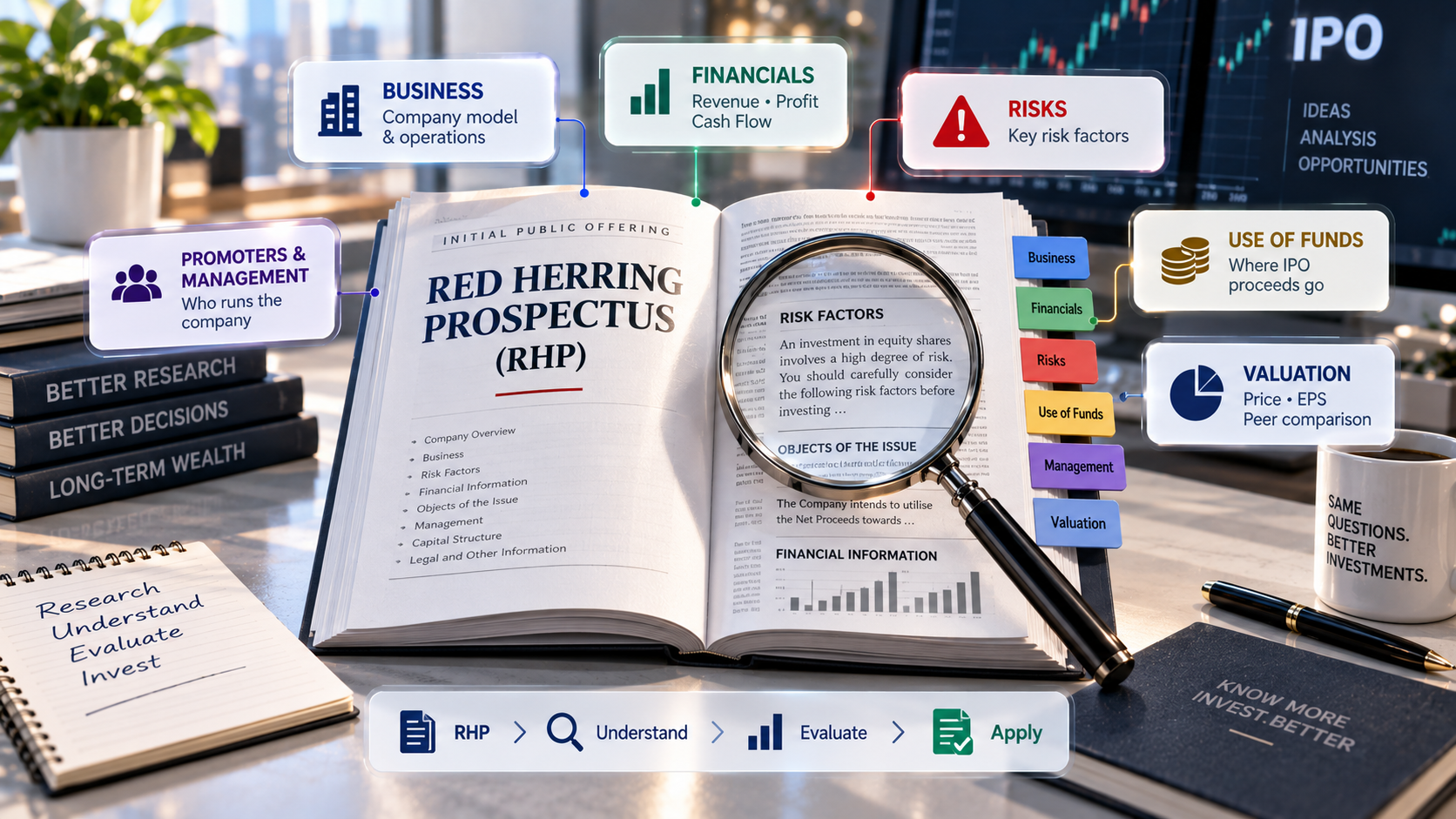
Quick Answer
An IPO RHP, or Red Herring Prospectus, is one of the most important documents investors can read before applying for an IPO.
It explains the company’s business, financials, risks, promoters, industry, issue structure, fresh issue and OFS split, use of proceeds and legal disclosures.
Investors do not need to read every page in one sitting. But they should review the most important sections before deciding whether an IPO fits their risk profile.
IPO RHP Overview
IPO headlines often focus on GMP, subscription numbers and listing expectations. But the RHP gives investors a deeper view of the company.
The RHP includes formal disclosures about the business, financials, risks and offer structure.
It can help investors understand whether the company is growing, profitable, debt-heavy, dependent on a few customers, exposed to legal risks or raising funds for productive purposes.
What Is an IPO RHP?
RHP stands for Red Herring Prospectus.
It is an offer document filed before an IPO. It contains detailed information about the company and the public issue.
The RHP usually includes:
company overview
industry overview
business model
financial statements
risk factors
promoters and management
objects of the issue
offer structure
legal proceedings
related party transactions
basis of offer price
The RHP helps investors understand the company beyond short-term market buzz.
Why Reading the RHP Matters
Reading the RHP matters because IPO investing involves risk.
A company may have strong brand visibility but weak margins. Another company may be profitable but highly dependent on a few customers. Some IPOs may raise fresh capital for expansion, while others may mainly provide an exit to existing shareholders.
The RHP helps investors identify these details.
| Reason | Why It Matters |
|---|---|
| Understand the business | Shows how the company earns revenue |
| Check risk factors | Highlights business, legal, financial and industry risks |
| Review financials | Helps evaluate growth, profits, margins and debt |
| Know use of proceeds | Shows how fresh issue funds will be used |
| Check selling shareholders | Shows who is reducing stake through OFS |
| Understand valuation | Helps compare IPO pricing with earnings and peers |
Key Sections in an IPO RHP
| Section | What to Check |
|---|---|
| Business Overview | Products, services, customers, revenue model and competitive strengths |
| Risk Factors | Key risks that may affect business, revenue or profitability |
| Financial Information | Revenue, PAT, EBITDA, assets, debt, cash flows and margins |
| Objects of the Issue | How fresh issue proceeds will be used |
| Offer Structure | Fresh issue, OFS, issue size and shareholder sale |
| Promoters and Management | Promoter background, experience and post-IPO holding |
| Basis of Offer Price | Valuation metrics and peer comparison |
| Legal Proceedings | Material litigation, regulatory actions or disputes |
Business Overview
The business overview section explains what the company does.
Investors should check:
products and services
revenue segments
key customers
geographic presence
manufacturing or operating facilities
distribution network
business model
competitive strengths
growth strategy
A useful question to ask is: Can the company explain its business clearly, and does the business have a reasonable growth path?
Investors should also check whether revenue depends on one product, one customer, one region or one industry.
Risk Factors
The risk factors section is one of the most important parts of the RHP.
It lists risks that may affect the company’s business, financial performance or future prospects.
Common IPO risk factors include:
customer concentration
supplier dependence
high debt
regulatory risk
legal proceedings
raw material price volatility
working capital pressure
industry slowdown
promoter or group company risks
dependence on key personnel
Investors should not skip this section. Risk factors often reveal details that are not visible in marketing headlines.
Financial Information
| Metric | Why It Matters |
|---|---|
| Total Income | Shows revenue scale and growth |
| Profit After Tax | Shows profitability |
| EBITDA | Helps assess operating performance |
| Net Worth | Shows shareholder equity base |
| Borrowings | Shows debt levels |
| Cash Flow | Shows whether profits convert into cash |
| Margins | Helps evaluate efficiency and pricing power |
Objects of the Issue
The Objects of the Issue section explains how the company plans to use IPO proceeds.
This section is especially important when the IPO has a fresh issue component.
Common uses include:
capital expenditure
debt repayment
working capital
acquisitions
technology investment
manufacturing expansion
general corporate purposes
If a large portion is used for debt repayment, investors should check whether it improves the balance sheet. If proceeds are used for expansion, investors should check whether the company has a track record of executing similar plans.
Fresh Issue and OFS
The RHP clearly shows whether the IPO is a fresh issue, an OFS or a combination of both.
A fresh issue brings money into the company. An OFS allows existing shareholders to sell shares.
| Component | What It Means | What Investors Should Check |
|---|---|---|
| Fresh Issue | Company issues new shares and receives proceeds | How proceeds will be used |
| OFS | Existing shareholders sell shares | Who is selling and how much stake remains |
| Fresh Issue + OFS | Part company fundraising and part shareholder sale | Both use of proceeds and selling shareholder details |
Investors can also read Ultra’s guide on Fresh Issue vs OFS in IPO.
Valuation and Basis of Offer Price
The basis of offer price section explains how the company justifies the IPO price.
It may include metrics such as:
EPS
P/E ratio
return on net worth
net asset value
peer comparison
industry metrics
Investors should compare valuation with the company’s growth, profitability, debt levels and peers.
A strong company can still be expensive if valuation is too high. A cheaper IPO may still carry business or financial risks.
Investor Checklist
| Question | Why It Matters |
|---|---|
| What does the company do? | Helps understand the business model |
| Is revenue growing? | Shows business momentum |
| Is profit growing? | Shows earnings quality |
| How much debt does the company have? | Shows financial risk |
| What are the top risk factors? | Highlights possible red flags |
| Is the IPO fresh issue or OFS? | Shows where IPO proceeds go |
| Who is selling shares? | Shows shareholder exit or dilution |
| How is the IPO priced? | Helps evaluate valuation comfort |
| Are there legal proceedings? | Shows litigation or regulatory risk |
Final Thoughts
Reading an IPO RHP may look difficult at first, but investors do not need to read every page in one go.
The most important sections are business overview, risk factors, financial information, objects of the issue, offer structure, promoter holding and basis of offer price.
The RHP helps investors move beyond IPO buzz and understand the company’s actual business, risks and valuation.
Before applying for any IPO, investors should use the RHP as the primary document and treat GMP or market sentiment only as secondary inputs.
Disclaimer: This article is for educational and informational purposes only. It is not investment advice, IPO recommendation or a suggestion to apply for any IPO. IPO investments are subject to market risk, business risk, valuation risk and listing risk. Investors should read the RHP carefully and consult a qualified financial advisor before making any investment decision.
FAQs
1. What is an IPO RHP?
An IPO RHP, or Red Herring Prospectus, is an offer document that contains detailed information about the company, issue structure, financials, risks and IPO terms.
2. Why should investors read the RHP?
Investors should read the RHP to understand the company’s business, financials, risks, use of proceeds, valuation and offer structure.
3. Which RHP section should investors read first?
Investors can start with business overview, risk factors, financial information, objects of the issue and offer structure.
4. What are risk factors in an RHP?
Risk factors are disclosures that highlight business, financial, legal, regulatory or industry risks that may affect the company.
5. What is objects of the issue?
Objects of the issue explains how the company plans to use IPO proceeds from the fresh issue component.
6. Does the company receive money from OFS?
No. In an OFS, the money goes to selling shareholders, not to the company.
7. What financials should investors check in an RHP?
Investors should check total income, profit after tax, EBITDA, net worth, borrowings, cash flows and margins.
8. What is basis of offer price?
Basis of offer price explains how the company justifies the IPO pricing using valuation metrics and peer comparison.
9. Is GMP mentioned in the RHP?
No. GMP is unofficial and is not part of the RHP.
10. Can reading the RHP guarantee good IPO returns?
No. Reading the RHP does not guarantee returns, but it helps investors make a more informed decision.
Recent articles
View all
IPO
IPO Price Band and Lot Size Explained for Beginners
A simple guide explaining how IPO price bands and lot sizes work, why they matter for retail investors and what to check before applying for an IPO.
Sachin Gadekar
·
23 Sep 2026

IPO
What Is IPO GMP and Why It Can Be Misleading?
A simple guide explaining IPO GMP, grey market premium, expected listing price, common misconceptions, risks and what investors should check before applying for an IPO.
Sachin Gadekar
·
22 Sep 2026

IPO
Fresh Issue vs OFS in IPO: What Investors Should Know
A simple guide explaining fresh issue, offer for sale, IPO proceeds, dilution, promoter selling and what retail investors should review before investing in an IPO.
Sachin Gadekar
·
21 Sep 2026

Jindal Supreme India IPO Details: Date, Price Band, Review & How to Apply
A complete guide to Jindal Supreme India IPO 2026, covering issue size, price band, lot size, important dates, company profile, financials, risks and application process.
17 Sep 2026