What Is IPO GMP and Why It Can Be Misleading?
22 September 2026 · Sachin Gadekar
A simple guide explaining IPO GMP, grey market premium, expected listing price, common misconceptions, risks and what investors should check before applying for an IPO.
Quick Overview
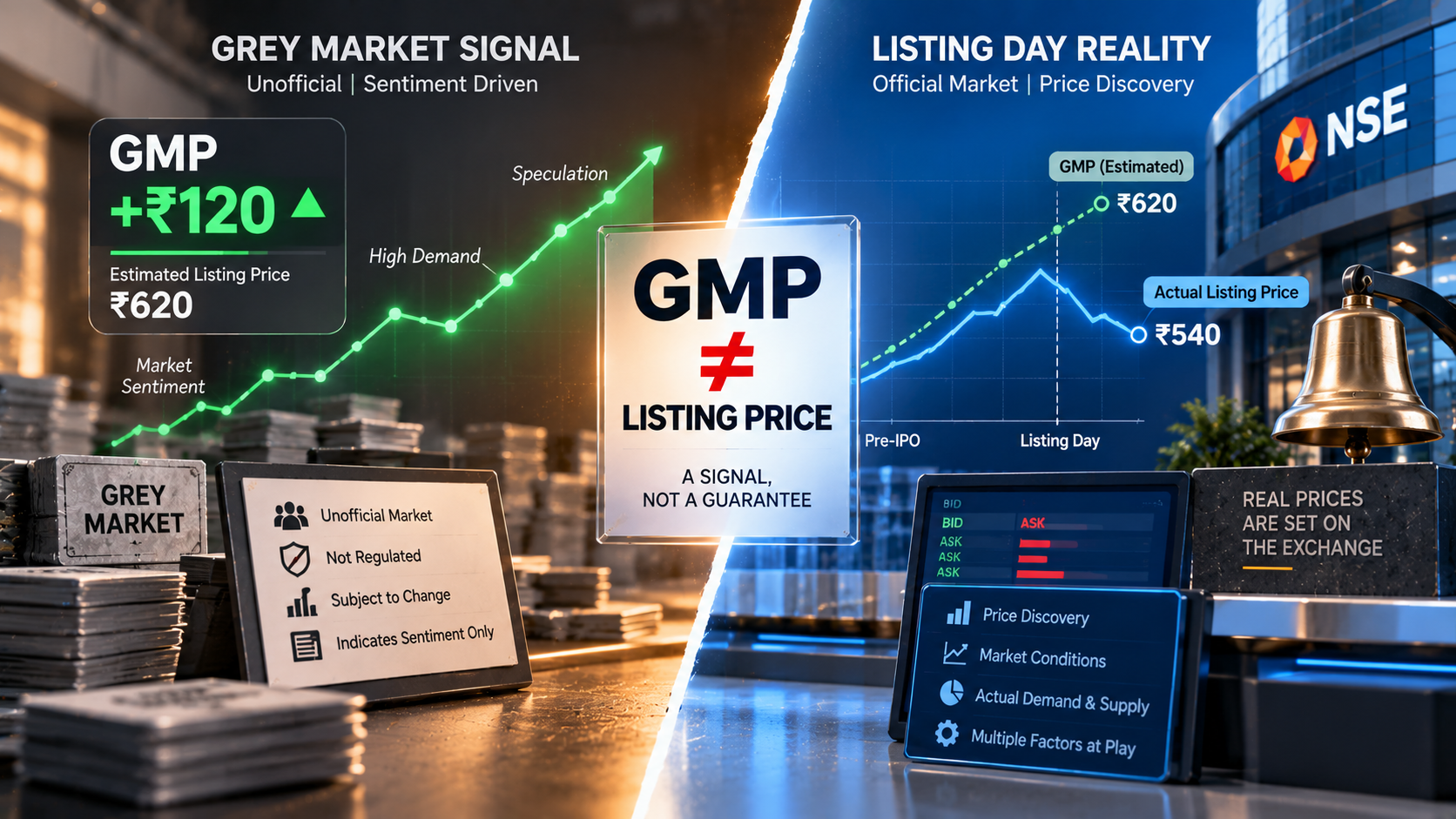
IPO GMP, or Grey Market Premium, is the unofficial premium at which IPO shares may trade in the grey market before listing.
For example, if an IPO has an issue price of ₹100 and the GMP is ₹20, the implied grey market price is ₹120. This is often used to estimate a possible listing price.
However, GMP is not official, not regulated and not guaranteed. It can change quickly before listing and may not reflect the company’s fundamentals, valuation or long-term business quality.
Investors should not rely only on GMP while deciding whether to apply for an IPO. It should be treated as a sentiment indicator, not as investment advice or a confirmed listing gain.
IPO GMP
IPO investors often search for GMP before applying for a public issue. It is commonly used to understand market sentiment around an IPO before it lists on the stock exchange.
GMP is popular because it gives a quick estimate of how the IPO may perform on listing day. But this estimate is unofficial and may change many times before listing.
A high GMP may create excitement around an IPO. A low or negative GMP may make investors cautious. However, both signals need context.
GMP should be seen as one input among many, not the main reason to apply for an IPO.
What Is IPO GMP?
IPO GMP stands for Initial Public Offering Grey Market Premium.
It refers to the premium at which IPO shares are believed to be trading in the unofficial grey market before they are listed on the stock exchange.
The grey market is not a formal exchange. It is an unofficial market where IPO-related demand and sentiment may be reflected before listing.
| Term | Meaning |
|---|---|
| IPO | Initial Public Offering, where a company offers shares to the public |
| GMP | Grey Market Premium |
| IPO GMP | Unofficial premium over the IPO issue price before listing |
| Grey Market | Unofficial market outside the recognised stock exchanges |
For example, if the IPO price is ₹500 and the GMP is ₹50, the grey market is indicating an estimated price of ₹550.
But this does not mean the stock will definitely list at ₹550.
How IPO GMP Is Calculated
IPO GMP is generally shown as a rupee premium over the issue price.
The basic calculation is:
Expected Listing Price = IPO Issue Price + GMP
For example:
| Particulars | Example |
|---|---|
| IPO Issue Price | ₹100 |
| GMP | ₹20 |
| Estimated Listing Price | ₹120 |
| Estimated Listing Gain | 20% |
In this example, the GMP suggests a possible listing gain of 20%. However, the actual listing price may be higher, lower or completely different.
What Is Expected Listing Price?
Expected listing price is an estimate based on GMP.
The formula usually used is:
Expected Listing Price = Upper Price Band + GMP
For example, if an IPO has an upper price band of ₹250 and GMP of ₹30, the expected listing price becomes ₹280.
But this is only a market estimate. It is not declared by the company, stock exchange, SEBI, registrar or lead manager.
Actual listing depends on several factors, including:
demand and supply on listing day
broader market conditions
IPO subscription levels
company fundamentals
valuation comfort
institutional participation
investor sentiment
sector outlook
This is why expected listing price should not be treated as confirmed listing price.
Why Investors Track GMP
Investors track IPO GMP because it gives a quick sense of market sentiment.
A rising GMP may suggest strong demand in the unofficial market. A falling GMP may suggest reduced enthusiasm. A negative GMP may indicate weak sentiment before listing.
| Reason | Explanation |
|---|---|
| Listing expectation | GMP is often used to estimate possible listing price |
| Market sentiment | It may reflect short-term demand around the IPO |
| Comparison | Investors compare GMP across IPOs during busy issue periods |
| Quick signal | It is easy to understand and widely discussed |
Why IPO GMP Can Be Misleading
IPO GMP can be misleading because it is unofficial and volatile.
It can change quickly based on market rumours, subscription numbers, broader market movement or short-term sentiment.
A high GMP does not always mean the company is fundamentally strong. A low GMP does not always mean the company is weak.
1. GMP Is Not Regulated
GMP is not published or verified by the stock exchanges, SEBI, company, registrar or lead managers.
It comes from the unofficial grey market. Because of this, investors should be careful while using it.
2. GMP Can Change Quickly
A GMP value seen in the morning may change by evening. It may also change sharply between the IPO closing date and listing date.
3. GMP Does Not Guarantee Listing Gains
Even if an IPO shows strong GMP before listing, the actual listing can be lower than expected.
Market sentiment can change on listing day.
4. GMP Ignores Long-Term Fundamentals
GMP focuses on short-term listing expectations. It does not fully capture business quality, financial performance, valuation, debt, profitability, competition or risks.
5. GMP Can Create FOMO
High GMP can make investors feel that they are missing an opportunity. This may lead to rushed decisions without reading the RHP or understanding the company.
IPO GMP vs Company Fundamentals
GMP and company fundamentals are very different.
GMP is a short-term sentiment indicator. Fundamentals show how the company is actually performing.
| Point | IPO GMP | Company Fundamentals |
|---|---|---|
| Nature | Unofficial market sentiment | Business and financial performance |
| Time Horizon | Short-term listing expectation | Long-term business quality |
| Source | Grey market discussions | RHP, financial statements and disclosures |
| Reliability | Can be volatile and unverified | Based on formal company disclosures |
| Usefulness | May indicate demand sentiment | Helps evaluate investment quality |
Positive GMP vs Negative GMP
| GMP Type | Meaning | Investor Interpretation |
|---|---|---|
| Positive GMP | Grey market price is above issue price | May indicate positive listing sentiment |
| Zero GMP | No premium over issue price | May indicate neutral sentiment |
| Negative GMP | Grey market price is below issue price | May indicate weak listing sentiment |
Even positive GMP should be used carefully. It does not remove business risk, valuation risk or market risk.
Similarly, negative GMP does not always mean the company has poor fundamentals. It may simply reflect weak market conditions or low short-term demand.
What Investors Should Check Instead
| Factor | Why It Matters |
|---|---|
| RHP | Contains official details about the company, offer and risks |
| Business Model | Shows how the company earns revenue |
| Financials | Helps evaluate revenue, profit, margins, debt and cash flows |
| Valuation | Helps compare IPO pricing with earnings, sales and peers |
| Fresh Issue vs OFS | Shows whether IPO proceeds go to the company or selling shareholders |
| Promoter Holding | Shows promoter stake before and after the IPO |
| Risk Factors | Highlights business, financial, legal and industry risks |
| Industry Outlook | Helps assess growth opportunities and competitive pressure |
Investors comparing IPO structures can also read Ultra’s guide on Fresh Issue vs OFS in IPO.
Common IPO GMP Misconceptions
Misconception 1: High GMP means guaranteed profit
This is not correct. GMP is unofficial and can change. Listing gains are never guaranteed.
Misconception 2: GMP is the official listing price
GMP is not the official listing price. The actual listing price is discovered on the stock exchange on listing day.
Misconception 3: GMP tells whether the company is good or bad
GMP reflects short-term sentiment. It does not fully judge the company’s business quality, financials or valuation.
Misconception 4: Negative GMP means the IPO should be ignored
Negative GMP may indicate weak sentiment, but investors should still evaluate the company’s fundamentals and valuation.
Misconception 5: Subscription and GMP are enough to decide
Subscription and GMP can show demand, but investors should also read the RHP, financials, risk factors and use of proceeds.
Final Thoughts
IPO GMP is one of the most searched terms during IPO season because it gives a quick estimate of possible listing sentiment.
But investors should remember that GMP is unofficial, unregulated and volatile. It can indicate market mood, but it cannot guarantee listing gains.
A strong IPO decision should be based on official disclosures, financials, valuation, industry outlook, risk factors and personal suitability.
GMP can be used as a signal, but it should not become the main reason to apply for an IPO.
Disclaimer: This article is for educational and informational purposes only. It is not investment advice, IPO recommendation or a suggestion to apply for any IPO. IPO investments are subject to market risk, business risk, valuation risk and listing risk. GMP is unofficial and does not guarantee listing gains. Investors should read the RHP carefully and consult a qualified financial advisor before making any investment decision.
FAQs
1. What is IPO GMP?
IPO GMP stands for Grey Market Premium. It is the unofficial premium at which IPO shares may trade in the grey market before listing.
2. How is IPO GMP calculated?
IPO GMP is usually added to the IPO issue price to estimate a possible listing price. For example, if the issue price is ₹100 and GMP is ₹20, the estimated listing price is ₹120.
3. Is IPO GMP official?
No. IPO GMP is unofficial and is not published or verified by SEBI, stock exchanges, the company, registrar or lead managers.
4. Does GMP guarantee listing gains?
No. GMP does not guarantee listing gains. Actual listing price may be higher or lower than the GMP-based estimate.
5. What does positive GMP mean?
Positive GMP means the grey market price is above the IPO issue price. It may indicate positive short-term sentiment.
6. What does negative GMP mean?
Negative GMP means the grey market price is below the IPO issue price. It may indicate weak listing sentiment.
7. Should investors apply for an IPO only because GMP is high?
No. Investors should not rely only on GMP. They should review the RHP, business model, financials, valuation, risks and personal suitability.
8. Can GMP change before listing?
Yes. GMP can change quickly before listing due to market conditions, demand, subscription levels and investor sentiment.
9. Is GMP useful for IPO investors?
GMP can be useful as a sentiment indicator, but it should be used carefully and along with official IPO disclosures.
10. What should investors check apart from GMP?
Investors should check the RHP, company financials, valuation, industry outlook, fresh issue and OFS structure, promoter holding and risk factors.
11. Is GMP the same as listing price?
No. GMP is only an unofficial estimate. The actual listing price is discovered on the stock exchange on listing day.
12. Why is IPO GMP misleading?
GMP can be misleading because it is unofficial, volatile, unregulated and may not reflect the company’s fundamentals or valuation.
Recent articles
View all
IPO
Fresh Issue vs OFS in IPO: What Investors Should Know
A simple guide explaining fresh issue, offer for sale, IPO proceeds, dilution, promoter selling and what retail investors should review before investing in an IPO.
Sachin Gadekar
·
21 Sep 2026

Jindal Supreme India IPO Details: Date, Price Band, Review & How to Apply
A complete guide to Jindal Supreme India IPO 2026, covering issue size, price band, lot size, important dates, company profile, financials, risks and application process.
17 Sep 2026

UPI Fee Shake-Up: Everything You Need to Know About the ₹2,000 Threshold
A simple awareness guide explaining the UPI fee discussion, the ₹2,000 threshold, and why most users should understand the difference between bank UPI and wallet-based UPI payments.
Sachin Gadekar
·
17 Sep 2026

IPO
Hero Motors IPO GMP: Date, Price Band, Review & How to Apply
A complete guide to Hero Motors IPO 2026, covering issue size, price band, lot size, important dates, GMP context, company profile, financials, shareholding, risks and application process.
Sachin Gadekar
·
15 Sep 2026