Monthly Income from Bonds in India: How It Works and What to Expect (2026)
21 April 2026 · Sankarshan B
A practical, end-to-end guide to earning monthly income from bonds in India, covering how coupon payments work, which bonds pay monthly, real income calculations by corpus size, tax treatment, and common mistakes to avoid.

How Bond Income Works: The Coupon Mechanism
The idea of earning a fixed income every month from your investments — without checking stock prices, without market anxiety, without active management — is what draws investors to bonds in the first place. For retirees building a cash flow plan, working professionals building passive income, or HNIs looking for predictable, non-market-correlated income, monthly income bonds are one of the most practical instruments available in India today.
But the mechanics are widely misunderstood. What exactly is a monthly coupon? Is it the same as interest? How does the money actually reach your account? What is the difference between coupon rate and YTM — and why does it matter? How much corpus do you need to generate ₹50,000 per month from bonds?
This guide answers all of these questions, clearly and practically.
When you buy a bond, you are lending money to the issuer — a company, an NBFC, or a government entity. In return, the issuer makes a contractual promise: they will pay you a fixed coupon (interest) at agreed intervals throughout the bond's life, and return your principal at maturity.
The coupon is expressed as a percentage of the bond's face value (par value) — typically ₹1,000 per bond unit in India. If a bond has a face value of ₹1,000 and a coupon rate of 10% per annum with monthly payments, the monthly coupon per bond unit is:
₹1,000 × 10% ÷ 12 = ₹8.33 per bond unit per month
If you hold 1,000 bond units (total investment ₹10 lakhs at face value), your monthly coupon income is:
₹8.33 × 1,000 units = ₹8,333 per month
This is the core mechanics of monthly bond income. The coupon amount is fixed, contractual, and does not change with market conditions — unless it is a floating rate bond (where the rate resets periodically).
Key terms to know:
Face value / Par value: The nominal value of one bond unit — typically ₹1,000 in India
Coupon rate: The annual interest rate expressed as a percentage of face value
Coupon frequency: How often the coupon is paid — monthly, quarterly, semi-annual, or annual
Maturity date: The date on which the issuer repays your principal
Coupon payment date: The specific dates on which coupon amounts are credited to your account
Coupon Rate vs Yield to Maturity (YTM): The Most Misunderstood Distinction
This is the single most common source of confusion for first-time bond investors and getting it wrong leads to real miscalculations of expected monthly income.
Coupon rate is the fixed percentage of face value that the issuer pays as interest each year. It never changes once the bond is issued.
Yield to Maturity (YTM) is the total effective return you earn on the bond if you buy it at the current market price and hold it to maturity incorporating both the coupon income AND any capital gain or loss between the purchase price and the face value repaid at maturity.
Why they differ: Bonds trade in the secondary market at prices above or below face value. If you buy a ₹1,000 face value bond that pays a 10% coupon for ₹950 in the secondary market, your effective yield is higher than 10% because you earn the same ₹100 annual coupon on a ₹950 investment, plus a ₹50 capital gain at maturity. Conversely, if you pay ₹1,050 for the same bond, your YTM is lower than 10%.
Coupon Rate vs YTM — What It Means for Your Monthly Income
| Scenario | Face Value | Purchase Price | Coupon Rate | Annual Coupon Income | YTM | Monthly Income (per ₹1,000 bond) |
|---|---|---|---|---|---|---|
| Buy at face value (primary market) | ₹1,000 | ₹1,000 | 10% | ₹100 | 10% | ₹8.33 |
| Buy at discount (secondary market) | ₹1,000 | ₹950 | 10% | ₹100 | ~11.1% | ₹8.33 (same coupon) |
| Buy at premium (secondary market) | ₹1,000 | ₹1,050 | 10% | ₹100 | ~9.1% | ₹8.33 (same coupon) |
The practical implication: Your monthly coupon income is always calculated on face value — not on what you paid. Whether you buy at ₹950 or ₹1,050, you receive the same ₹8.33 per month per ₹1,000 face value bond. The YTM changes, but the monthly cash in hand does not.
This means: when planning monthly income from bonds, use the coupon rate to calculate actual monthly cash flows, not the YTM. YTM is useful for comparing total return across different bonds, but it is not your monthly deposit.
Monthly vs Quarterly vs Annual Coupon: What Is the Difference?
Most Indian corporate bonds (NCDs) offer investors a choice of payout frequency at the time of issuance. The options are typically:
Monthly: Coupon paid every calendar month - 12 payments per year
Quarterly: Coupon paid every 3 months - 4 payments per year
Annual: Coupon paid once a year
Cumulative: No periodic payouts - interest compounds and is paid along with principal at maturity
Does payout frequency affect the effective yield? Yes, slightly. Because monthly payments mean you receive cash earlier and can reinvest it, while annual payments delay your cash. Most issuers offer a marginally lower effective rate on monthly options compared to annual or cumulative options to account for this time value difference.
Payout Frequency — Trade-offs for Monthly Income Investors
| Payout Frequency | Best For | Effective Rate (typical) | Cash Flow Pattern | Reinvestment Advantage |
|---|---|---|---|---|
| Monthly | Retirees, passive income builders needing regular cash | Slightly lower than annual | Predictable, every month | High — can reinvest 12x/year |
| Quarterly | Investors needing periodic income but not monthly | Slightly lower than annual | Every 3 months | Moderate — 4x/year |
| Annual | Investors who do not need regular income | Highest among periodic options | Once a year | Low — 1x/year |
| Cumulative | Long-term wealth builders; no income need during tenure | Highest overall (compounding benefit) | Lump sum at maturity | Automatic compounding within bond |
Which Bonds Pay Monthly Income in India?
Not all bonds in India pay monthly. Here is a breakdown of which categories offer monthly payout options and which do not:
Pay Monthly - Corporate NCDs (most common): Listed Non-Convertible Debentures issued by NBFCs, manufacturing companies, and infrastructure firms frequently offer monthly coupon options. This is the most accessible and most popular source of monthly bond income for retail investors in India.
Pay Semi-Annual - Government Securities (G-Secs): Standard dated G-Secs pay coupons semi-annually — twice a year, on fixed dates. They do not offer monthly payout options. If you want monthly income, G-Secs are not the right instrument.
Pay Semi-Annual - RBI Floating Rate Savings Bonds: Interest is paid every 6 months — January 1 and July 1. Not monthly.
Pay Monthly - Some PSU and Infrastructure Bonds: Select PSU bonds and infrastructure bonds (available on bond platforms) offer monthly coupon options. Less common than corporate NCDs but available.
No Monthly Option - Tax-Free Bonds: The older PSU tax-free bonds (NHAI, PFC, IRFC secondary market) pay coupons annually or semi-annually. Monthly option is not available.
Pay Monthly - Post Office Monthly Income Scheme (POMIS): Not technically a bond, but a government-backed savings scheme that pays monthly interest at 7.4% on investments up to ₹9 lakhs (single) or ₹15 lakhs (joint). One of the most reliable monthly income options for conservative investors.
Monthly Income Bonds: Real Examples in India (2026)
| Issuer | Rating | Coupon Rate | Tenure | Monthly Income per ₹1L Face Value | Security | Risk Level |
|---|---|---|---|---|---|---|
| Shriram Finance | AA+ (CRISIL) | 9.5%–10% | 2–5 years | ₹792–₹833 | Secured | Low–Moderate |
| Bajaj Finance | AAA (CRISIL) | 8.15%–8.5% | 1–5 years | ₹679–₹708 | Secured | Very Low |
| Tata Capital Financial Services | AA+ (ICRA) | 9%–9.5% | 2–5 years | ₹750–₹792 | Secured | Low |
| IIFL Finance | AA (CRISIL) | 9% | 24–60 months | ₹750 | Secured | Low–Moderate |
| Mahindra Finance | AA (ICRA) | 9.5%–10.5% | 2–4 years | ₹792–₹875 | Secured | Low–Moderate |
| Indel Money | BBB+ (CRISIL) | 12% | 2–3 years | ₹1,000 | Secured | Moderate |
| Poonawalla Fincorp | AAA (CRISIL) | 9%–10.25% | 1–3 years | ₹750–₹854 | Secured | Very Low |
Note: Monthly income per ₹1 lakh face value = Coupon Rate ÷ 12 × ₹1,00,000. These are indicative figures based on current market data. Actual rates vary by series, tenure, and market conditions. Always verify with the issuer's offer document or bond platform before investing. For a comprehensive guide to corporate bond ratings, issuers, and returns, read Ultra's detailed article: Best Corporate Bonds in India 2026.
How Much Corpus Do You Need? Real Income Calculations
| Corpus Invested | At 9% Coupon | At 10% Coupon | At 11% Coupon | At 12% Coupon |
|---|---|---|---|---|
| ₹10 Lakhs | ₹7,500/month | ₹8,333/month | ₹9,167/month | ₹10,000/month |
| ₹25 Lakhs | ₹18,750/month | ₹20,833/month | ₹22,917/month | ₹25,000/month |
| ₹50 Lakhs | ₹37,500/month | ₹41,667/month | ₹45,833/month | ₹50,000/month |
| ₹1 Crore | ₹75,000/month | ₹83,333/month | ₹91,667/month | ₹1,00,000/month |
| ₹2 Crore | ₹1,50,000/month | ₹1,66,667/month | ₹1,83,333/month | ₹2,00,000/month |
Now apply the tax reality (30% bracket):
The figures above are pre-tax. For investors in the 30% bracket, monthly income after tax is approximately 70% of the gross figure. To earn ₹50,000 per month post-tax at a 10% coupon, you need:
Required gross monthly income = ₹50,000 ÷ 0.70 = ₹71,429/month Required corpus = ₹71,429 × 12 ÷ 10% = ₹85.7 lakhs
Rule of thumb for monthly income planning:
At 10% coupon, 30% tax bracket: every ₹1 lakh corpus generates approximately ₹583 post-tax per month
To generate ₹1 lakh post-tax per month at 10% coupon: need approximately ₹1.71 crore corpus
To generate ₹50,000 post-tax per month at 10% coupon: need approximately ₹86 lakhs corpus
How Does Coupon Payment Actually Reach You?
This is what most bond guides skip entirely, but it is genuinely useful to understand, especially for first-time bond investors.
Step 1 - Bond is held in your demat account: Your bonds are held electronically in your demat account (CDSL or NSDL), identified by their ISIN number. The depository maintains a record of how many units of each bond you hold.
Step 2 - Record date: Before each coupon payment, the issuer announces a record date, typically 10–15 days before the payment date. Only investors who hold the bond on the record date receive the coupon. If you buy a bond after the record date, you receive the coupon in the next cycle, not the current one.
Step 3 - Coupon is credited to your bank account: On the coupon payment date, the issuer's registrar and transfer agent (like Link Intime, KFin Technologies, or Bigshare Services) processes the payment. The coupon amount is directly credited to the bank account linked to your demat account, via NEFT, RTGS, or ECS.
Step 4 - TDS is deducted before credit: If your annual interest from a single issuer exceeds ₹5,000, TDS (Tax Deducted at Source) at 10% is deducted before the coupon is credited. You receive the post-TDS amount in your account. You can adjust this TDS against your final tax liability when filing your ITR.
What to watch for:
Ensure your demat account has the correct bank account linked this is where all coupon payments arrive
Keep your PAN updated in your demat account missing PAN can cause higher TDS deduction (20%)
If you sell a bond between coupon dates, you receive accrued interest as part of the sale price (dirty price) — this is taxed as capital gain or income depending on the holding period
Tax on Monthly Bond Income in India
| Income Type | Tax Treatment | TDS | Post-Tax Yield at 30% Slab |
|---|---|---|---|
| Monthly coupon from listed corporate NCD | Taxable as interest income at applicable slab rate | 10% TDS if interest > ₹5,000/year from single issuer | 7% net on 10% gross; 7.7% on 11%; 8.4% on 12% |
| Capital gain on selling bond before maturity (held >12 months) | LTCG — 12.5% without indexation (listed bonds) | No TDS on capital gains | 12.5% flat on gain amount |
| Capital gain on selling bond before maturity (held ≤12 months) | STCG — taxed at applicable slab rate | No TDS on capital gains | 30% on gain amount |
| Tax-free bond coupon (PSU old series, secondary market) | Fully exempt under Section 10(15)(iv)(h) | No TDS | Full coupon retained — equivalent to ~13% pre-tax at 42.74% rate |
Form 15G / 15H for TDS avoidance: If your total annual income is below the taxable threshold, you can submit Form 15G (non-senior citizens) or Form 15H (senior citizens) to the issuer or registrar to request that TDS not be deducted. This is available for individual investors whose total income does not exceed the basic exemption limit.
For a deeper understanding of how bonds are taxed across different holding periods and instrument types, read: Best Fixed Income Investments in India 2026.
Monthly Bond Income vs Other Monthly Income Options
| Instrument | Monthly Income on ₹10L | Risk Level | Tax Treatment | Post-Tax at 30% | Capital Protection |
|---|---|---|---|---|---|
| Corporate NCD (AA-rated, 10%) | ₹8,333 | Low–Moderate | Slab rate | ₹5,833 | Yes (at maturity) |
| Post Office MIS (7.4%) | ₹6,167 | Sovereign | Slab rate | ₹4,317 | Yes (sovereign) |
| Bank FD (7%, monthly payout) | ₹5,833 | Very Low | Slab rate + TDS | ₹4,083 | Yes (DICGC insured up to ₹5L) |
| Corporate FD — Bajaj Finance (8.5%, monthly) | ₹7,083 | Low | Slab rate + TDS | ₹4,958 | Yes (issuer credit risk) |
| High-Yield NCD — BBB+ (12%) | ₹10,000 | Moderate | Slab rate | ₹7,000 | Subject to credit risk |
| Asset Leasing (12%) | ₹10,000 | Low–Moderate | Slab rate | ₹7,000 | Asset-backed |
The clear story from this table: AA-rated corporate NCDs at 10% deliver ₹5,833 post-tax per month per ₹10 lakhs — meaningfully more than bank FDs (₹4,083) or Post Office MIS (₹4,317), with manageable credit risk. For investors seeking the combination of monthly income, capital protection, and above-FD yields, AA-rated NCDs are the strongest option in the monthly income universe.
For investors who want to understand alternative monthly income options alongside bonds, read: Best Passive Income Investments in India Delivering 10%+ Returns.
Risks to Understand Before Investing for Monthly Income
Credit risk- the primary risk: The issuer could default on coupon payments or principal repayment. This risk is minimised by sticking to AAA and AA-rated issuers with strong financial track records. IL&FS (2018) and DHFL (2019) are painful reminders that defaults happen both were previously considered safe names.
Interest rate risk: If market interest rates rise after you lock in a bond, new bonds will offer higher yields while your bond's coupon is fixed. Your monthly income amount does not change but the market value of your bond falls if you try to sell before maturity. For investors holding to maturity, this is irrelevant.
Reinvestment risk: When your bond matures and you need to reinvest the principal, prevailing rates may be lower than when you originally invested. This is why laddering bond maturities across different time horizons is important.
Liquidity risk: Most corporate NCD secondary market trading in India is thin particularly for smaller issuers. If you need to exit before maturity, you may have to sell at a discount. Plan to hold monthly income bonds to maturity whenever possible.
Payout timing risk: Occasionally, coupon payments are delayed due to administrative issues with the registrar or bank account mismatches. This is usually resolved within a few days but can disrupt monthly cash flow planning. Maintain a small buffer in your savings account.
How to Build a Monthly Income Bond Portfolio
Step 1: Define your monthly income target Decide the post-tax monthly income you need. Work backwards using the formula:
Required gross monthly income = Target post-tax income ÷ (1 − tax rate)
Required corpus = Required gross monthly income × 12 ÷ average coupon rate
Step 2: Diversify across issuers and rating tiers Never concentrate your monthly income portfolio in a single issuer. A practical allocation:
50% in AAA-rated issuers (Bajaj Finance, Poonawalla Fincorp) — lower yield, highest safety
35% in AA-rated issuers (Shriram Finance, Tata Capital, IIFL Finance) — moderate yield, good safety
15% in A/BBB+ rated issuers (higher yield, more credit risk) — small allocation only
Step 3: Ladder maturities Spread maturities across 1, 2, 3, and 5-year tenures. This ensures capital returns regularly for reinvestment and reduces the impact of rate changes at any single point.
Step 4: Align payout dates If possible, select bonds from different issuers whose payout dates spread across the month — so you receive income on the 5th, 15th, and 25th rather than all on the same date. This smooths cash flow.
Step 5: Access through SEBI-registered platforms Use SEBI-registered Online Bond Platform Providers (OBPPs) like Ultra, GoldenPi, Jiraaf, or Wint Wealth — they provide curated bond inventory with full disclosure of coupon rates, payout frequencies, credit ratings, and maturity dates.
For a complete guide to the best corporate bonds available in India today, read: Best Corporate Bonds in India 2026: Ranked by Returns, Rating & Tenure.
FAQs
Q1. Which bonds pay monthly interest in India?
Corporate NCDs (Non-Convertible Debentures) from NBFCs like Shriram Finance, Bajaj Finance, IIFL Finance, Mahindra Finance, and Poonawalla Fincorp commonly offer monthly coupon payout options. Post Office MIS is a government-backed scheme that also pays monthly. Standard G-Secs pay semi-annually and do not offer monthly options.
Q2. How much do I need to invest in bonds to earn ₹50,000 per month?
At a 10% coupon rate (pre-tax), you need approximately ₹60 lakhs to generate ₹50,000/month gross. After 30% income tax, the post-tax monthly income is approximately ₹35,000. To earn ₹50,000 post-tax at 10% coupon, you need approximately ₹86 lakhs corpus.
Q3. Is monthly bond income guaranteed?
The coupon payment is contractual the issuer is legally obligated to pay. However, it is not guaranteed in the way bank deposits are insured. If the issuer defaults, coupon payments can be missed. Investing in AAA and AA-rated bonds from established issuers substantially reduces but does not eliminate this risk.
Q4. How is monthly bond income taxed in India?
Monthly coupon income from corporate bonds is taxed as interest income under "Income from Other Sources" at your applicable slab rate (up to 30% plus surcharge for HNIs). TDS at 10% is deducted if annual interest from a single issuer exceeds ₹5,000. This TDS is adjustable against your final tax liability.
Q5. What is the minimum investment in monthly income bonds?
Most corporate NCD primary issues have a minimum application of ₹10,000 (10 units at ₹1,000 face value). On the secondary market, you can buy as few as 1 bond unit at the prevailing market price.
Q6. What is the difference between monthly coupon and cumulative option in NCDs?
Monthly coupon: interest is paid every month to your bank account. Cumulative: interest is compounded and paid along with principal at maturity. The cumulative option generates a higher total return because of compounding but provides no monthly cash flow. Choose monthly if you need regular income; choose cumulative if you are building a corpus and do not need interim cash.
Q7. Can I live off bond income in India?
Yes, with sufficient corpus. At ₹1 crore invested in AA-rated bonds at 10%, you generate approximately ₹83,333/month gross (₹58,333 post-tax at 30%). For most households in smaller cities or towns, this is a liveable income. In metros, a ₹2–3 crore corpus is typically needed to sustain lifestyle expenses from bond income alone.
Disclaimer
This article is for informational purposes only and does not constitute investment advice. Returns and yields mentioned are indicative. All bond investments carry credit risk and are not insured. Please read offer documents carefully and consult a registered financial advisor before investing.
Recent articles
View all
invoice discounting
Invoice Discounting Due Diligence: What Investors Should Check Before Investing
A complete guide to invoice discounting due diligence, covering what to check before you invest and how ultra reviews every business before listing its invoices
Prerna Bhardwaj
·
26 Oct 2026
invoice discounting
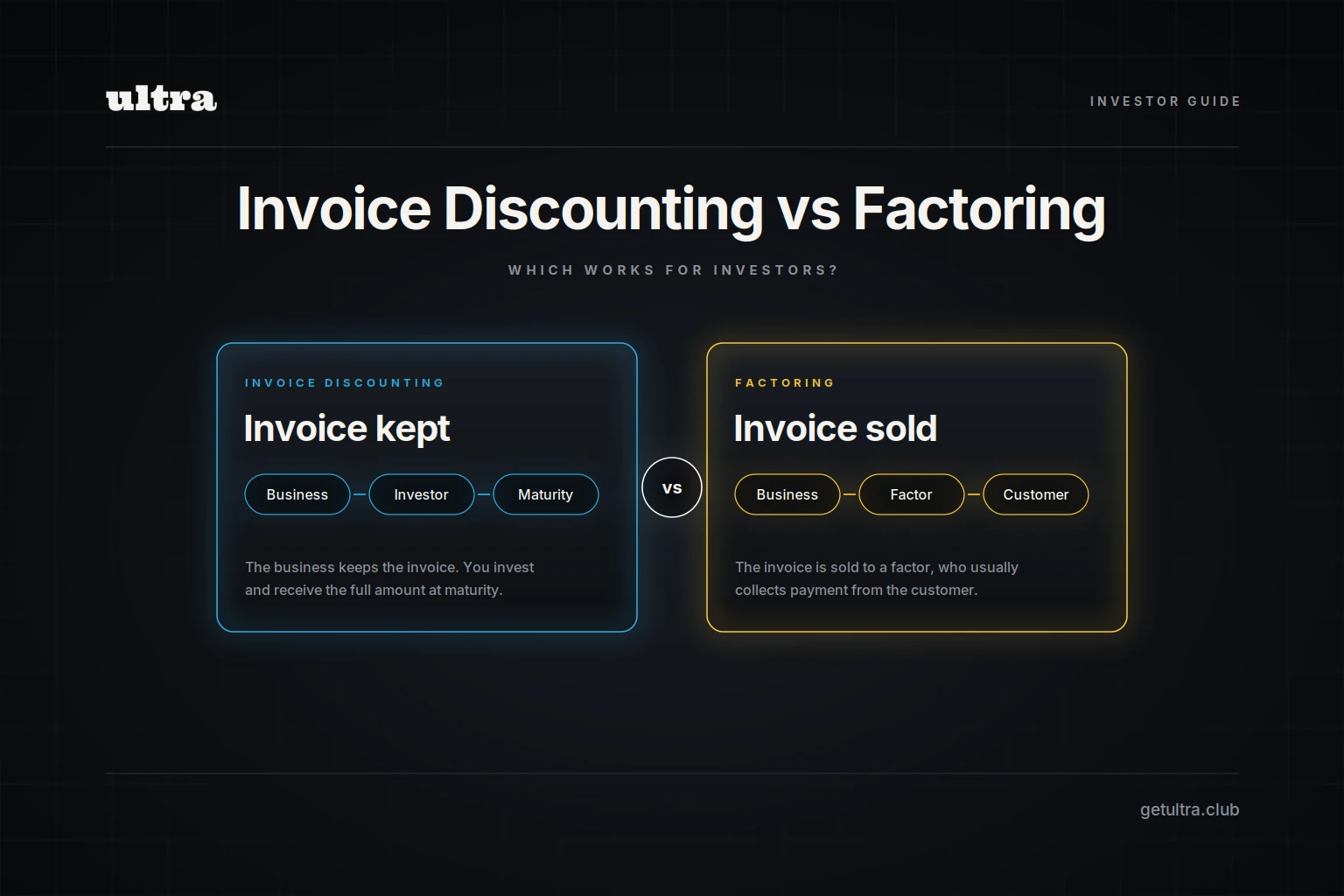
Invoice Discounting vs Factoring: Which Works for Investors?
A complete guide to invoice discounting vs factoring, covering how each works, the key differences between them and why investors choose invoice discounting on ultra.
Prerna Bhardwaj
·
22 Oct 2026
invoice discounting
Invoice Discounting Investment in India: How It Works
A complete guide to invoice discounting investment in India, covering how it works, why experienced investors consider it, where it fits in a portfolio and how to invest with ultra.
Prerna Bhardwaj
·
21 Oct 2026

IPO
Reliance Jio IPO: Date, Price, GMP, Valuation, Review & Details
A complete guide to Reliance Jio IPO 2026, covering Jio Platforms IPO details, issue size, expected date, price band status, GMP context, shareholder quota, company profile, financials, valuation and risks.
Sachin Gadekar
·
19 Oct 2026