Best Corporate Bonds in India 2026: Ranked by Returns, Rating & Tenure
09 April 2026 · Sankarshan B
A comprehensive, issuer-specific guide to the best corporate bonds in India for 2026, ranked by credit rating tier, with real yield figures, tenure, and risk profile for every category.

What Are Corporate Bonds? A Quick Primer
Most articles on "best corporate bonds in India" give you one of two things: a list of corporate bond mutual funds (which is not the same thing at all) or a generic explanation of what bonds are. Neither is particularly useful if you want to actually invest in individual corporate bonds.
This guide is different. We cover individual corporate bonds and NCDs the actual instruments you buy through your demat account or a bond platform ranked by credit rating tier, with real yield ranges, specific issuer examples, tenure profiles, and an honest assessment of risk at each level.
The Indian corporate bond market reached ₹53.6 lakh crore (~$626 billion) in 2025, its largest ever and 2026 is shaping up to be another record year for issuances. There has never been a better time for retail and HNI investors to build a direct corporate bond portfolio.
A corporate bond is a debt instrument when you buy one, you are lending money to a company. In return, the company pays you a fixed coupon (interest) at regular intervals (monthly, quarterly, or annually) and returns your principal at maturity.
Unlike equity, you are not betting on the company's growth. Your return is contractually fixed from day one. The key risk is credit risk the possibility that the company cannot repay. This is why credit ratings (AAA, AA, A, BBB, etc.) are the single most important factor in evaluating any corporate bond.
In India, bonds are rated by CRISIL, ICRA, CARE Ratings, and India Ratings. The rating scale runs from AAA (highest safety) down to D (default). For investment purposes, anything rated BBB and above is considered investment grade.
How We Ranked These Bonds
We organise this guide into four rating tiers plus a special category:
Tier 1: AAA-rated — safest, lower yields (8–9.5%)
Tier 2: AA-rated — high quality, moderate yields (9.5–11%)
Tier 3: A-rated — adequate safety, higher yields (11–12.5%)
Tier 4: BBB-rated — investment grade but elevated risk, highest yields (12–13.7%)
Special: Quasi-sovereign (KIIFB) — unique category
Within each tier, we provide specific real issuer examples with indicative yield ranges, tenure profiles, and risk notes. These are illustrative — always verify current yields and ratings from SEBI-registered bond platforms or the issuer's offer documents before investing.
Tier 1: AAA-Rated PSU and Infrastructure Bonds — 8% to 9.5%
Tier 1: AAA-Rated PSU and Infrastructure Bonds — 8% to 9.5%
Best for: Conservative investors wanting yields above FDs with near-sovereign safety
AAA is the highest credit rating in India. Bonds at this level are issued primarily by Public Sector Undertakings (PSUs), large NBFCs with government backing, and top-tier private sector firms. The default risk is extremely low — these issuers have strong financial backing and long operating histories.
Key Issuers in This Tier
REC Limited (Rural Electrification Corporation)
REC is a AAA-rated government-owned NBFC financing the power sector. REC bonds are among the most actively traded in the Indian corporate bond market, offering yields of approximately 8–9% p.a. across tenures of 3–10 years. They are considered benchmark bonds for the NBFC sector.
Power Finance Corporation (PFC)
PFC is another government-owned infrastructure financier, also AAA-rated. PFC bonds trade alongside REC at similar yield levels — 8–9% p.a. — and are held widely by institutional and retail investors alike.
NHAI (National Highways Authority of India)
NHAI issues both taxable and tax-free bonds. Its taxable bonds offer approximately 8–8.5% coupon rates. Its older tax-free bonds (secondary market) carry coupon rates of 7.64–8.75% but trade at yields of 5.5–6.75% in the secondary market — making them attractive primarily for high-bracket taxpayers calculating post-tax returns.
Poonawalla Fincorp
A AAA-rated private sector NBFC, Poonawalla Fincorp has issued bonds at coupon rates up to 10.25% (ISIN INE511C08AG6, maturing March 2027) — notable because it is AAA-rated but offers a coupon well above typical PSU bonds, reflecting private sector pricing dynamics.
Bajaj Finance
One of India's best-known AAA-rated NBFCs, Bajaj Finance issues bonds at approximately 8.15–8.5% p.a. across 1–5 year tenures. High demand from retail investors makes these bonds liquid and well-regarded.
Tier 1: AAA-Rated Corporate Bonds — Key Examples (2026)
| Issuer | Rating | Indicative Yield | Tenure Range | Issuer Type | Best For |
|---|---|---|---|---|---|
| REC Limited | AAA | 8%–9% | 3–10 years | Government PSU | Safety-first, benchmark bond |
| Power Finance Corporation (PFC) | AAA | 8%–9% | 3–10 years | Government PSU | Power sector exposure, high liquidity |
| NHAI (taxable) | AAA / Sovereign | 8%–8.5% | 5–15 years | Government entity | Long-term infrastructure bond |
| Bajaj Finance | AAA | 8.15%–8.5% | 1–5 years | Private NBFC | Short-medium tenure, retail-friendly |
| Poonawalla Fincorp | AAA | 9%–10.25% | 1–3 years | Private NBFC | Higher AAA yield, short tenure |
Tier 2: AA-Rated Corporate Bonds — 9.5% to 11%
Best for: Investors willing to accept slightly higher credit risk for meaningfully better yields
AA-rated bonds are still investment grade with high creditworthiness — one notch below AAA. Issuers in this category include large private sector NBFCs, real estate financiers, and mid-sized infrastructure companies. The additional credit risk versus AAA is modest, but the yield pickup is meaningful — typically 100–200 basis points more.
Key Issuers in This Tier
Shriram Finance
One of India's largest vehicle financing NBFCs, Shriram Finance is rated AA+ / AA and regularly issues NCDs at 9.5–10.5% p.a. across 2–5 year tenures. Monthly, quarterly, and annual coupon options are available, making it popular with income investors.
Tata Capital Financial Services
Tata group's NBFC arm, rated AA+, issues bonds at approximately 9–10% p.a. The Tata brand provides added comfort for retail investors, and secondary market liquidity is reasonable.
Mahindra Finance
Rated AA, Mahindra Finance issues bonds at 9.5–10.5% across various tenures. Vehicle and rural finance-focused business model with consistent financial performance.
Cholamandalam Investment and Finance
Chola (rated AA) regularly accesses the bond market at 9.5–10.5%, backed by a strong rural and vehicle finance franchise.
Tier 2: AA-Rated Corporate Bonds — Key Examples (2026)
| Issuer | Rating | Indicative Yield | Tenure Range | Issuer Type | Best For |
|---|---|---|---|---|---|
| Shriram Finance | AA+ | 9.5%–10.5% | 2–5 years | Vehicle finance NBFC | Monthly income, diversified tenures |
| Tata Capital Financial Services | AA+ | 9%–10% | 2–5 years | Tata group NBFC | Brand comfort, moderate yield |
| Mahindra Finance | AA | 9.5%–10.5% | 2–5 years | Rural / vehicle NBFC | Rural India exposure, stable track record |
| Cholamandalam Investment | AA | 9.5%–10.5% | 2–4 years | Vehicle finance NBFC | Consistent performance, good liquidity |
Tier 3: A-Rated Corporate Bonds — 11% to 12.5%
Best for: Yield-seeking investors with above-average risk tolerance who understand NBFC and sector risk
A-rated bonds offer the highest yields within the clearly investment-grade universe. Issuers include growing NBFCs, MFIs (microfinance institutions), and mid-sized infrastructure companies. Returns at this level begin to approach or match invoice discounting yields — but with longer tenures, providing predictable income locking.
Key Issuers in This Tier
Spandana Sphoorty Financial
A large listed MFI, rated A, with NCD yields up to 12–12.5% for medium-tenure series. Strong franchise in rural and semi-urban lending, but exposed to microfinance sector-specific risks including regulatory changes and rural income shocks.
Criss Financial Holdings
A smaller NBFC rated A–, issuing listed NCDs at coupons up to 12–12.4% for short-to-medium tenures. Higher yield than most A-rated peers, reflecting both its smaller scale and the A– (rather than A or A+) rating.
RDC Concrete India
A ready-mix concrete industry player with NCDs offering approximately 11–11.5% coupon at A– rating and 2028 maturity. Sector diversification appeal for investors wanting exposure beyond financial services.
Tier 3: A-Rated Corporate Bonds — Key Examples (2026)
| Issuer | Rating | Indicative Yield | Tenure Range | Issuer Type | Risk Note |
|---|---|---|---|---|---|
| Spandana Sphoorty Financial | A | 11.5%–12.5% | 2–4 years | Listed MFI | Microfinance sector risk, regulatory sensitivity |
| Criss Financial Holdings | A– | 11.5%–12.4% | 1–3 years | Smaller NBFC | Scale risk; higher yield reflects size |
| RDC Concrete India | A– | 11%–11.5% | 2–3 years | Infrastructure / construction | Sector concentration in construction |
Tier 4: BBB-Rated High-Yield Bonds — 12% to 13.7%
Best for: Experienced investors with high risk appetite seeking maximum fixed-income yield
BBB is the lowest investment-grade rating — one notch above sub-investment grade. Bonds here carry the highest credit risk within the investment-grade universe, but still represent companies with adequate financial capacity. The yields compensate meaningfully, reaching 12–13.7% in this tier.
Key Issuers in This Tier
Indel Money
A gold-loan and retail-lending NBFC, Indel Money issues secured NCDs rated BBB+ (Stable) by CRISIL. A representative bond (ISIN INE0BUS07BX5) carries a 12% coupon maturing July 2028, with monthly interest payouts and YTM in the 12–12.7% range. The higher-coupon or longer-tenor series within its public issue structure can yield up to 13.7%. Secured structure provides a collateral layer.
Satya MicroCapital
An NBFC-MFI lending to women micro-entrepreneurs, Satya MicroCapital issues bonds rated BBB+ (Stable) by ICRA at coupons of 10.4–12%. The business model — rural microfinance — carries exposure to monsoon, collection risk, and regulatory changes in the MFI space.
Tier 4: BBB-Rated High-Yield Bonds — Key Examples (2026)
| Issuer | Rating | Indicative Yield | Tenure | Security | Risk Note |
|---|---|---|---|---|---|
| Indel Money | BBB+ (CRISIL) | 12%–13.7% | 2–3 years | Secured NCD | Gold-loan NBFC; lower rating; monthly payouts |
| Satya MicroCapital | BBB+ (ICRA) | 10.4%–12% | 1–2 years | Unsecured NCD | MFI risk; rural credit exposure; unsecured |
Special Category: KIIFB Quasi-Sovereign Bonds — 9% to 9.5%
Best for: Conservative long-term investors wanting above-sovereign yields with public-sector backing
The Kerala Infrastructure Investment Fund Board (KIIFB) occupies a unique position in the Indian bond market. These are quasi-sovereign infrastructure bonds backed by the Kerala state government, with long maturities (2031–2035) and AA-category ratings — offering 9–9.5% coupon rates.
They sit between pure sovereign (G-Secs) and private corporate bonds in the risk spectrum — offering meaningfully better yields than G-Secs while retaining a government-linked issuer. The primary risk is state government fiscal position and the long duration, which increases interest rate sensitivity.
Best for: Long-horizon investors (5–10 years) who want to lock in 9–9.5% yields from a quasi-government borrower and are comfortable holding to maturity.
Primary Market vs Secondary Market: How to Buy Corporate Bonds
| Parameter | Primary Market | Secondary Market |
|---|---|---|
| Who is the seller | The issuing company | An existing NCD holder |
| Price | Fixed at face value (₹1,000 per unit typically) | Market-determined, fluctuates with rates and sentiment |
| Application method | ASBA or UPI through broker or bank | Buy order on NSE/BSE through trading account |
| Minimum investment | As specified in offer document (typically ₹10,000) | One NCD at prevailing market price (may vary) |
| Allotment | FCFS basis; subject to subscription and category limits | Immediate on trade execution (T+1 settlement) |
| Coupon rate | Fixed as per offer document | Same fixed coupon; effective yield changes with price |
| Access to information | Prospectus filed with SEBI and exchanges | Exchange filings, ISIN disclosures, rating updates |
Master Comparison: Corporate Bonds Ranked by Rating and Return
| Rating Tier | Example Issuers | Indicative Yield | Typical Tenure | Risk Level | Coupon Frequency | Best Suited For |
|---|---|---|---|---|---|---|
| AAA — PSU / Govt-backed | REC, PFC, NHAI, IRFC | 8%–9% | 3–10 years | Very Low | Annual / Semi-annual | Conservative core portfolio, capital safety |
| AAA — Private NBFC | Bajaj Finance, Poonawalla Fincorp | 8.15%–10.25% | 1–5 years | Very Low–Low | Monthly / Quarterly / Annual | Better yield than bank FD, short tenure |
| AA — Large NBFC | Shriram Finance, Tata Capital, Mahindra Finance | 9.5%–10.5% | 2–5 years | Low–Moderate | Monthly / Quarterly / Annual | Regular income at meaningful yields |
| Quasi-Sovereign (AA) | KIIFB | 9%–9.5% | 7–12 years | Low | Annual | Long-duration, state-backed income |
| A — Growing NBFC / MFI | Spandana Sphoorty, Criss Financial, RDC Concrete | 11%–12.5% | 1–4 years | Moderate | Monthly / Quarterly | Yield seekers with sector understanding |
| BBB — High Yield | Indel Money, Satya MicroCapital | 12%–13.7% | 1–3 years | Moderate–High | Monthly | Experienced investors, small portfolio allocation |
How to Build a Corporate Bond Portfolio
A well-constructed corporate bond portfolio for 2026 should be built on three principles: rating diversification, tenure laddering, and issuer diversification.
Rating diversification means not putting everything in one tier. A sensible starting allocation might be 50% AAA, 30% AA, and 20% in A or BBB- capturing higher yields from a small portion while keeping the core safe.
Tenure laddering means staggering maturities- some bonds maturing in 1–2 years, others in 3–5 years. This ensures you have regular capital returning without being forced to reinvest everything at once, and reduces interest rate risk.
Issuer diversification means never concentrating more than 10–15% of your bond portfolio in a single issuer. Even AAA-rated issuers can face unexpected stress- diversification is the simplest form of risk management.
Sample Corporate Bond Portfolio Allocation (₹10–25 Lakh)
| Rating Tier | Suggested Allocation | Target Yield | Tenure | Purpose |
|---|---|---|---|---|
| AAA (PSU — REC, PFC) | 30% | 8%–9% | 5–7 years | Safe core, benchmark income |
| AAA (Private — Bajaj, Poonawalla) | 20% | 9%–10.25% | 1–3 years | Short-tenure, better AAA yield |
| AA (Shriram, Tata Capital) | 30% | 9.5%–10.5% | 2–4 years | Regular monthly income |
| A / BBB (select issuers) | 20% | 11%–13% | 1–3 years | Yield enhancement, small allocation |
Key Risks to Understand Before Investing
Credit risk: The primary risk in corporate bonds. If the issuer defaults, coupon payments and/or principal repayment may be delayed or lost. Always check the rating agency, outlook (Stable vs. Negative), and issuer financials before investing.
Interest rate risk: When market interest rates rise, existing bond prices fall in the secondary market. This affects you only if you sell before maturity — if you hold to maturity, you receive the contracted coupon and principal regardless.
Liquidity risk: Secondary market liquidity for Indian corporate bonds is uneven. Large AAA PSU bonds are liquid; smaller NBFC NCDs may be difficult to sell before maturity. Plan to hold most bonds to maturity.
Concentration risk: Putting too much into one issuer or one sector (e.g., all NBFC bonds) amplifies the impact of sector-specific stress. Diversify across issuers, sectors, and tenures.
Rating downgrade risk: A bond rated AA today could be downgraded to A or below if the issuer's financial position deteriorates. Monitor ratings periodically and set a threshold for action if a downgrade occurs.
Taxation of Corporate Bonds in India
| Income Type | Tax Treatment | TDS Applicable? |
|---|---|---|
| Coupon interest (listed bonds) | Taxable as interest income at applicable slab rate | Yes — 10% TDS if interest > ₹5,000/year (avoidable via Form 15G/15H) |
| Capital gain on listed bonds (held > 12 months) | 12.5% LTCG without indexation | No |
| Capital gain on listed bonds (held ≤ 12 months) | STCG taxed at applicable slab rate | No |
| Capital gain on unlisted bonds (held > 36 months) | 20% LTCG with indexation | No |
| Capital gain on unlisted bonds (held ≤ 36 months) | STCG taxed at applicable slab rate | No |
| Tax-free bond coupon (NHAI, PFC old series) | Fully tax-exempt under Section 10(15)(iv)(h) | No |
FAQs
Q1. What is the best corporate bond to invest in India in 2026?
There is no single best bond it depends on your risk tolerance and return target. For maximum safety, AAA PSU bonds from REC or PFC offer 8–9%. For higher yields with moderate risk, AA-rated NBFC bonds from Shriram Finance or Tata Capital offer 9.5–10.5%. For 12%+, BBB-rated bonds like Indel Money are options for experienced investors.
Q2. Are corporate bonds better than FDs in 2026?
For yields, yes AAA corporate bonds typically offer 1–2% more than equivalent bank FDs without significantly more risk. However, corporate bonds are not DICGC-insured like bank FDs. The right choice depends on your need for insurance protection vs. higher yield.
Q3. How do I buy corporate bonds in India?
You can buy through: (1) SEBI-registered Online Bond Platform Providers (OBPPs) like BondScanner; (2) your broker's bond section (Zerodha, HDFC Securities, ICICI Direct); or (3) directly on NSE/BSE through your demat account for listed bonds.
Q4. What is the minimum investment in corporate bonds?
Most primary market NCD issues have a minimum of ₹10,000 (10 units at ₹1,000 face value). On the secondary market, you can buy as little as one bond unit at the prevailing price.
Q5. Are corporate bonds safe in India?
AAA and AA-rated bonds from well-established issuers are considered low to moderate risk. Lower-rated bonds carry more risk. The Indian corporate bond market has seen very few AAA-rated defaults historically. Stick to rated instruments and diversify.
Q6. How is corporate bond interest taxed?
Coupon income is taxed as interest income at your slab rate. TDS of 10% applies if annual interest exceeds ₹5,000 this can be avoided by submitting Form 15G/15H if your total income is below the taxable threshold.
Disclaimer
This article is for informational purposes only and does not constitute investment advice. Returns and yields mentioned are indicative based on publicly available market data and may vary. Always verify current yields and ratings from offer documents or SEBI-registered platforms before investing. All investments carry risk.
Recent articles
View all
IPO
Fusion CX IPO Details: Date, Price, GMP, Review & How to Apply
A complete guide to Fusion CX IPO 2026, covering issue size, price band, lot size, GMP context, company profile, financials, valuation, risks and application process.
Sachin Gadekar
·
12 Oct 2026
finance
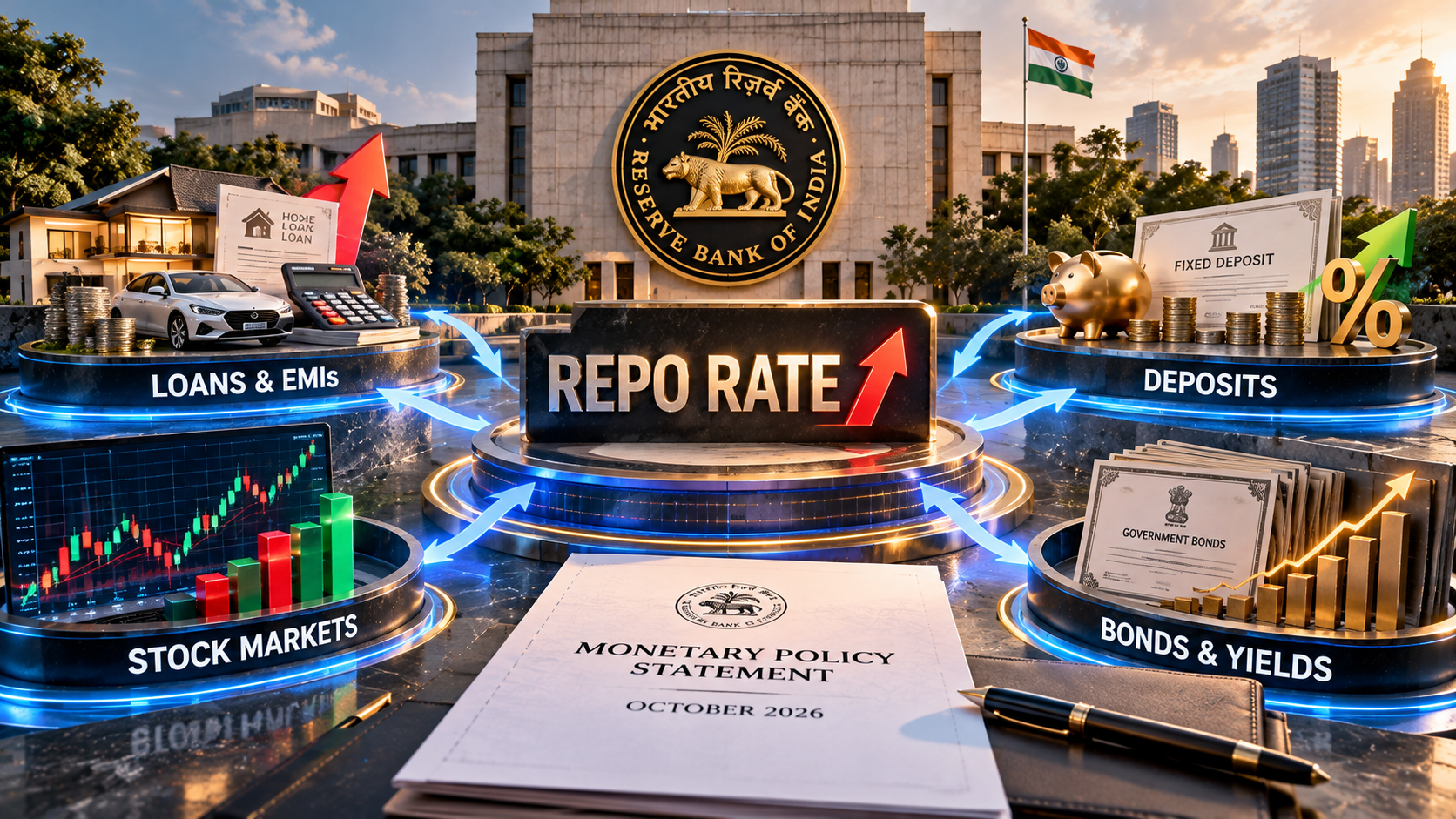
RBI Repo Rate Hike: October 2026 Policy Update, Impact on Loans, EMIs, Deposits & Markets
A simple guide to the October 2026 RBI repo rate hike, what it means for borrowers, depositors, investors, banks and the broader economy.
Sachin Gadekar
·
08 Oct 2026

IPO
HD Fire Protect IPO Details: Date, Price, GMP, Review & How to Apply
A complete guide to HD Fire Protect IPO 2026, covering issue size, OFS structure, price band, lot size, GMP context, company profile, financials, risks, valuation and application process.
Sachin Gadekar
·
07 Oct 2026

IPO
Reliance Jio IPO: Date, Price, GMP, Valuation, Review & Details
A complete guide to Reliance Jio IPO 2026, covering Jio Platforms IPO details, issue size, expected date, price band status, GMP context, shareholder quota, company profile, financials, valuation and risks.
Sachin Gadekar
·
07 Oct 2026