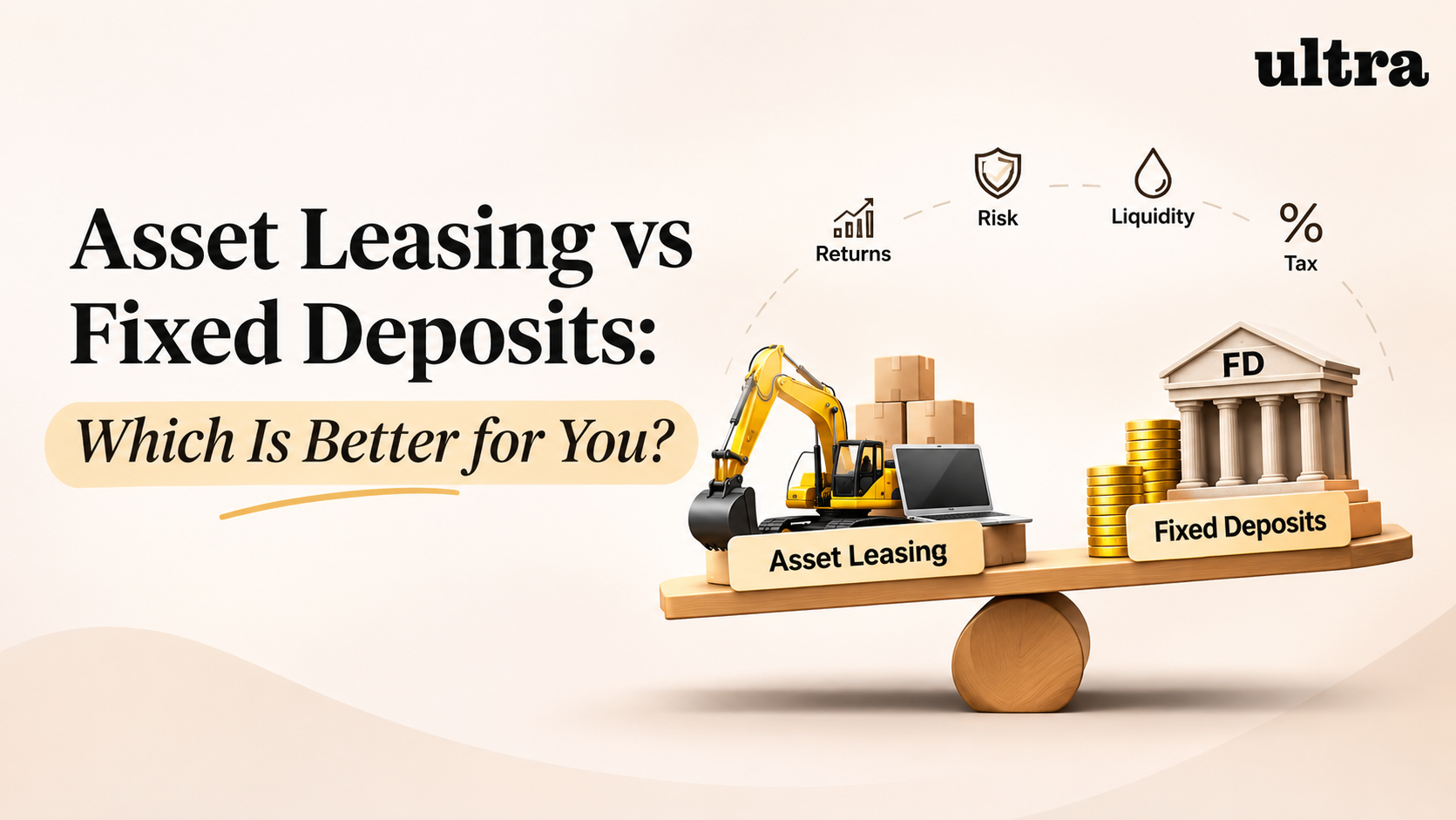
Asset Leasing vs Fixed Deposits: Which Is Better for You?
25 November 2026 · Team ultra
Compare asset leasing and fixed deposits on returns, safety, liquidity and tax, and find out which suits your goals and risk appetite.
introduction
Fixed Deposits (FDs) have long been a popular investment choice in India because of their predictable returns. However, investors are increasingly exploring alternatives to fixed deposits to diversify their investments and earn additional income.
One such option is asset leasing, where investors earn income through lease rentals paid by companies that use the asset. But how do asset leasing returns compare with FD interest, and how safe is asset leasing?
In this blog, we compare asset leasing vs fixed deposits based on returns, risks, liquidity and taxation to help you decide which may suit you better.
Asset Leasing vs Fixed Deposits: Understanding the Concept Copy
Asset Leasing
Asset leasing is an agreement where the owner of the asset (the lessor) allows another party (the lessee) to use the asset for a fixed period in exchange for periodic payments called lease rentals. The asset may be machinery, a vehicle, equipment or a commercial building.
For the lessee, leasing lets a company use the asset without buying it, so it avoids a large upfront capital expenditure (capex). The lessor retains ownership of the asset and receives the lease rentals.
From an investor's point of view, asset leasing offers a chance to earn regular income from lease rentals. Minimum investment amounts vary by platform and by deal, so check the ticket size before investing. Actual earnings, however, depend on the lessee's ability to pay on time and on the asset's value at the end of the lease.
On platforms such as Ultra, the investor typically buys the asset and leases it to a company under a tri-party licensing agreement. The platform agrees to buy the asset back at a set value at the end of the tenure.
Fixed Deposits
Fixed Deposits (FDs) are financial products offered by banks and some NBFCs. You invest a lump sum for a fixed tenure at an interest rate that is locked in when you book the deposit.
Unlike a savings account, the rate does not change during the tenure. Tenures range from a few days to several years, depending on the institution (SBI, for example, offers 7 days to 10 years).
On maturity, you get back your principal along with the interest, unless you chose to receive interest monthly or quarterly. Premature withdrawal is usually allowed, subject to a penalty and the bank's conditions.
Types of Asset Leasing
Not every lease works the same way. The structure decides who carries the asset's risks and what happens when the lease ends.
• Direct lease: The lessor buys the asset from the vendor and rents it to the lessee, who uses it without owning it.
• Sale and leaseback: The lessee sells an asset it already owns, or has just bought, to the lessor and then leases it back. This frees up cash while the company keeps using the asset.
• Lease rental discounting: The asset owner borrows from a lender against the rent it expects to receive. This is borrowing by the owner, not an investment product for retail investors.
Leases are also classified by who bears the risks of ownership:
• Operating lease: Ownership never passes to the lessee, the term is shorter, and the lessor looks after the asset. It suits assets that need frequent replacement.
• Finance lease: The lessor owns the asset during the term, but the lessee takes on most of the risks and rewards of ownership and can usually buy the asset at the end.
Before you invest, check which type a deal is. It affects your income, your exposure to the asset's value and your exit at the end.
How Asset Leasing Works on a Platform
On a leasing platform, the process usually runs like this:
• You buy the asset. You purchase an asset a company needs, such as laptops or equipment, and own it as the lessor.
• You sign the lease. A tri-party licensing agreement is signed between you (the lessor), the company using the asset (the lessee) and the platform, which acts as the service provider.
• You receive monthly rent. The lessee pays a predefined monthly rent for the agreed tenure.
• The asset is bought back. Under a separate agreement to sell, the platform buys the asset from you at a set buyback value at the end of the tenure.
For example, an investor buys laptops and leases them to a company through the platform. Because the investor owns the laptops, they receive monthly rent for the tenure.
Bank FDs vs NBFC FDs
Fixed deposits come from two kinds of institutions, and the protection behind them differs.
Bank FDs are covered by DICGC deposit insurance up to ₹5 lakh per depositor per bank, including interest. For reference, SBI's FD rates in 2026 range from 3.05% to 6.60% a year for the general public and 3.55% to 7.10% for senior citizens, depending on tenure.
NBFC FDs (also called corporate FDs) usually pay more but are not covered by DICGC insurance. Instead, RBI requires deposit-taking NBFCs to hold at least an investment-grade credit rating (BBB- or above) and limits their deposit tenure to between 12 and 60 months.
Check the FD's rating before investing, and remember that a higher rate usually means higher risk.
Asset Leasing Returns vs FD Interest
Both fixed deposits and asset leasing generate income, but in different ways. In a fixed deposit, you earn interest at a fixed rate.
For example, a hypothetical ₹5 lakh FD at 6.5% a year, with interest paid out annually, earns ₹32,500 in a year before tax. The main benefit is that you know the return in advance, and it does not change during the tenure.
Asset leasing, on the other hand, earns income as rent paid by the company that uses the asset. Depending on the deal, investors receive regular rental income, and the indicative return may be higher than FD rates.
Late payments, maintenance costs and a fall in the asset's value can reduce what you actually earn. In short, FDs offer predictable income, while asset leasing offers potentially higher but uncertain income.
Asset Leasing vs Fixed Deposits at a Glance
[Insert Comparison Table 1 provided below.]
Worked Example: How Lease Rent Turns Into a Return
A common mistake is to read the monthly rent as the return. In a lease, part of every rent payment is your own money coming back. Here is a hypothetical example:
A year's rent of ₹34,800 is 34.8% of the amount invested, but the actual return is only about 11.1% a year, because most of the rent is your own capital being returned. Missing just three of the 36 payments cuts the return by almost half, which is why the lessee's ability to pay matters so much.
To compare a lease with an FD fairly, look at the annualised return the deal shows (IRR or XIRR), not the rent, and set it against the FD rate after tax.
The figures are hypothetical and do not represent an Ultra deal or indicative returns on any live deal.
Is Asset Leasing Safe? Risk and Capital Protection
Every investment carries some risk, and it is worth understanding it before you invest.
Bank FDs are generally considered low-risk, especially with financially strong banks. However, the Deposit Insurance and Credit Guarantee Corporation (DICGC) insures bank deposits only up to ₹5 lakh per depositor per bank, and this limit covers principal and interest together. FDs with NBFCs are not covered by DICGC insurance.
The main risks in asset leasing are delayed rent, lessee default and a fall in the asset's value through depreciation.
If the lessee cannot pay, your income is affected, and how much you recover depends on the lease terms and whether the asset can be repossessed and re-leased or sold.
Unlike bank fixed deposits, there is no standard deposit insurance available for asset leasing investments.
Direct Asset Leasing vs Lease-Backed SDIs
Lease income can reach investors in two ways, and they work differently.
SEBI's SDI framework includes rental and equipment-leasing receivables among the debt that can be securitised, and listed SDIs are one of the products SEBI-registered Online Bond Platform Providers may offer.
Before investing, check which structure a deal uses, because it changes your rights, the disclosures you receive and how you can exit.
Liquidity, Lock-in Period and Tax
Liquidity is how easily you can turn an investment into cash when you need it.
FDs are more liquid because most banks allow premature withdrawal, usually with a penalty of about 0.5%–1% on the interest rate. RBI requires banks to offer premature withdrawal on term deposits of up to ₹1 crore.
In asset leasing, your money is usually committed for the full lease tenure, and early exit is either not available or depends on the platform's terms.
Tax on FD Interest and Lease Income
FD interest is added to your income and taxed at your slab rate. Banks deduct TDS at 10% if your interest from one bank exceeds ₹50,000 in a financial year (₹1 lakh for senior citizens), under Section 393(1) of the Income-tax Act, 2025.
For asset leasing, tax depends on how the deal is structured. Lease rentals are generally taxable at your slab rate, and the sale or buyback of the asset at the end of the tenure may have separate tax implications. Check the deal documents and consult a tax advisor.
When comparing the two, look at post-tax returns and liquidity, not just the headline rate.
What to Check Before You Invest
Before choosing between asset leasing and fixed deposits, take time to understand the terms of each. Choosing on the stated return alone can be costly, and a little research can help you avoid unpleasant surprises.
For Fixed Deposits
Start with the institution offering the FD. Check whether it is a bank or an NBFC and how reliable it is. For NBFC FDs, check the credit rating.
Compare rates across tenures instead of picking an FD only because it offers the highest rate. Also check whether interest is paid out periodically or added on at maturity.
Other points to check are the maturity amount, premature withdrawal rules, penalties and tax. For bank FDs, keep the DICGC insurance limit in mind.
For Asset Leasing
For asset leasing, look closely at both the asset and the lease agreement. Understand the asset, who legally owns it and the company that will use it. The condition of the asset, its service life, and required maintenance should also be considered.
The agreement should clearly state the rent, payment schedule, lease term, and who pays for repairs, insurance and other costs.
Also find out what happens if the lessee defaults. Can the asset be repossessed? Who will manage it, and how easily can it be leased to someone else or sold?
These factors can significantly affect your actual return. If you invest through an online platform, read all documents carefully and check the platform's fees, commissions and buyback terms.
For Both
Check whether the stated return is before or after costs, and whether it is fixed or only an estimate.
In asset leasing, ask whether the rent can change and whether there could be idle periods when the asset is not in use. For FDs, compare the effective annual yield over the full term and check that the withdrawal terms suit your needs.
Finally, look beyond the headline rate to the post-tax return and any costs. Avoid locking away money you may need for emergencies for a long period. It is also wise not to put all your savings into one instrument.
Careful selection, understanding the terms and keeping your financial goals in mind can make the decision easier.
Which Is Better for You?
The right choice depends on your financial goals and risk appetite.
Fixed Deposits May Be Suitable For:
1. Risk-averse investors who want predictable returns.
2. Retirees looking for regular interest income.
3. Investors who value capital safety and simplicity above all.
4. Investors who may need their money at short notice.
Asset Leasing May Be Suitable For:
1. Investors looking for an alternative source of regular income.
2. Investors willing to take more risk for potentially higher returns.
3. Investors who can stay invested for the full lease tenure.
Conclusion
Fixed deposits are suitable for investors who prioritise predictability and relatively lower risk. Asset leasing may be worth exploring for those seeking alternative income opportunities and willing to accept additional risks.
Ultimately, the better investment is not necessarily the one offering higher returns, but the one that fits your financial goals and risk tolerance. Whichever you choose, compare post-tax returns, read the terms and keep an emergency fund separate.
FAQs
Recent articles
View all
invoice discounting
Why Negative Operating Cash Flow Doesn’t Always Mean a Bad Business
Understand why profitable companies can report negative operating cash flow, the financial ratios that explain it, and the warning signs investors should watch.
Team ultra
·
23 Nov 2026
invoice discounting
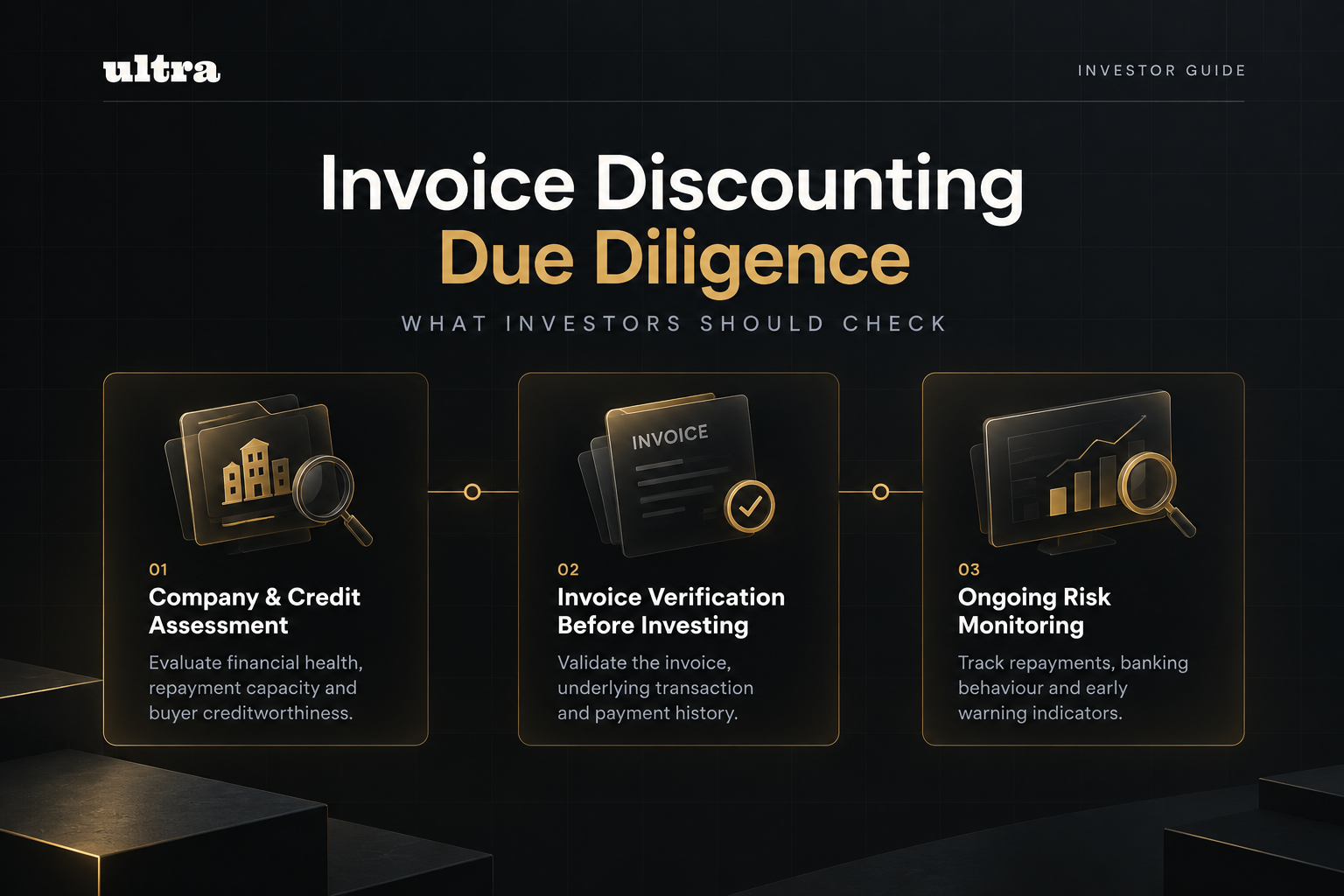
Invoice Discounting Due Diligence: What Investors Should Check Before Investing
A complete guide to invoice discounting due diligence, covering what to check before you invest and how ultra reviews every business before listing its invoices
Prerna Bhardwaj
·
26 Oct 2026
invoice discounting
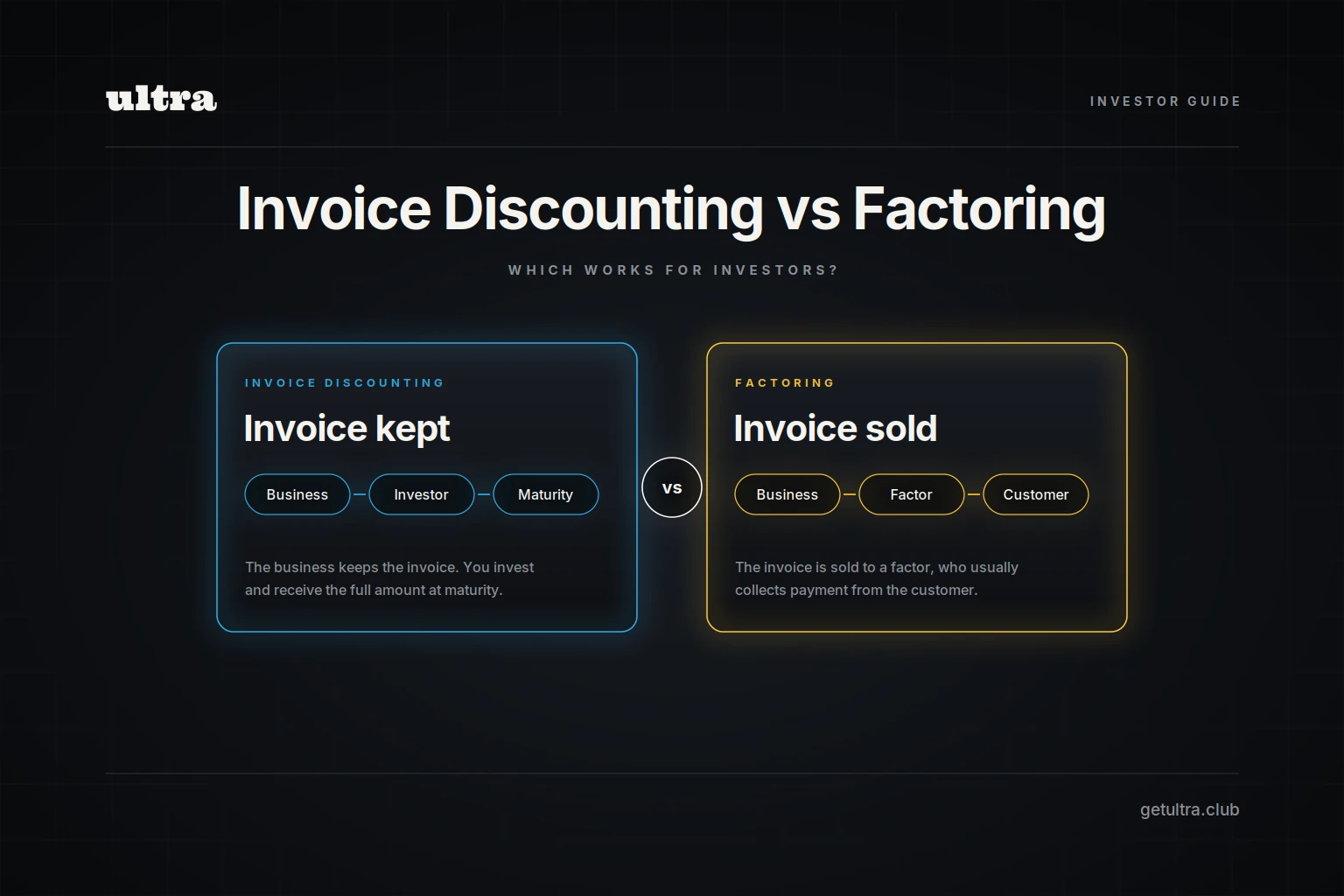
Invoice Discounting vs Factoring: Which Works for Investors?
A complete guide to invoice discounting vs factoring, covering how each works, the key differences between them and why investors choose invoice discounting on ultra.
Prerna Bhardwaj
·
22 Oct 2026
invoice discounting
Invoice Discounting Investment in India: How It Works
A complete guide to invoice discounting investment in India, covering how it works, why experienced investors consider it, where it fits in a portfolio and how to invest with ultra.
Prerna Bhardwaj
·
21 Oct 2026