Invoice Discounting Investment in India: How It Works
21 October 2026 · Prerna Bhardwaj
A complete guide to invoice discounting investment in India, covering how it works, why experienced investors consider it, where it fits in a portfolio and how to invest with ultra.

Every working day, goods leave factories across India on a promise. A supplier delivers, an invoice is raised, and payment is scheduled for a date weeks away. The work is done; the money is not yet in hand. For most businesses, this gap is simply the cost of trading with larger companies. For a growing number of investors, it has become an opportunity.
That opportunity is invoice discounting investment. This guide explains what it is, why experienced investors are adding it to their portfolios, and how to invest in invoice discounting in India.
What is Invoice Discounting Investment
In invoice discounting, you invest in a business's unpaid invoices at a discounted value. When the invoice matures, you receive the full amount, and the difference is your return. It's a simple way to earn short-term returns linked to real business transactions.
Businesses that sell on credit often wait weeks or months to be paid. Invoice discounting gives them access to that money early, while investors earn a return for funding the gap. Each investment is tied to a single invoice with a fixed maturity date.
Why Experienced Investors Consider Invoice Discounting
For investors whose core portfolio is already in place, the question is rarely how to earn more from the same instruments. It is what else deserves a place alongside them. Invoice discounting answers that question in a few distinct ways.
1. Time: Deals on ultra run from 10 to 90 days, so capital returns within weeks rather than years. Each maturity becomes a natural moment to reassess, redeploy or step back, a degree of control that long-tenure instruments rarely offer.
2. Source of Return: Equities move with sentiment and bonds with interest rates. An invoice discounting return comes from something more grounded: a business transaction completing as agreed. It is linked to real economic activity, not to where the market closes.
3. Clarity: Each investment is tied to a specific invoice, so you know exactly what your capital is working on. There is no large, pooled fund to look through; every deal can be assessed on its own merits.
Together, these qualities make invoice discounting a natural complement for investors who have covered the familiar ground of stocks, mutual funds and fixed deposits, and are looking for something that works differently.
Where Invoice Discounting Fits in Your Portfolio
A well-built portfolio is less about choosing one instrument than about giving each a clear role. Equities drive long-term growth, while other holdings bring stability and income. Invoice discounting fills a specific space within that mix: short, defined commitments with returns tied to completed business transactions.
Many investors use it for capital they want working over weeks or months rather than years, money that can be invested, returned and redeployed in regular cycles.
Invoice Discounting on ultra
ultra brings together discerning investors and carefully selected opportunities, the kind once reserved for a few. Invoice discounting is central to that idea, and the platform is designed to make it straightforward to access and easy to manage.
A curated selection: Not every business makes it onto ultra. Each business is checked before its invoices are listed, so every deal you see has already been through a review. The aim is curation over volume: fewer, better opportunities rather than an endless list to sort through.
Clarity at every step: Each deal is presented with its terms set out plainly, so you can understand what you are investing in before you commit. You choose the deals that suit you, and your portfolio stays fully in your hands.
Built around your time: With tenures from 10 to 90 days, your capital comes back in regular cycles. At every maturity, you can reinvest in the next opportunity, so your capital keeps working for you
Disclaimer
This article is for educational and informational purposes only and is not investment, legal or tax advice. Invoice discounting involves credit risk and is not insured. Returns are not guaranteed, and you may lose part or all of the capital you invest. Past performance is not an indicator of future results. Read each deal's documents carefully and seek independent advice where needed.
Frequently Asked Questions
Q1. What is invoice discounting investment on ultra?
On ultra, you invest in the unpaid invoices of carefully reviewed businesses at a discounted value. When the invoice matures, you receive the full invoice amount, including your return. It is a short-term investment linked to real business transactions, curated for investors who look beyond the usual options.
Q2. Is investing in invoice discounting on ultra safe?
At ultra, every company is reviewed by a dedicated in-house credit team before it is onboarded. The review covers financial analysis, cash flows, banking details, repayment capacity, credit profile and existing obligations, with risk assessed across 50+ parameters, including financial health, repayment track record, business performance, market conditions and compliance. Like any investment, invoice discounting still carries risk.
Q4. What is the tenure of invoice discounting deals on ultra?
Deals on ultra run from 10 to 90 days.
Q5. How do I start investing on ultra?
Download ultra from the Play Store or App Store, complete your KYC in the app, explore the open invoice discounting deals and invest in the ones that fit your goals.
Q6. How does ultra choose which invoices to list?
Every invoice on ultra comes from a business that has cleared a detailed review by ultra's dedicated in-house credit team. Before onboarding, the team studies how the business earns, how it manages cash and how reliably it repays, assessing each company across 50+ parameters. Only businesses that meet these standards are onboarded, so every deal you see has already passed a rigorous filter. The result is a curated selection: fewer, stronger opportunities rather than an endless list.
Recent articles
View all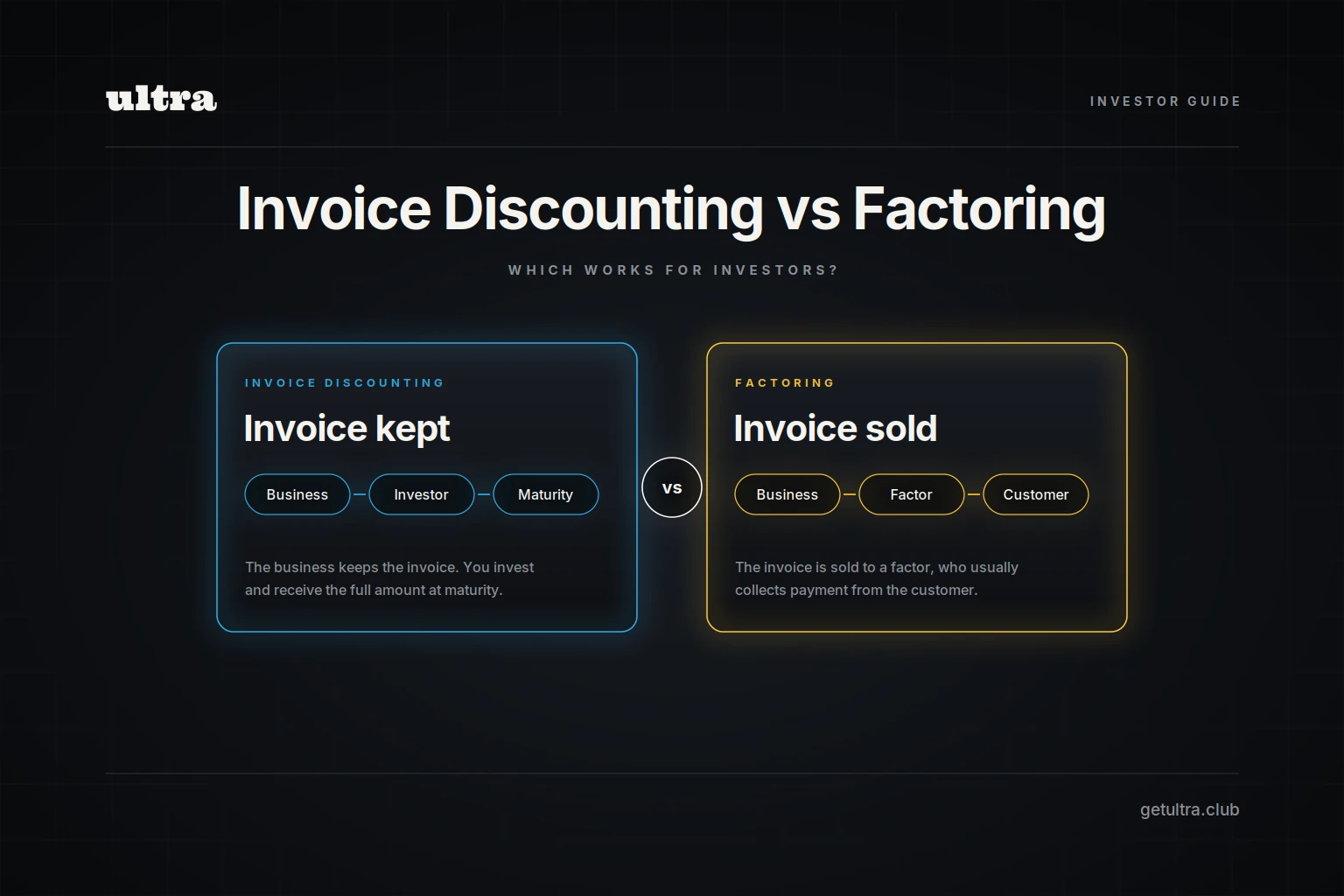
invoice discounting
Invoice Discounting vs Factoring: Which Works for Investors?
A complete guide to invoice discounting vs factoring, covering how each works, the key differences between them and why investors choose invoice discounting on ultra.
Prerna Bhardwaj
·
22 Oct 2026

IPO
Reliance Jio IPO: Date, Price, GMP, Valuation, Review & Details
A complete guide to Reliance Jio IPO 2026, covering Jio Platforms IPO details, issue size, expected date, price band status, GMP context, shareholder quota, company profile, financials, valuation and risks.
Sachin Gadekar
·
19 Oct 2026

IPO
Paras Healthcare IPO Details: Date, Price, GMP, Review & How to Apply
A complete guide to Paras Healthcare IPO 2026, covering the issue structure, price band, lot size, GMP, hospital network, financial performance, valuation and key risks.
Sachin Gadekar
·
15 Oct 2026

IPO
Zetwerk IPO Details: Date, Price, GMP, Review & How to Apply
A complete guide to Zetwerk Manufacturing Business IPO 2026, covering issue size, price band, lot size, GMP context, company profile, financials, valuation, risks and application process.
Sachin Gadekar
·
14 Oct 2026