Invoice Discounting vs Factoring: Which Works for Investors?
22 October 2026 · Prerna Bhardwaj
A complete guide to invoice discounting vs factoring, covering how each works, the key differences between them and why investors choose invoice discounting on ultra.
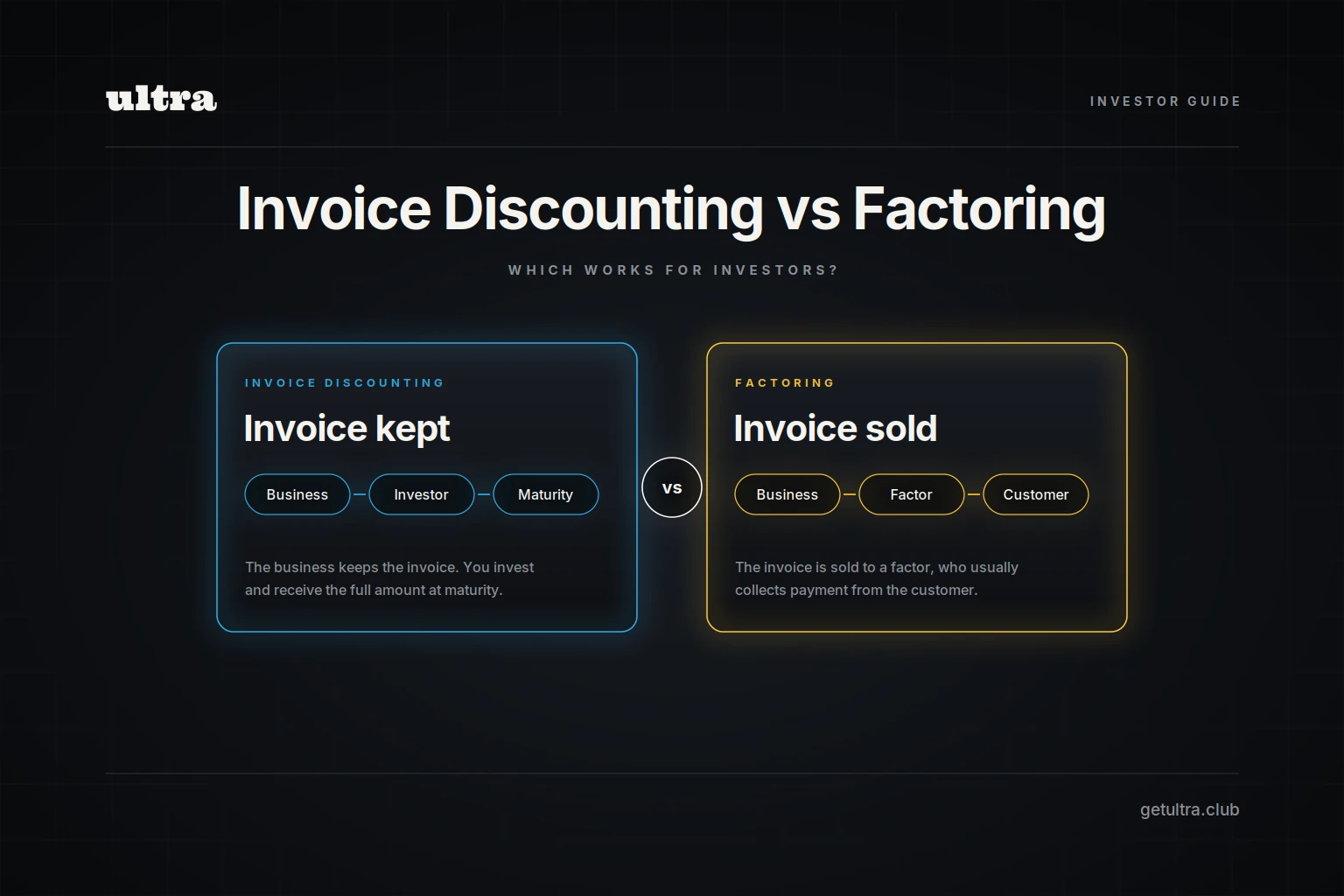
Invoice discounting and factoring are often mentioned in the same breath. Both turn a business's unpaid invoices into money today, and both exist for the same reason: businesses that sell on credit cannot always wait weeks or months to be paid.
Yet the two work very differently, and the difference matters most to the person putting the money in. This guide looks at invoice discounting vs factoring from an investor's point of view: how each works, where they part ways, and why invoice discounting is the model built for investors.
What is Invoice Discounting
In invoice discounting, a business raises money against invoices its customers have not yet paid. The business keeps ownership of its invoices and its relationship with its customers, and the arrangement is usually confidential.
For an investor, invoice discounting is a short-term investment. You invest in a business's unpaid invoice at a discounted value, and when the invoice matures, you receive the full invoice amount, including your return. Each investment is tied to a specific invoice with a fixed maturity date. For a fuller introduction, read What is invoice discounting?
What is Invoice Factoring
Invoice factoring, often simply called factoring or debt factoring, is a way for a business to sell its unpaid invoices to a financier known as a factor. The factor pays the business a large part of the invoice value upfront and then usually takes over collecting payment from the customer. Because the factor deals with the customer directly, the arrangement is usually visible to them.
Factoring is mainly a financing service between a business and a factoring company. It is not typically structured as an investment that individuals can access.
Difference Between Invoice Discounting and Factoring
At first glance, the two can look alike. The table below shows where they part ways.
| Parameter | Invoice Discounting | Factoring |
|---|---|---|
| What happens to the invoice | Used to raise money; the business keeps ownership | Sold to the factor |
| Who collects payment | Usually the business | Usually the factor |
| Customer awareness | Often confidential | Usually disclosed to the customer |
| Customer relationship | Stays with the business | Partly handled by the factor |
| Open to individual investors | Yes, through curated platforms like ultra | Rarely; mainly between businesses and financiers |
Three differences stand out:
Ownership - In invoice discounting, the invoice stays with the business and is used to raise money. In factoring, the invoice is sold, and the factor steps into the business's place.
Control - With invoice discounting, the business usually continues to manage its customers, and the arrangement stays private. With factoring, the customer typically pays the factor instead.
Access - For investors, this is the difference that matters most. Invoice discounting has been opened up to investors through curated platforms, while factoring largely remains a service for businesses.
Exact structures vary by provider and deal. If you have come across the term bill discounting, read our guide to the difference between factoring and bill discounting.
Why Investors Prefer Invoice Discounting
For investors whose core portfolio is already in place, invoice discounting offers something the familiar instruments do not :
Time - Deals on ultra run from 10 to 90 days, so capital returns within weeks rather than years. At every maturity, you can reinvest in the next opportunity and keep your capital working.
Clarity - Every investment is tied to a specific invoice with a fixed maturity date, so you know exactly what your capital is working on and when it returns.
Return - An invoice discounting return comes from a business transaction completing as agreed. It is linked to real economic activity, not to market sentiment.
For a closer look at how it works and where it fits in a portfolio, read our guide to invoice discounting investment in India.
Invoice Discounting on ultra
ultra brings together discerning investors and carefully selected opportunities, the kind once reserved for a few.
A curated selection. Every company on ultra is reviewed by a dedicated in-house credit team before it is onboarded. The review covers financial analysis, cash flows, banking details, repayment capacity, credit profile and existing obligations, with risk assessed across 50+ parameters. Only businesses that meet these standards are onboarded, so every deal you see has already passed a rigorous filter.
Clarity at every step. Each deal is presented with its terms set out plainly, so you understand what you are investing in before you commit.
Built around your time. With tenures from 10 to 90 days, your capital comes back in regular cycles. At every maturity, you can reinvest in the next opportunity. NRIs can invest on ultra too. Get ultra on the Play Store or the App Store and discover the invoice discounting opportunities open today.
Disclaimer
This article is for educational and informational purposes only and is not investment, legal or tax advice. Invoice discounting involves credit risk and is not insured. Returns are not guaranteed, and you may lose part or all of the capital you invest. Past performance is not an indicator of future results. Read each deal's documents carefully and seek independent advice where needed.
Frequently Asked Questions
Q1. What is the main difference between invoice discounting and factoring?
In invoice discounting, a business raises money against its unpaid invoices while keeping ownership of them and control of collecting payment. In factoring, the business sells its invoices to a factor, who usually collects payment from the customer.
Q2. Which is better for investors, invoice discounting or factoring?
Invoice discounting is the model built for investors. On ultra, you invest in invoices from businesses reviewed by a dedicated in-house credit team across 50+ parameters, with tenures of 10 to 90 days and terms shown upfront. Factoring, by contrast, is mainly a service between businesses and factoring companies.
Q3. Is invoice discounting the same as bill discounting?
The two terms are often used interchangeably. Both involve raising money against unpaid invoices or bills before they are due. For more, read our guide to the difference between factoring and bill discounting.
Q4. What is the difference between invoice financing and invoice discounting?
Invoice financing is the broad term for raising money against unpaid invoices. Invoice discounting and factoring are both forms of invoice financing. Of the two, invoice discounting is the one investors can access on ultra.
Q5. How do I invest in invoice discounting on ultra?
Download ultra from the Play Store or App Store, complete your KYC in the app and explore the curated deals. Each deal's terms are shown upfront, so you can invest with clarity.
Recent articles
View all
invoice discounting
Invoice Discounting Investment in India: How It Works
A complete guide to invoice discounting investment in India, covering how it works, why experienced investors consider it, where it fits in a portfolio and how to invest with ultra.
Prerna Bhardwaj
·
21 Oct 2026

IPO
Reliance Jio IPO: Date, Price, GMP, Valuation, Review & Details
A complete guide to Reliance Jio IPO 2026, covering Jio Platforms IPO details, issue size, expected date, price band status, GMP context, shareholder quota, company profile, financials, valuation and risks.
Sachin Gadekar
·
19 Oct 2026

IPO
Paras Healthcare IPO Details: Date, Price, GMP, Review & How to Apply
A complete guide to Paras Healthcare IPO 2026, covering the issue structure, price band, lot size, GMP, hospital network, financial performance, valuation and key risks.
Sachin Gadekar
·
15 Oct 2026

IPO
Zetwerk IPO Details: Date, Price, GMP, Review & How to Apply
A complete guide to Zetwerk Manufacturing Business IPO 2026, covering issue size, price band, lot size, GMP context, company profile, financials, valuation, risks and application process.
Sachin Gadekar
·
14 Oct 2026