Invoice Discounting Due Diligence: What Investors Should Check Before Investing
26 October 2026 · Prerna Bhardwaj
A complete guide to invoice discounting due diligence, covering what to check before you invest and how ultra reviews every business before listing its invoices
What is Invoice Discounting Due Diligence
Invoice discounting due diligence is the process of assessing an invoice-backed investment before you commit your money. It looks at the invoice, the customer expected to pay it, the payment terms and the risks involved, so that your decision rests on more than the headline return.
Due diligence works at two levels: the deal in front of you, and the platform that put it there. A careful investor looks at both. The checklist below covers the deal, and the sections after it cover what to expect from a platform.
What to Check Before You Invest
A considered review comes down to six checks. Each tells you something the headline return cannot, and each is one ultra’s team works through before a deal reaches you.
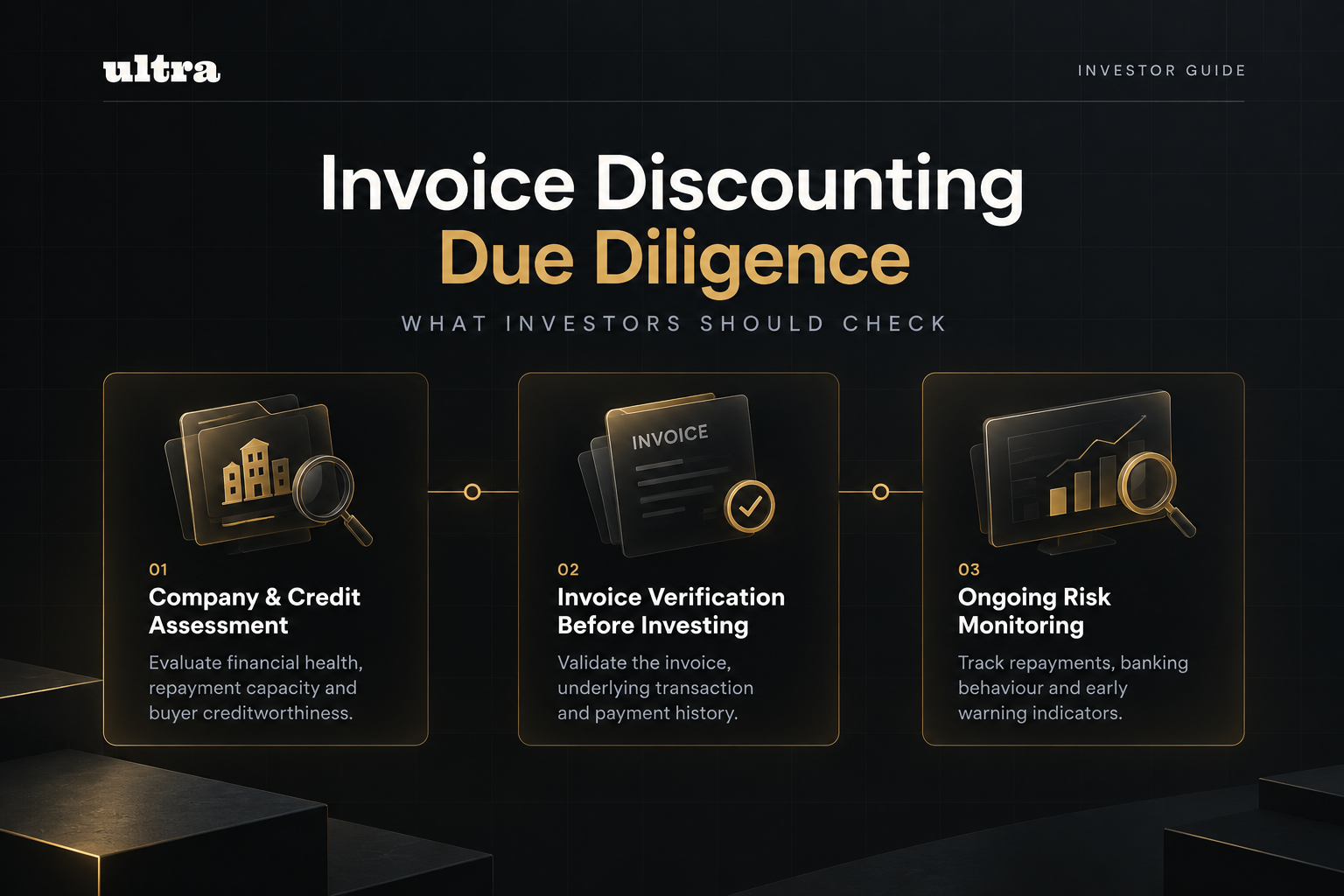
1. The business and its repayment capacity - Look at the financial health of the business raising the invoice: its cash flows, banking details, existing obligations and credit profile. At ultra, a dedicated in-house credit team carries out detailed financial analysis on every company before it is onboarded.
2. The invoice and the transaction - Understand what the invoice relates to and who the parties are. ultra validates the underlying transaction and the parties involved.
3. The paying customer - Your payout depends on the customer paying on time, so their position matters as much as the business’s. ultra’s assessment covers buyer and debtor factors, not only the business listing the invoice.
4. The legal documentation - The agreements behind a deal should be complete and in order. ultra reviews the required agreements and documents as part of onboarding.
5. How repayment is secured - Ask what stands behind the repayment. ultra uses eNACH mandates, post-dated or undated cheques where applicable, and escrow with independent trustee oversight through Universal Trusteeship Services Limited.
6. Monitoring after you invest - Diligence should not stop at onboarding. An independent risk monitoring team at ultra tracks financial performance, banking behaviour, repayments, overdue amounts, leverage, legal and regulatory developments and early-warning indicators. If risks emerge, it can step up monitoring, reduce exposure, add mitigants or suspend further exposure.
How ultra Reviews Every Business
Not every invoice makes it onto ultra. Every company is reviewed by a dedicated in-house credit team before it is onboarded, and the work does not stop once a deal is live.
Before onboarding: The team carries out detailed due diligence on the company: financial analysis, cash flows, banking details and repayment capacity, along with its credit profile and existing financial obligations. The underlying invoice and transaction are verified, and the parties involved are validated. Legal and documentation checks review the required agreements. Risk is then assessed across 50+ parameters, including financial health, repayment track record, business performance, market conditions and compliance, covering financial, operational, credit, compliance, legal, transaction and buyer or debtor factors.
Security in place: Repayment is supported by eNACH mandates, post-dated or undated cheques wherever applicable, and escrow with trustee oversight. Universal Trusteeship Services Limited provides independent third-party trustee involvement in the transaction structure.
After onboarding: An independent risk monitoring team continuously tracks financial performance, banking behaviour, repayments, overdue amounts, leverage, legal and regulatory developments and early-warning indicators. If risks emerge, ultra can enhance monitoring, reduce exposure, add mitigants, or suspend or restrict further exposure.
The aim is curation over volume: fewer, better opportunities. No process can remove risk entirely, and due diligence helps identify and mitigate risks rather than eliminate the possibility of default or loss. What it does is make sure the groundwork is done before a deal reaches you.
Invoice Discounting on ultra
ultra brings together discerning investors and carefully selected opportunities, the kind once reserved for a few. Invoice discounting is central to that idea, and the platform is designed to make it straightforward to access and easy to manage.
Clarity at every step:
Each deal is presented with its terms set out plainly, so you can understand what you are investing in before you commit. You choose the deals that suit you, and your portfolio stays fully in your hands.
Built around your time:
With tenures from 10 to 90 days, your capital comes back in regular cycles. At every maturity, you can reinvest in the next opportunity, so your capital keeps working for you.
Frequently Asked Questions
1. What does due diligence mean in invoice discounting?
Due diligence involves evaluating a company’s financial health, credit profile, repayment capacity, and the validity of invoices before an investment opportunity is onboarded.
2. How does ultra assess invoice discounting opportunities?
ultra’s in-house credit team evaluates companies across 50+ parameters, including financial performance, banking details, repayment history, compliance, and transaction validity.
3. Does ultra monitor companies after onboarding?
Yes. ultra’s independent Risk Monitoring team tracks repayments, banking behaviour, overdue amounts, leverage, and other early-warning indicators.
4. What security mechanisms may be used in invoice discounting?
Depending on the transaction, these may include eNACH mandates, post-dated or updated cheques, escrow arrangements, and trustee oversight.
5. What is the role of Universal Trusteeship Services Limited (UTSL)?
UTSL provides independent third-party trustee involvement in the transaction structure, supporting transaction oversight.
Recent articles
View all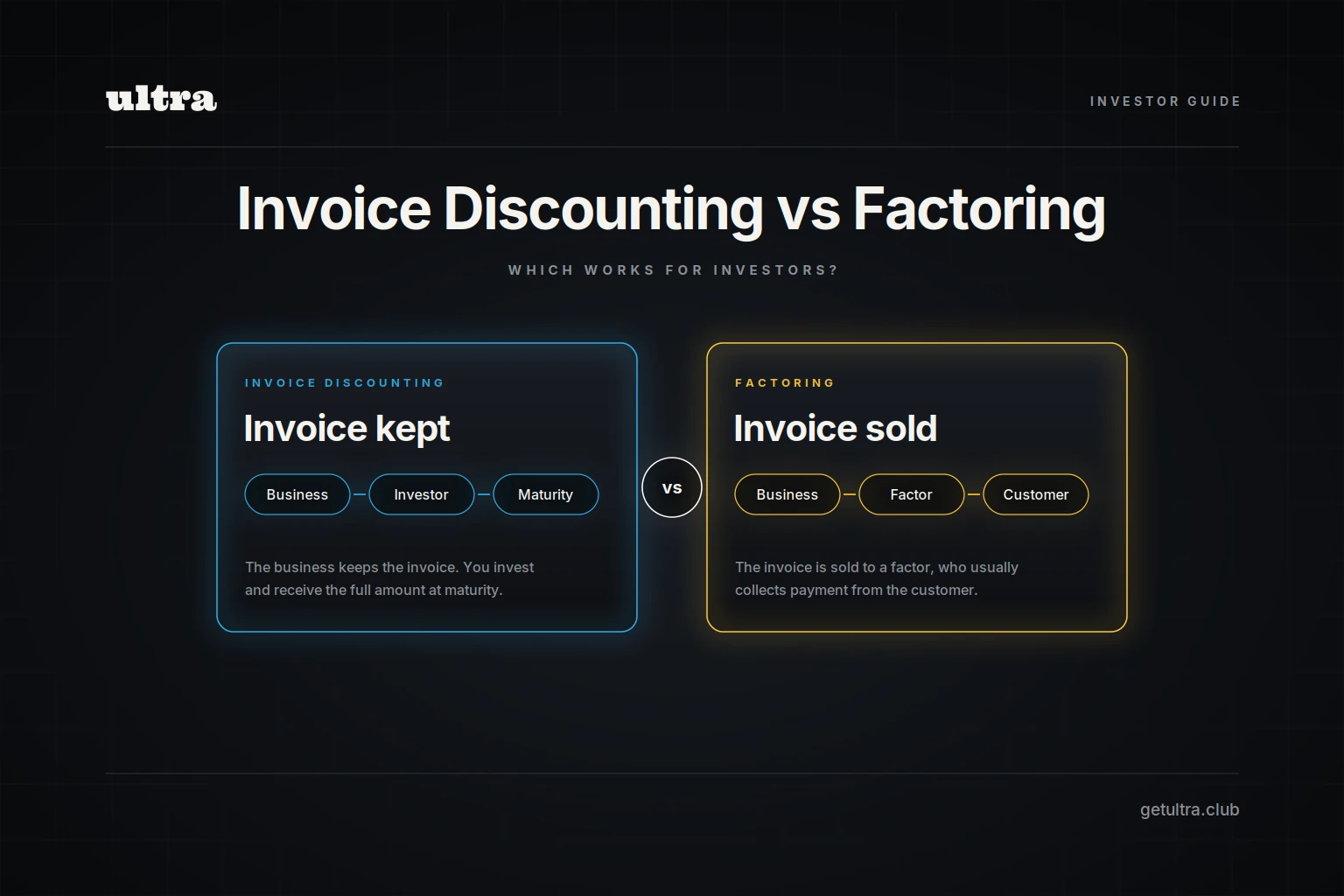
invoice discounting
Invoice Discounting vs Factoring: Which Works for Investors?
A complete guide to invoice discounting vs factoring, covering how each works, the key differences between them and why investors choose invoice discounting on ultra.
Prerna Bhardwaj
·
22 Oct 2026

invoice discounting
Invoice Discounting Investment in India: How It Works
A complete guide to invoice discounting investment in India, covering how it works, why experienced investors consider it, where it fits in a portfolio and how to invest with ultra.
Prerna Bhardwaj
·
21 Oct 2026

IPO
Reliance Jio IPO: Date, Price, GMP, Valuation, Review & Details
A complete guide to Reliance Jio IPO 2026, covering Jio Platforms IPO details, issue size, expected date, price band status, GMP context, shareholder quota, company profile, financials, valuation and risks.
Sachin Gadekar
·
19 Oct 2026

IPO
Paras Healthcare IPO Details: Date, Price, GMP, Review & How to Apply
A complete guide to Paras Healthcare IPO 2026, covering the issue structure, price band, lot size, GMP, hospital network, financial performance, valuation and key risks.
Sachin Gadekar
·
15 Oct 2026