UPI Fee Shake-Up: Everything You Need to Know About the ₹2,000 Threshold
17 September 2026 · Sachin Gadekar
A simple awareness guide explaining the UPI fee discussion, the ₹2,000 threshold, and why most users should understand the difference between bank UPI and wallet-based UPI payments.
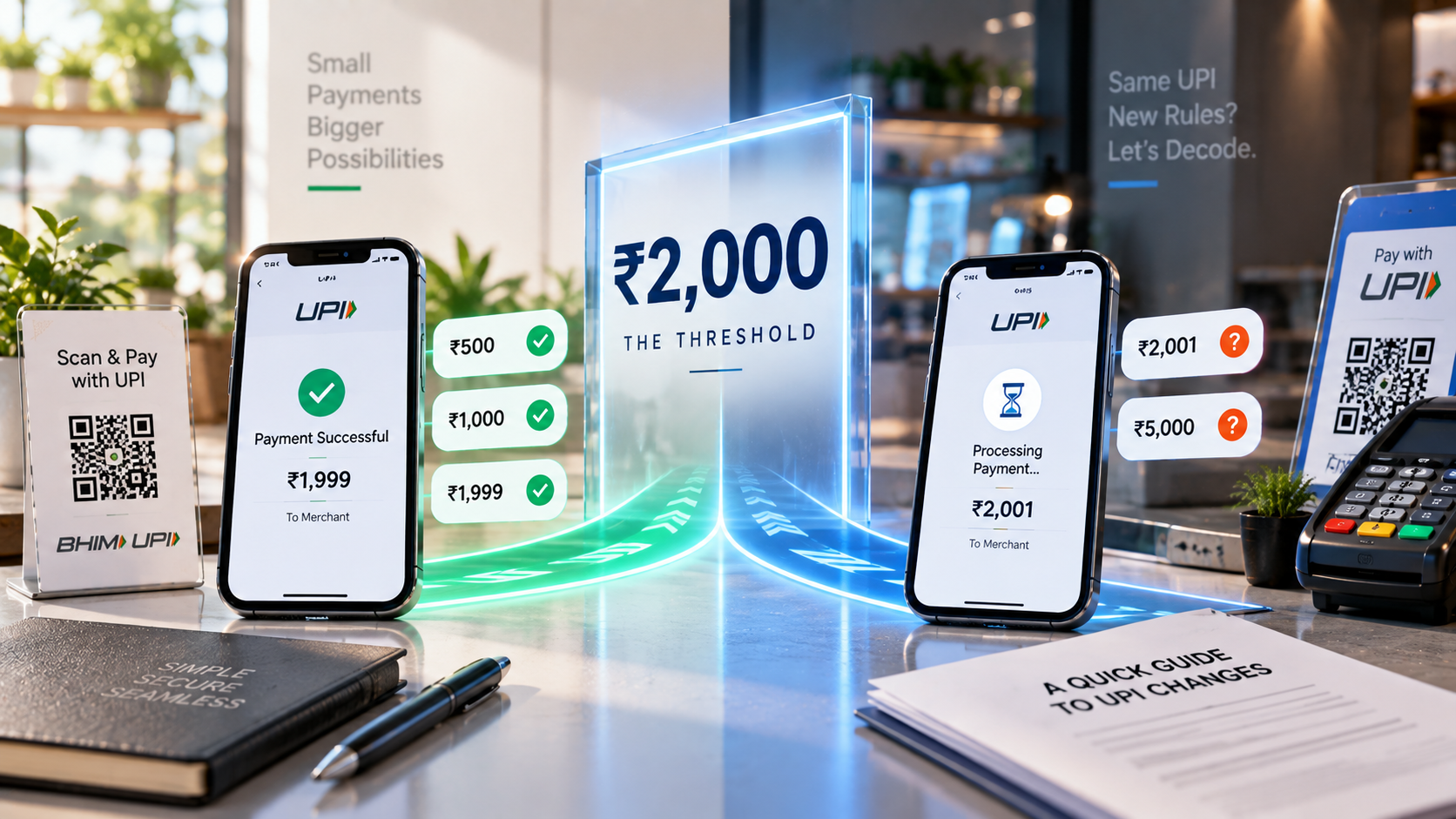
Quick Answer
The ₹2,000 UPI threshold is often discussed in relation to certain merchant payments made through prepaid payment instruments, such as wallets or similar stored-value instruments.
For regular users, the key point is this: not every UPI transaction above ₹2,000 automatically becomes chargeable. The fee discussion usually applies to specific payment flows, especially where a wallet or prepaid instrument is used for merchant payments.
Normal UPI payments made directly from a bank account to another bank account are different from wallet-based merchant transactions.
Before assuming that UPI has become expensive for everyone, it is important to understand:
who is paying
what type of UPI transaction is involved
whether the transaction is bank-account-based or wallet-based
whether the payment is to a merchant
whether the value crosses the ₹2,000 threshold
UPI Fee Shake-Up Overview
UPI has become one of India’s most widely used digital payment systems because it is fast, simple and accepted almost everywhere.
From splitting a restaurant bill to paying a local store, booking services or shopping online, UPI has made real-time payments part of everyday life.
However, whenever there is a discussion around UPI fees, users often get confused about whether they will now have to pay extra for making digital payments.
The recent conversation around the ₹2,000 threshold is one such example. Many people see headlines around UPI charges and assume that all UPI payments above ₹2,000 will become chargeable.
That is not the complete picture.
The threshold is more relevant to certain types of merchant payments, especially where prepaid payment instruments such as wallets are involved.
What Is the ₹2,000 Threshold?
The ₹2,000 threshold refers to a transaction value level often used to determine whether certain UPI-linked merchant transactions may attract an interchange or similar fee.
In simple terms, the threshold helps separate smaller everyday payments from higher-value merchant transactions.
| Point | Meaning |
|---|---|
| Threshold Amount | ₹2,000 |
| Main Relevance | Certain merchant payments using prepaid instruments or wallets |
| Not Automatically Applicable To | All UPI payments above ₹2,000 |
| Common Confusion | Users may assume every large UPI transaction becomes chargeable |
The important distinction is that the threshold is not simply about the transaction amount. It is also about the payment route.
A ₹2,500 payment made directly from a bank account using UPI may be treated differently from a ₹2,500 merchant payment made through a prepaid wallet.
Does Every UPI Payment Above ₹2,000 Attract a Fee?
No. Every UPI transaction above ₹2,000 does not automatically attract a fee.
The fee discussion generally depends on the type of transaction. A normal UPI payment from a bank account is different from a UPI payment made through a prepaid wallet or similar instrument.
| Transaction Type | Fee Impact |
|---|---|
| Bank account to bank account UPI transfer | Generally not part of the wallet-based ₹2,000 fee discussion |
| Person-to-person UPI payment | Usually treated differently from merchant payments |
| Merchant payment using bank account UPI | May not be the same as prepaid wallet-based merchant payments |
| Merchant payment using wallet or prepaid instrument above ₹2,000 | This is where the threshold becomes more relevant |
Bank UPI vs Wallet UPI
The biggest source of confusion is the difference between bank-account-based UPI and wallet-based UPI.
Bank UPI
In a regular bank UPI transaction, money moves directly from the payer’s bank account to the receiver’s bank account.
This is the UPI flow most people use when they pay through apps linked to their savings account.
Wallet UPI
In wallet-based UPI, the payment may be routed through a prepaid instrument. The user may first load money into a wallet or use a stored-value balance, and then make a payment to a merchant.
The ₹2,000 threshold conversation is more relevant to this prepaid instrument route.
Who May Be Affected?
The impact may vary depending on the type of participant in the payment chain.
1. Regular Users
For regular users, the main impact is awareness. Users should understand whether they are paying directly from a bank account or through a wallet.
A headline about UPI fees does not always mean the user will directly pay extra.
2. Merchants
Merchants may need to understand whether certain high-value wallet-based UPI payments could carry a fee or cost impact.
This may matter more for businesses that accept frequent wallet-based payments above ₹2,000.
3. Payment Apps and Wallet Providers
Payment platforms may need to clearly communicate how payments are routed and whether any charges apply to specific transaction types.
4. Banks and Payment Participants
Banks and payment ecosystem participants may be involved in interchange, settlement or processing arrangements depending on the transaction flow.
What It Means for Users
For everyday users, the most important thing is not to panic.
The ₹2,000 threshold does not mean that every UPI payment above ₹2,000 will lead to a direct user charge.
Users should check:
whether they are paying from a bank account or wallet
whether the payment is going to a person or a merchant
whether the payment app shows any charge before confirmation
whether the merchant is passing any cost to the customer
Most users should continue to read the payment confirmation screen carefully before approving any transaction.
Common Misconceptions
Misconception 1: All UPI payments above ₹2,000 are chargeable
This is not accurate. The transaction type and payment source matter.
Misconception 2: Users will always pay the fee
Not necessarily. In many cases, fee discussions relate to merchant-side or payment ecosystem charges, not direct customer charges.
Misconception 3: Bank UPI and wallet UPI are the same
They are not the same. Bank UPI uses money directly from a bank account, while wallet UPI may use a prepaid balance.
Misconception 4: The ₹2,000 threshold applies to person-to-person transfers
The threshold is generally discussed in the context of certain merchant payment flows, not normal person-to-person transfers.
Misconception 5: GMP-style rumours and payment headlines should be trusted immediately
Payment rules should be checked through official updates, app disclosures and merchant terms rather than social media forwards or headlines.
Why the ₹2,000 Limit Matters
The ₹2,000 limit matters because it helps classify transaction size for certain merchant payment flows.
Small everyday payments are common across India, and keeping them simple is important for digital payment adoption.
Higher-value merchant transactions may involve different economics for payment companies, wallet providers, banks and merchants.
This is why the threshold is often discussed in the context of payment system sustainability, merchant acceptance and cost-sharing within the ecosystem.
For users, the real takeaway is simple: understand the payment route before assuming a fee applies.
How to Check Before Paying
Before making a UPI payment, users can follow a few simple checks:
Check whether the money is being paid from your bank account or wallet.
Review the payment confirmation screen.
Look for any visible fee or charge before approving.
Check whether the payment is to a person or a merchant.
Avoid relying only on forwarded messages or social media claims.
For large merchant payments, confirm with the payment app or merchant if any extra cost applies.
A payment should always be approved only after reviewing the final amount.
Final Thoughts
The UPI ₹2,000 threshold has created confusion because many users assume that all UPI payments above ₹2,000 will become chargeable.
That is not the right way to look at it.
The threshold is more relevant to specific merchant payment flows, especially where prepaid wallets or similar instruments are involved. Regular bank-account-based UPI payments are different from wallet-based UPI payments.
For users, the best approach is to stay informed, check the payment source and review the final amount before approving a transaction.
For merchants, it is important to understand the cost structure shared by payment service providers and whether certain wallet-based transactions may carry additional charges.
Disclaimer: This article is for educational and awareness purposes only. Payment rules, fees and thresholds may change based on NPCI, RBI, bank, wallet provider or payment service provider updates. Users and merchants should verify the latest official circulars, app disclosures and service terms before relying on any fee-related information.
FAQs
1. What is the UPI ₹2,000 threshold?
The ₹2,000 threshold refers to a transaction value level often discussed for certain UPI-linked merchant payments, especially where prepaid wallets or similar instruments are used.
2. Does every UPI payment above ₹2,000 attract a fee?
No. Every UPI payment above ₹2,000 does not automatically attract a fee. The payment route, transaction type and merchant category may matter.
3. Are normal bank UPI payments chargeable?
Normal bank-account-based UPI payments are different from wallet-based UPI payments. Users should check the latest official terms, but the ₹2,000 fee discussion is usually more relevant to certain prepaid instrument merchant payments.
4. What is wallet-based UPI?
Wallet-based UPI refers to payments made using a prepaid wallet or stored-value balance instead of directly paying from a bank account.
5. Will users have to pay extra for UPI?
Not necessarily. In many cases, fee discussions relate to merchant-side or payment ecosystem charges. Users should check the final payment screen before approving any transaction.
6. Are person-to-person UPI transfers affected?
The ₹2,000 threshold is generally discussed in relation to certain merchant payment flows, not regular person-to-person UPI transfers.
7. Why is the ₹2,000 amount important?
The threshold helps separate smaller payments from higher-value merchant transactions in certain payment arrangements.
8. What should merchants check?
Merchants should check whether their payment service provider applies any charges for wallet-based UPI payments above ₹2,000 and whether terms differ by merchant category.
9. Is UPI still useful for everyday payments?
Yes. UPI remains one of the most convenient digital payment methods for everyday use. Users should simply understand the difference between bank UPI and wallet-based payments.
10. Where should users verify the latest UPI fee rules?
Users should refer to official updates from NPCI, RBI, banks, wallet providers, payment apps or payment service providers for the latest rules.
Recent articles
View all
IPO
Fresh Issue vs OFS in IPO: What Investors Should Know
A simple guide explaining fresh issue, offer for sale, IPO proceeds, dilution, promoter selling and what retail investors should review before investing in an IPO.
Sachin Gadekar
·
21 Sep 2026

Jindal Supreme India IPO Details: Date, Price Band, Review & How to Apply
A complete guide to Jindal Supreme India IPO 2026, covering issue size, price band, lot size, important dates, company profile, financials, risks and application process.
17 Sep 2026

IPO
Hero Motors IPO GMP: Date, Price Band, Review & How to Apply
A complete guide to Hero Motors IPO 2026, covering issue size, price band, lot size, important dates, GMP context, company profile, financials, shareholding, risks and application process.
Sachin Gadekar
·
15 Sep 2026

IPO
NSE IPO Details: Date, Price Band, Allotment Status, Review & How to Apply
A complete guide to National Stock Exchange of India IPO 2026, covering issue size, price band, lot size, allotment status, listing schedule, company profile, financials, valuation context, risks and application process.
Sachin Gadekar
·
15 Sep 2026