Tax-Free Bonds in India 2025: Are They Still Worth It for HNIs?
21 May 2026 · Sankarshan B
An honest, data-driven assessment of whether Indian tax-free bonds are still worth investing in for HNIs in 2025 -covering the YTM vs coupon confusion, current secondary market yields, post-tax return comparisons at each surcharge bracket, and a clear verdict on when they belong in an HNI portfolio.

The answer most articles give you is: "Yes, tax-free bonds are excellent for high-bracket investors because the interest is completely exempt from income tax."
That answer was more accurate in 2013 when these bonds were first issued at 8–8.75% coupons and rates were high. In 2025, it requires a more careful look. No new tax-free bonds have been issued since 2016. The bonds trading in the secondary market have coupons of 7.64–8.91% -but the actual yield-to-maturity (YTM) you receive when you buy them today is 5.1–5.7%, because prices have risen far above face value.
At 5.1–5.7% YTM, are they still worth it? The answer depends precisely on your tax bracket, the alternatives available to you, and whether you understand the difference between the coupon rate you see quoted and the actual return you will earn.
This article gives you the honest answer.
What Are Tax-Free Bonds? The Quick Recap
Tax-free bonds are fixed-income instruments issued by government-backed PSUs -NHAI, PFC, IRFC, HUDCO, NTPC, REC, NABARD -under a special government authorisation. The defining feature: under Section 10(15)(iv)(h) of the Income Tax Act, the coupon income is completely exempt from income tax. No TDS, no filing required, no regime dependency.
These bonds were issued between 2012 and 2016 to fund infrastructure projects. The government authorised PSUs to raise capital through tax-free bonds during this period as the fiscal deficit was elevated and infrastructure investment needed funding. Since 2016, no new tax-free bonds have been issued. All available bonds are from older series, now trading in the secondary market.
Why they were popular: When issued at 8–8.75% coupons with full tax exemption, an investor in the 30% bracket received an effective pre-tax equivalent yield of approximately 11–12.5%. At the time, that was competitive with almost any investment-grade instrument available.
What has changed: Bond prices in the secondary market have risen significantly as interest rates fell from the 2013–14 peaks. An 8% coupon bond originally issued at ₹1,000 now trades at ₹1,200–1,400 in the secondary market. The coupon income remains ₹80 per year per bond -but on a ₹1,300 purchase price, your actual yield (YTM) is only ~5.5%, not 8%.
The Most Important Distinction: Coupon Rate vs YTM
This single concept explains most of the confusion around tax-free bonds in 2025 -and most articles either ignore it or bury it in a footnote.
Coupon rate: The fixed interest payment as a percentage of the original face value (₹1,000). An 8.67% coupon bond pays ₹86.70 per bond per year, every year until maturity. This never changes.
YTM (Yield to Maturity): The total return you actually earn if you buy the bond today at the current market price and hold it to maturity -accounting for both the coupon income and the capital gain or loss between what you paid and the ₹1,000 face value returned at maturity.
The problem: Most articles, platforms, and even some brokers prominently display the coupon rate -8.67%, 8.91%, 8.75% -which sounds excellent. But the YTM is what you actually earn, and it is currently 5.1–5.7% because you are buying these bonds at significant premiums above face value.
Worked Example
| Parameter | At Original Issue (2013) | In Secondary Market (2025) |
|---|---|---|
| Face value | ₹1,000 | ₹1,000 |
| Purchase price | ₹1,000 | ~₹1,300–₹1,500 |
| Annual coupon | ₹86.70 (8.67%) | ₹86.70 (same -fixed) |
| Coupon rate (on face value) | 8.67% | 8.67% (stated, misleading) |
| YTM (actual return earned) | 8.67% | ~5.2% |
| At maturity, you receive | ₹1,000 (=purchase price) | ₹1,000 (₹300–500 LESS than purchase price) |
| Capital gain / loss at maturity | Zero | Capital LOSS of ₹300–500 per bond |
The key insight: When you buy a tax-free bond in the secondary market at ₹1,300–1,500, you will receive ₹1,000 back at maturity -a guaranteed capital loss. The coupon income is tax-free, but that capital loss is a real cost that reduces your effective return to approximately 5.1–5.7% YTM. The quoted 8.67% coupon is what the original investor earns on their ₹1,000 cost -not what you earn on your ₹1,300–1,500 today.
Always use YTM, not coupon rate, when evaluating secondary market tax-free bonds.
Current Tax-Free Bonds Available in India (2025)
Current tax-free bonds available in the secondary market include NHAI bonds with maturity dates ranging 2029–2035 and coupon rates of 7.64–8.75%, NTPC tax-free bonds with an 8.91% coupon maturing in 2033 and YTM of approximately 5.6%, PFC tax-free bonds with an 8.67% coupon maturing in 2033 and YTM of approximately 5.2%, IRFC tax-free bonds with an 8.63% coupon maturing in 2029 and YTM of approximately 5.11%, and HUDCO tax-free bonds with a 7.64% coupon maturing in 2032 and YTM of approximately 5.7%.
| Issuer | Credit Rating | Coupon Rate | Approx. Maturity | Current YTM (approx.) | Coupon Tax Treatment | Capital Gain at Maturity |
|---|---|---|---|---|---|---|
| NHAI | AAA | 7.64%–8.75% | 2029–2035 | 5.5%–5.9% | 100% tax-free | Capital loss (taxable) |
| NTPC | AAA | 8.91% | 2033 | 5.6% | 100% tax-free | Capital loss (taxable) |
| PFC | AAA | 8.67% | 2033 | 5.2% | 100% tax-free | Capital loss (taxable) |
| IRFC | AAA | 8.63% | 2029 | 5.11% | 100% tax-free | Capital loss (taxable) |
| HUDCO | AA+ | 7.64% | 2032 | 5.7% | 100% tax-free | Capital loss (taxable) |
| REC | AAA | 8.01%–8.71% | 2028–2033 | 5.3%–5.6% | 100% tax-free | Capital loss (taxable) |
Important note: YTM figures are approximate as of 2025 and change daily with secondary market prices. Always verify current YTM on BSE/NSE before investing. The capital loss at maturity is taxable under capital gains rules -this reduces the effective after-tax YTM further if held to maturity.
Post-Tax Return Reality: Who Actually Benefits?
The defining question: at a YTM of 5.1–5.7%, is the tax-free status enough to make these bonds attractive?
The answer is strictly a function of your marginal tax rate. The higher your tax bracket, the more valuable the tax exemption -because you are keeping more of that 5.1–5.7% YTM rather than paying tax on it.
| Tax Bracket | Effective Tax Rate (incl. surcharge + cess) | Tax-Free Bond YTM | Pre-Tax Equivalent Yield | Comparable Taxable Return Needed to Match | Worth Buying? |
|---|---|---|---|---|---|
| Below ₹7L (zero tax under new regime) | 0% | 5.5% | 5.5% | 5.5% | No -bank FDs give 7%+ with zero complexity |
| ₹7–12L (5–10% slab) | ~5–10% | 5.5% | 5.8%–6.1% | 6.1% | No -FDs still better |
| ₹12–24L (15–20% slab) | ~15–20% | 5.5% | 6.5%–6.9% | 6.9% | Marginal -FDs at 7.5% still ahead post-tax |
| ₹24–50L (30% slab, no surcharge) | 31.2% | 5.5% | 7.99% | 8% | Borderline -G-Secs and AAA bonds getting close |
| ₹50L–₹1Cr (10% surcharge) | 34.32% | 5.5% | 8.37% | 8.37% | Yes -beats most AAA bonds on post-tax basis |
| ₹1–2Cr (15% surcharge) | 35.88% | 5.5% | 8.58% | 8.58% | Yes -strong case |
| ₹2–5Cr (25% surcharge, both regimes) | 39% | 5.5% | 9.02% | 9.02% | Yes -clearly worth it |
| Above ₹5Cr (old regime, 37% surcharge) | 42.74% | 5.5% | 9.61% | 9.61% | Yes -very strong case (old regime only) |
The clear conclusion from this table: Tax-free bonds are genuinely attractive only for investors in income brackets above ₹50 lakhs annually where surcharge begins to apply. Below that level, the post-tax equivalent yield of 7.99–8.37% is competitive but not decisively better than alternatives. Above ₹50 lakhs, the tax-free benefit becomes structurally compelling -a 5.5% YTM that earns nothing in tax becomes 8.37–9.61% pre-tax equivalent at higher brackets.
The optimal investor for tax-free bonds is someone earning ₹1 crore or more annually -where the 35.88–42.74% effective rate makes the tax-free exemption worth significantly more than for lower-bracket investors.
Tax-Free Bonds vs Alternatives: The Honest Comparison
| Instrument | Gross Yield / YTM | Tax Treatment | Post-Tax Yield (35.88%) | Credit Quality | Liquidity | Tenure |
|---|---|---|---|---|---|---|
| Tax-Free PSU Bond (NHAI/PFC secondary) | 5.5% YTM | Coupon: 100% tax-free; Capital gain at maturity: taxable | 5.5% (approx -before capital loss adjustment) | AAA (near-sovereign) | Moderate -BSE/NSE secondary | 5–10 years remaining |
| G-Secs (10-year benchmark) | 6.7% | Interest: slab rate | 4.30% | Sovereign | High | 10 years |
| AAA Corporate Bond (Bajaj Finance, REC) | 8.5%–10% | Interest: slab rate | 5.45%–6.41% | AAA | Moderate -listed | 1–5 years |
| AA Corporate NCD (Shriram, IIFL) | 10%–11% | Interest: slab rate | 6.41%–7.05% | AA | Moderate -listed | 2–5 years |
| Invoice Discounting (large corporate/PSU buyers) | 11%–13% | Interest: slab rate | 7.05%–8.33% | Buyer-dependent (low–moderate) | Low -locked 30–90 days | 30–90 days |
| Bank FD (large scheduled bank) | 7% | Interest: slab rate | 4.49% | Bank (DICGC up to ₹5L) | Moderate (premature break penalty) | 1–5 years |
| PPF | 7.1% (tax-free, EEE) | Fully tax-free (EEE) | 7.1% | Sovereign | Very Low -15-year lock | 15 years |
The comparison reveals an important nuance: At a 35.88% effective rate, the tax-free bond YTM of 5.5% is approximately equivalent in post-tax terms to a taxable bond yielding ~8.58% gross. Currently, AA corporate bonds and invoice discounting both exceed this threshold -meaning they offer higher post-tax returns even after tax, at the ₹1–2 crore income level. PPF at 7.1% fully tax-free also beats tax-free bonds on a post-tax basis.
Where tax-free bonds still win: Credit quality. A 5.5% YTM from an AAA near-sovereign instrument with zero credit risk is structurally different from 7% post-tax from an AA corporate bond. For HNIs who specifically want zero credit risk and zero tax complexity in their income stream -particularly retirees managing liquidity -tax-free bonds remain the cleanest instrument available.
For a full comparison of fixed income instruments by risk and return, read: Best Fixed Income Investments in India 2026
The Secondary Market: How to Actually Buy Them
No new tax-free bonds are available in the primary market -all are bought through the secondary market.
Step 1 -Open or use your existing demat account Tax-free bonds are exchange-listed -you need a demat and trading account with any SEBI-registered broker (Zerodha, HDFC Securities, ICICI Direct, Angel One). No separate account needed.
Step 2 -Search by ISIN or issuer name Navigate to your broker's bond section. Search for "NHAI", "IRFC", "PFC", "NTPC", or "HUDCO" -or search by ISIN directly. Multiple series are available for each issuer -they differ in coupon rate, maturity date, and current market price.
Step 3 -Check YTM, not coupon rate Before placing any order, verify the current YTM -not the coupon rate. Most bond broking platforms (and some retail brokers) display YTM alongside the price. If your broker shows only the coupon rate, calculate YTM yourself using the Excel =YIELD() or =XIRR() function with the current price, coupon, and maturity date.
Step 4 -Check liquidity Tax-free bond secondary market liquidity varies significantly by series. NHAI and IRFC bonds from larger series typically have better liquidity; smaller HUDCO and NABARD series can have very thin trading volumes -meaning you may struggle to buy or sell meaningful quantities without moving the price.
Step 5 -Buy at the clean price, check accrued interest Bonds in the secondary market trade at a "dirty price" (clean price + accrued interest since the last coupon date). Ensure you understand the clean price versus the total cost you will pay. The accrued interest you pay at purchase will be returned to you at the next coupon date.
Step 6 -Hold to maturity or until you want to exit Tax-free bond secondary market liquidity means exit before maturity may involve selling at a discount to current market price. Plan to hold to maturity if you invest -do not treat these as liquid instruments.
Risks Investors Often Overlook
1. Capital loss at maturity (the most underappreciated risk): If you buy at ₹1,400 and receive ₹1,000 at maturity, the ₹400 difference is a capital loss. This loss is taxable -STCG at slab rate if held less than 12 months, LTCG at 12.5% if held longer. The tax-free coupon income partially offsets this, but the capital loss meaningfully reduces your effective return below the stated YTM. Always compute after-tax YTM -incorporating the capital loss tax -before investing.
2. Thin secondary market liquidity: Some series have extremely low daily trading volumes on BSE/NSE. If you need to sell before maturity, you may have to accept a price that significantly erodes your return. Stick to the most actively traded series -primarily NHAI and large IRFC/PFC series.
3. Reinvestment risk at maturity: When your tax-free bond matures, you receive ₹1,000 per bond in a world where no new tax-free bonds are available to reinvest in. You will need to redeploy into taxable instruments -likely at lower post-tax returns than your original tax-free bond provided. This is the long-term structural disadvantage of this asset class -it is shrinking, not growing.
4. Capital gains tax on sale before maturity: The interest income is tax-free, but capital gains if you sell before maturity are taxable. If you buy at ₹1,400 and sell at ₹1,500 before maturity, the ₹100 gain is LTCG (at 12.5% if held 12+ months) or STCG (slab rate if held less). Do not conflate the tax-free income with tax-free capital gains -they are different.
New Regime vs Old Regime: How the 2025 Surcharge Cap Changes the Calculation
Budget 2025 introduced a critical change that directly affects the tax-free bond calculus for ultra-HNIs: the new tax regime now caps the maximum surcharge at 25% even for very high incomes, versus 37% possible under the old regime.
What this means for tax-free bond investors with income above ₹5 crore:
| Regime | Max Surcharge | Effective Tax Rate | Tax-Free Bond YTM | Pre-Tax Equivalent Yield | Advantage vs Taxable AAA Bond at 9% |
|---|---|---|---|---|---|
| Old Regime | 37% | 42.74% | 5.5% | 9.61% | +0.61% -tax-free bond wins |
| New Regime | 25% (capped) | 39% | 5.5% | 9.02% | +0.02% -essentially breakeven |
The implication: For HNIs above ₹5 crore income who opt for the new regime, the tax advantage of tax-free bonds narrows significantly -a 5.5% YTM is only barely better than a 9% taxable AAA bond. For the same investor in the old regime at 42.74%, the advantage is more meaningful. The new regime's 25% surcharge cap has reduced (but not eliminated) the attractiveness of tax-free bonds for ultra-HNIs.
For a full guide to the old vs new regime decision and all tax-saving strategies available to HNIs, read: Tax-Saving Investment Options for HNIs in India FY 2025–26: Beyond 80C
Who Should -and Should Not -Invest in Tax-Free Bonds
Tax-free bonds are a strong fit for:
HNIs with annual income above ₹1 crore under the old regime -where 35.88%+ effective rates make the tax exemption genuinely compelling
Retirees who want completely predictable, zero-complexity tax-free income for the remaining tenure of these bonds without worrying about issuer credit risk
Investors in the 39%–42.74% bracket who want to complement corporate bonds with an allocation that requires zero annual tax computation on its income
Those who specifically need near-sovereign credit quality and will not accept even AA-rated corporate bond credit risk
NRIs routing investments through NRE accounts -the coupon remains tax-free in India regardless of regime, and the fully repatriable NRE structure makes this particularly clean
Tax-free bonds are NOT a good fit for:
Investors in the 20% tax bracket or below -the post-tax equivalent yield is no better than a bank FD and the liquidity is far worse
Anyone who may need the capital before maturity -the thin secondary market and guaranteed capital loss at maturity make early exit costly
Investors expecting income growth -the coupon is fixed forever; in an inflationary environment, the purchasing power of your coupon income erodes year after year
Younger HNIs in the accumulation phase -the 5–10 year tenure combined with near-certain capital loss at maturity and fixed (non-growing) income is structurally sub-optimal for wealth building versus alternatives like equity, AIFs, or high-yield NCDs
FAQs
Q1. Are new tax-free bonds available in India in 2025?
No. The government has not issued new tax-free bonds since 2016. All tax-free bonds available to investors are from older series (2012–2016) now trading in the BSE/NSE secondary market. There is no indication of new issuances being planned.
Q2. What is the current return on tax-free bonds in India in 2025?
The stated coupon rates are 7.64–8.91%, but these are the returns on the original ₹1,000 face value. The actual return (YTM) you earn if you buy in the secondary market today is significantly lower -approximately 5.1–5.7% -because current prices of ₹1,200–1,500 are much higher than the ₹1,000 face value that will be returned at maturity.
Q3. Are tax-free bonds worth buying for HNIs in 2025?
At 5.1–5.7% YTM, they are worth buying only for investors in high tax brackets (income above ₹1 crore annually) where the tax exemption makes the pre-tax equivalent yield 8.5–9.6% -competitive with AAA alternatives. For investors in lower brackets, bank FDs and corporate bonds offer better post-tax returns with simpler structures.
Q4. How do I buy tax-free bonds in the secondary market?
Through your existing demat and trading account on BSE or NSE. Search for the issuer name (NHAI, PFC, IRFC, NTPC, HUDCO) in your broker's bond section, check the current YTM (not coupon rate), verify liquidity (daily trading volumes), and place a buy order. The bonds are credited to your demat on T+1 settlement.
Q5. What happens when a tax-free bond matures?
At maturity, the issuer repays you ₹1,000 per bond (face value) directly to your bank account -regardless of what you paid in the secondary market. If you paid ₹1,400, you receive ₹1,000 back -a ₹400 capital loss. This loss is taxable as LTCG at 12.5% (if held over 12 months). The coupon income during the holding period remains fully tax-free.
Q6. How does the Budget 2025 new regime surcharge cap affect tax-free bond attractiveness?
Budget 2025 capped the maximum surcharge under the new tax regime at 25% (effective rate ~39%), versus 37% under the old regime (effective rate 42.74%) for incomes above ₹5 crore. For new regime investors, a 5.5% YTM tax-free bond is equivalent to only 9.02% gross -barely ahead of AA corporate bonds. For old regime investors at 42.74%, the same bond is equivalent to 9.61% gross -a clearer advantage. The Budget 2025 change has narrowed but not eliminated tax-free bonds' attractiveness for ultra-HNIs.
Q7. Can NRIs invest in tax-free bonds in India?
Yes -NRIs can buy tax-free bonds through NRE or NRO account-linked demat accounts in the secondary market. The coupon income remains fully tax-free in India under Section 10(15)(iv)(h), regardless of the routing account. NRIs should check the tax treatment in their country of residence under applicable DTAA provisions, as the Indian tax exemption does not automatically apply abroad.
Disclaimer
This article is for informational and educational purposes only and does not constitute investment advice. YTM figures mentioned are approximate as of 2025 and change with secondary market prices. Capital gains tax treatment on maturity loss and sale applies as per current Income Tax Act provisions. Please verify current YTMs through your broker before investing and consult a SEBI-registered investment advisor and a qualified Chartered Accountant before making investment decisions.
Recent articles
View all
IPO
Orient Cables IPO Date, Price, GMP, Review & Details
A complete guide to Orient Cables IPO 2026, covering issue size, GMP context, price band, lot size, subscription status, company profile, financials, risks and application process.
Sachin Gadekar
·
30 Sep 2026

IPO
A-One Steels IPO Date, Price, GMP, Review & Details
A complete guide to A-One Steels IPO 2026, covering issue size, GMP context, price band, lot size, subscription status, company profile, financials, risks and application process.
Sachin Gadekar
·
29 Sep 2026

IPO
Moneyview IPO GMP Details: Date, Price Band, Subscription Status, Review & How to Apply
A complete guide to Moneyview IPO 2026, covering issue size, GMP context, price band, issue price, lot size, subscription status, company profile, financials, risks and application process.
Sachin Gadekar
·
28 Sep 2026
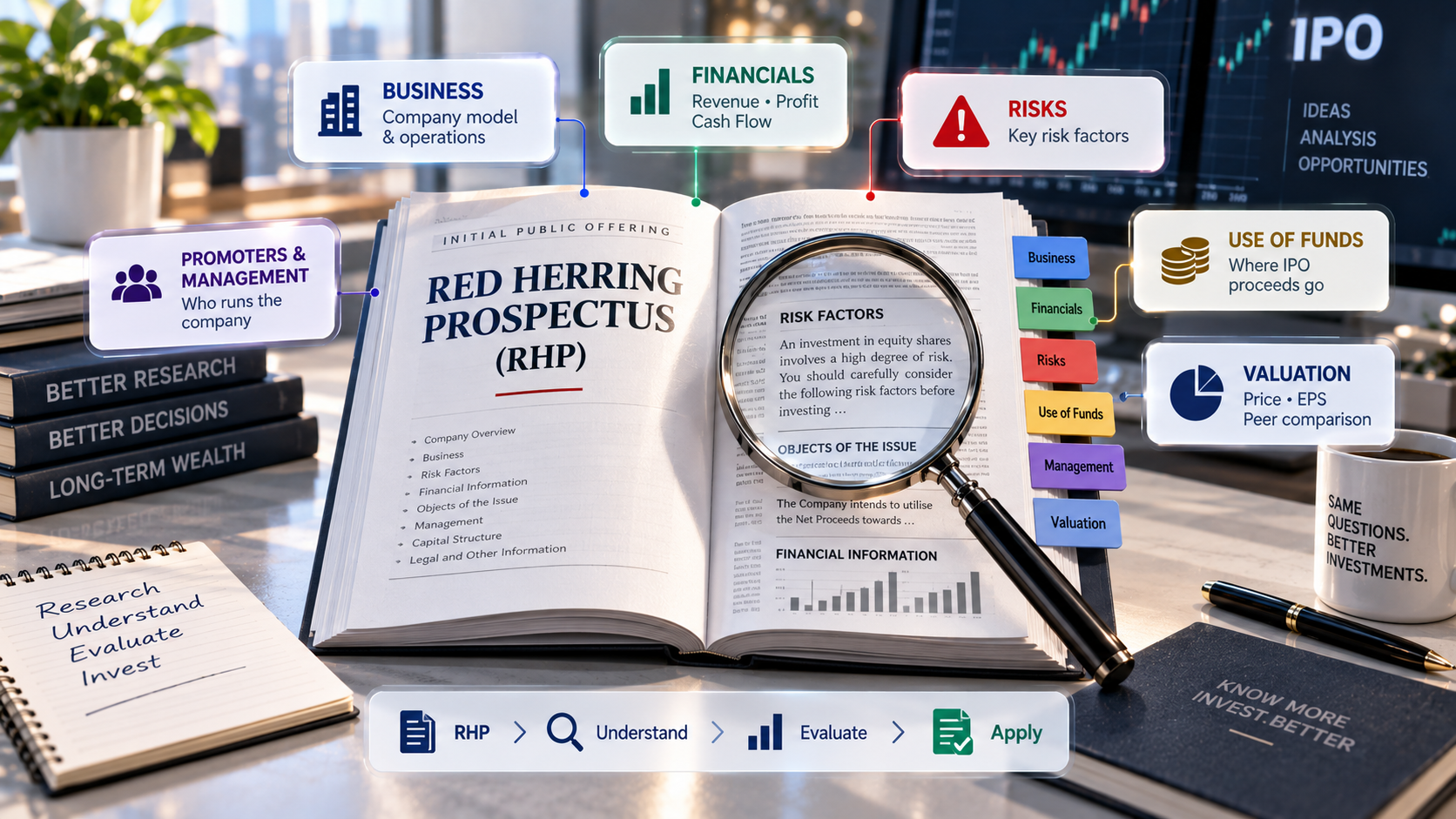
IPO
How to Read an IPO RHP Before Applying
A beginner-friendly guide to reading an IPO Red Herring Prospectus and understanding the key sections investors should review before applying.
Sachin Gadekar
·
24 Sep 2026