How to Use T-Bills and G-Secs to Build a Risk-Free Core in Your Portfolio
14 May 2025 · Sachin Gadekar
Looking for stability in uncertain markets? Learn how to use Treasury Bills (T-Bills) and Government Securities (G-Secs) to build a resilient investment core.
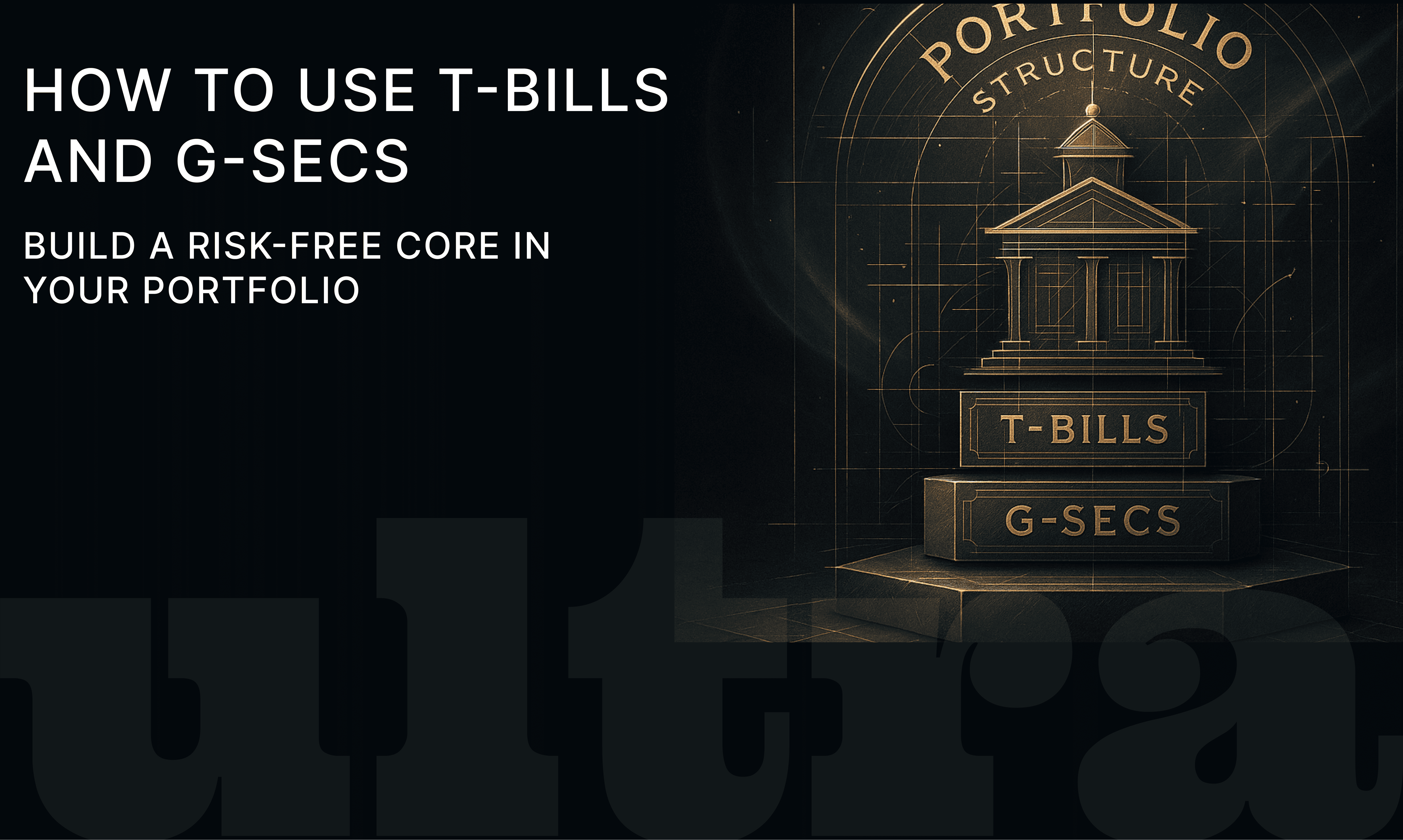
What Are T-Bills and G-Secs?
When it comes to building a robust investment portfolio, not all capital should be exposed to high risk. That’s where risk-free instruments like T-Bills and G-Secs come in. While equity and private assets offer the thrill of growth, T-Bills and G-Secs offer something far more important for long-term planning: stability and predictability.
In this article, we explore how you can strategically use these government-backed securities to anchor your portfolio while keeping liquidity, safety, and tax efficiency in mind.
Treasury Bills (T-Bills) are short-term debt instruments issued by the Government of India with maturities of 91, 182, or 364 days. They are sold at a discount and redeemed at face value—meaning you earn the difference.
Government Securities (G-Secs) are medium to long-term bonds (up to 40 years) issued by the government. They offer regular interest payouts (called coupons) and are considered virtually risk-free due to sovereign backing.
Why They Matter in a Modern Portfolio
These instruments serve as the core of capital preservation strategies. When equity markets fluctuate, these investments remain stable or even gain value as interest rates drop.
Benefits of T-Bills and G-Secs include:
Guaranteed principal and interest (backed by the government)
Predictable returns
Liquidity (tradable on platforms like RBI Retail Direct and NSE/BSE)
Tax efficiency in certain formats
Building a Risk-Free Core with T-Bills and G-Secs
1. Start with Your Time Horizon
T-Bills are ideal for goals within 1 year.
G-Secs are perfect for longer-term stability in goals 5–15 years away.
2. Define the Core Allocation
A common strategy is to keep 15–30% of your portfolio in low-risk assets, depending on your age, risk appetite, and market outlook.
Example: A 30-year-old investor may allocate 20% to G-Secs, while a retiree might go up to 60%.
3. Use Laddering for Stability + Liquidity
You can ladder your G-Secs across different maturities (e.g. 5, 10, 20 years) to ensure regular liquidity and reinvestment opportunities.
4. Consider T-Bills for Emergency Funds
T-Bills can be a smarter alternative to savings accounts or FDs, offering better returns with nearly zero risk.
T-Bills vs G-Secs: Key Differences
| Instrument | Tenure | Return Type | Best For |
|---|---|---|---|
| T-Bills | 91 to 364 days | Discount-based (no interest) | Short-term cash management |
| G-Secs | 1 to 40 years | Coupon (interest paid semi-annually) | Long-term wealth preservation |
When Should You Invest in T-Bills or G-Secs?
| Scenario | Recommendation |
|---|---|
| Parking funds for 3–12 months | T-Bills |
| Creating a stable retirement base | G-Secs with long durations |
| Interest rate drop expected | G-Secs (benefit from price gain) |
| Diversifying equity risk | Both (as fixed-income core) |
Use Case: Blending Ultra with G-Secs
At getultra.club, we believe modern investing blends safety and growth. While we focus on alternative and private assets, we always advocate for a core portfolio layer using risk-free government bonds—which can balance out your exposure to leasing, invoice discounting, or real estate-based fractional assets.
You can:
Park surplus capital in T-Bills for flexibility
Build a retirement core with G-Secs
Layer tax-free instruments like 7.75% RBI Savings Bonds or Tax-Free PSU Bonds if available
Expert Tip
"Don’t treat G-Secs and T-Bills as boring. They’re the foundation upon which smart investors build alpha-driven strategies."
FAQs
Q1. Are G-Secs completely risk-free?
Yes, they carry sovereign backing, making them the safest asset in India. However, market prices may fluctuate due to interest rate changes if sold before maturity.
Q2. Can I buy T-Bills in small amounts?
Absolutely. T-Bills are available in denominations as low as ₹10,000 via RBI Retail Direct or your broker.
Q3. What’s better for emergency funds—FDs or T-Bills?
T-Bills typically offer better returns and liquidity than traditional FDs, making them a smarter short-term choice.
Q4. Is there a lock-in for G-Secs?
There’s no lock-in, but they perform best when held till maturity. You can sell them on exchanges if liquidity is needed.
Recent articles
View all
finance
RBI Repo Rate Hike: October 2026 Policy Update, Impact on Loans, EMIs, Deposits & Markets
A simple guide to the October 2026 RBI repo rate hike, what it means for borrowers, depositors, investors, banks and the broader economy.
Sachin Gadekar
·
08 Oct 2026

IPO
Reliance Jio IPO: Date, Price, GMP, Valuation, Review & Details
A complete guide to Reliance Jio IPO 2026, covering Jio Platforms IPO details, issue size, expected date, price band status, GMP context, shareholder quota, company profile, financials, valuation and risks.
Sachin Gadekar
·
07 Oct 2026

IPO
HD Fire Protect IPO Details: Date, Price, GMP, Review & How to Apply
A complete guide to HD Fire Protect IPO 2026, covering issue size, OFS structure, price band, lot size, GMP context, company profile, financials, risks, valuation and application process.
Sachin Gadekar
·
07 Oct 2026

IPO
Nityas Gems & Jewellery IPO Details: Date, Price, GMP, Review & How to Apply
A complete guide to Nityas Gems & Jewellery IPO 2026, covering issue size, GMP context, price band, lot size, company profile, financials, risks, valuation and application process.
Sachin Gadekar
·
05 Oct 2026