RBI Repo Rate Hike: October 2026 Policy Update, Impact on Loans, EMIs, Deposits & Markets
08 October 2026 · Sachin Gadekar
A simple guide to the October 2026 RBI repo rate hike, what it means for borrowers, depositors, investors, banks and the broader economy.
Quick Answer
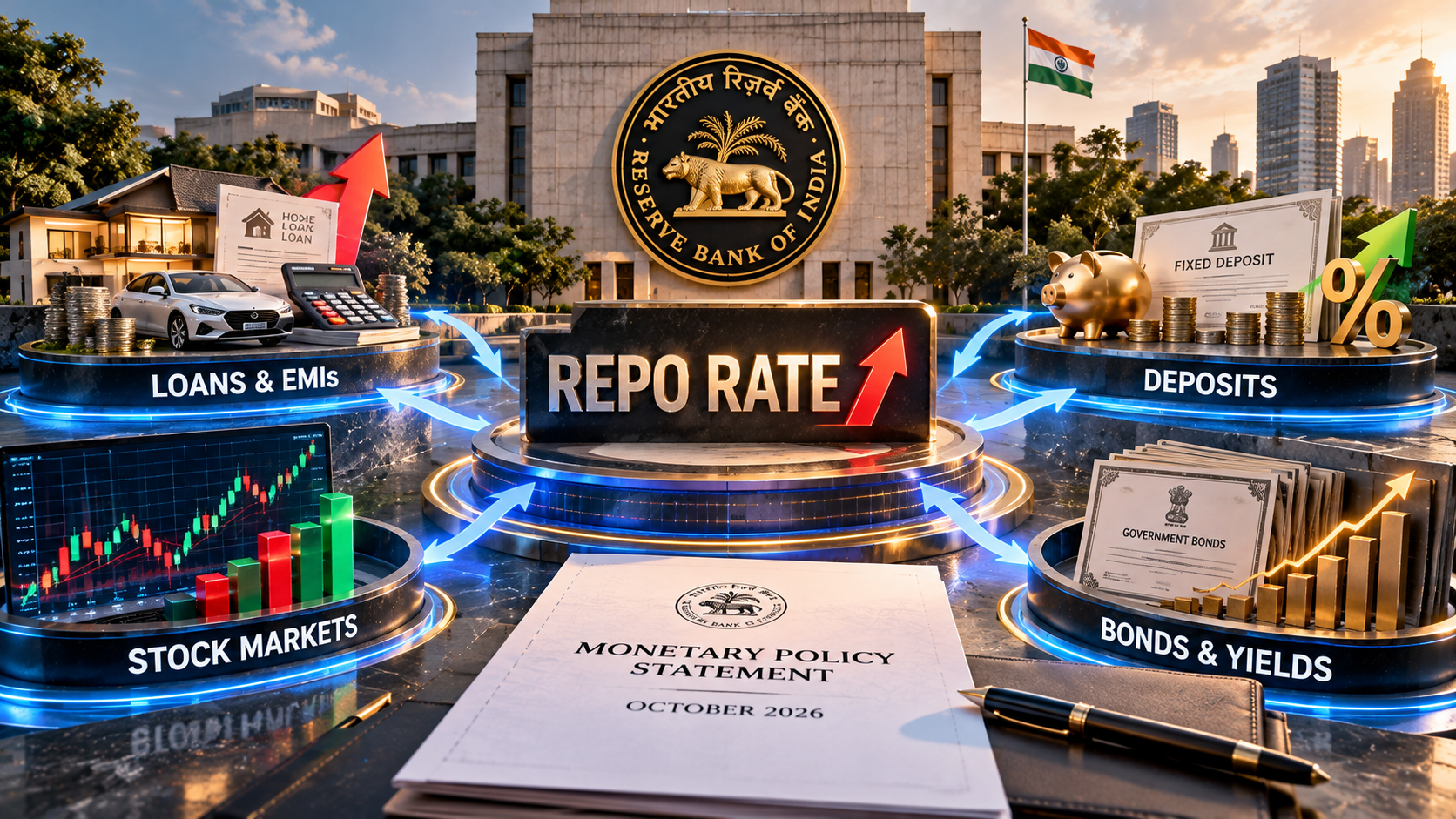
The RBI repo rate hike in October 2026 increased the repo rate by 25 basis points, taking it to 5.5% based on the source details shared. This marked a rate hike after a long pause, with reports describing it as the first repo rate increase after 44 months.
A repo rate hike usually makes borrowing more expensive. It can affect floating-rate home loans, personal loans, business loans, bank deposit rates, bond yields and broader market sentiment.
For borrowers, the immediate impact may come through higher EMIs or longer loan tenures, depending on how banks pass on the rate hike. For savers, deposit rates may gradually become more attractive if banks revise FD and savings rates upward.
The next RBI monetary policy date for 2026 was not provided in the available details. It should be checked from the official RBI MPC calendar once published or updated.
RBI Repo Rate Hike Overview
The Reserve Bank of India, through its Monetary Policy Committee, raised the repo rate by 25 basis points in October 2026, taking the repo rate to 5.5% based on the details shared.
A 25 basis point hike means the repo rate increased by 0.25 percentage points.
Repo rate changes matter because they influence the cost of money in the economy. When the RBI raises the repo rate, banks may face higher borrowing costs. Over time, this can affect loan rates, deposit rates, bond yields and overall liquidity conditions.
For households, the most visible impact is usually on floating-rate loans. For investors, rate hikes can affect debt instruments, bond prices, equity valuations and allocation decisions.
What Changed in the October 2026 RBI Policy
| Particulars | Details |
|---|---|
| Policy Action | Repo rate hike |
| Rate Change | 25 basis points |
| New Repo Rate | 5.5% |
| Previous Repo Rate | 5.25%, based on a 25 bps hike |
| Policy Month | October 2026 |
| Reported Context | First repo rate hike after 44 months, based on the source details shared |
| Immediate Impact Area | Floating-rate loans, deposit rates, bond yields and market sentiment |
The repo rate moved to 5.5% after a 25 bps increase. This means the earlier repo rate was effectively 5.25%, based on the size of the hike.
What Is Repo Rate
The repo rate is the rate at which the Reserve Bank of India lends short-term funds to commercial banks against eligible securities.
When the repo rate rises, borrowing money from the central bank becomes costlier for banks. Banks may then pass on higher costs to customers through higher lending rates.
In simple terms:
higher repo rate usually means loans may become costlier
lower repo rate usually means borrowing may become cheaper
rate changes affect liquidity, inflation, loan growth and savings behaviour
For borrowers, the repo rate is especially important when loans are linked to external benchmarks such as the repo rate.
Why RBI Hikes Repo Rate
The RBI may hike the repo rate when it wants to control inflation, manage liquidity or signal tighter monetary conditions.
A repo rate hike can help reduce excess demand in the economy by making borrowing more expensive. When borrowing slows, spending and credit growth may moderate, which can help manage inflationary pressure.
| Reason | Explanation |
|---|---|
| Inflation Control | Higher rates can help reduce demand-led inflation pressure. |
| Liquidity Management | A rate hike can signal tighter liquidity conditions in the banking system. |
| Currency Stability | Higher rates may support currency stability by improving interest-rate differentials. |
| Credit Growth Management | Costlier borrowing can moderate rapid credit growth. |
| Policy Signalling | A rate hike can signal the central bank’s stance on inflation and macroeconomic stability. |
A repo rate hike does not affect every borrower or investor immediately. The speed and scale of transmission depend on banks, loan types, deposit competition and market conditions.
Impact on Home Loans and EMIs
Home loans linked to floating rates may become costlier after a repo rate hike.
For borrowers, banks may respond in two main ways:
increase the EMI
keep EMI unchanged but extend the loan tenure
The actual impact depends on the loan structure, reset date, spread, outstanding principal and remaining tenure.
| Area | Possible Impact |
|---|---|
| Floating-Rate Home Loans | Interest rates may rise after the reset date. |
| EMI | EMI may increase if the bank revises the loan rate upward. |
| Loan Tenure | Tenure may increase if EMI is kept unchanged. |
| New Borrowers | New loans may be offered at higher rates. |
| Fixed-Rate Loans | Existing fixed-rate loans may not be immediately affected. |
Borrowers should check their loan statement, interest reset schedule and benchmark-linked rate to understand the actual impact.
Impact on Personal Loans and Business Loans
Personal loans, business loans and other retail credit products may also become costlier if banks revise lending rates upward.
However, the impact may differ across loan types.
Secured loans, floating-rate business loans and working capital limits may reflect rate changes faster. Unsecured personal loans may already include higher risk premiums, so the rate movement may vary by lender.
| Loan Type | Possible Impact |
|---|---|
| Home Loan | Floating-rate loans may see higher rates or longer tenure. |
| Personal Loan | New loans may become costlier depending on lender pricing. |
| Business Loan | Working capital and floating-rate facilities may become costlier. |
| Vehicle Loan | New loans may see higher interest rates. |
| Credit Card Debt | Credit card rates are already high and may not move directly with repo rate. |
Impact on Fixed Deposits and Savings
A repo rate hike can be positive for savers if banks increase deposit rates.
However, deposit rate transmission may take time. Banks may revise FD rates depending on liquidity, credit demand and competition for deposits.
| Product | Possible Impact |
|---|---|
| Fixed Deposits | Banks may increase FD rates over time. |
| Savings Accounts | Savings account rates may not move immediately. |
| Recurring Deposits | New RD rates may improve if banks revise deposit rates. |
| Short-Term Deposits | May adjust faster depending on bank funding needs. |
| Long-Term Deposits | Rates may depend on inflation expectations and yield curve movement. |
Depositors should compare rates across tenures and avoid choosing only the highest rate without checking liquidity needs, penalty rules and tax treatment.
Impact on Bonds and Debt Investments
Repo rate hikes can affect bond yields and debt investments.
When interest rates rise, yields on newly issued debt instruments may move higher. Existing bonds with lower coupons may see price adjustments, especially longer-duration bonds.
For debt investors, the impact depends on duration, credit quality, maturity profile and interest-rate sensitivity.
| Area | Possible Impact |
|---|---|
| Bond Yields | Yields may move higher after rate hikes. |
| Bond Prices | Existing bond prices may fall when yields rise. |
| Short-Duration Debt | Generally less sensitive to rate changes than long-duration debt. |
| Long-Duration Debt | More sensitive to interest-rate changes. |
| New Debt Investments | New opportunities may offer higher yields if rates reset upward. |
Impact on Stock Markets
A repo rate hike can influence stock markets because higher interest rates may affect borrowing costs, earnings expectations and valuation multiples.
Rate-sensitive sectors such as banking, NBFCs, real estate, automobiles and capital goods may react more sharply depending on the policy tone and market expectations.
However, market reaction also depends on whether the rate hike was expected, RBI commentary, inflation outlook, global cues and corporate earnings.
| Market Area | Possible Impact |
|---|---|
| Banks and NBFCs | Loan pricing, deposit costs and margins may be affected. |
| Real Estate | Higher home loan rates may affect affordability. |
| Automobiles | Vehicle loan costs may influence demand. |
| Consumer Discretionary | Higher borrowing costs can affect discretionary spending. |
| Debt-Heavy Companies | Higher finance costs may affect profitability. |
A repo rate hike should not be viewed in isolation. Investors should also consider earnings, valuations, sector outlook and macro conditions.
RBI Repo Rate History
The repo rate history helps investors understand how monetary policy has changed over time.
Based on the details shared, the October 2026 policy action took the repo rate to 5.5% after a 25 bps hike.
| Period / Policy Update | Repo Rate | Change | Context |
|---|---|---|---|
| Before October 2026 hike | 5.25% | Previous level based on 25 bps hike | Implied from the October 2026 hike details shared |
| October 2026 policy | 5.5% | +25 bps | RBI repo rate hike after a long pause, based on source details shared |
RBI Monetary Policy Next Date
The RBI monetary policy next date for 2026 was not provided in the details shared.
RBI MPC meetings are usually scheduled in advance, and the official dates are published by the Reserve Bank of India. Investors and borrowers should track the official MPC calendar for the next policy announcement.
| Particulars | Status |
|---|---|
| October 2026 Policy Decision | Repo rate hiked by 25 bps to 5.5%, based on source details shared |
| RBI Monetary Policy Next Date | Not provided in the available details |
| Full RBI MPC Meeting Calendar 2026 | Should be verified from RBI’s official MPC schedule before publication |
What Borrowers Can Do After a Repo Rate Hike
Borrowers do not need to panic after a repo rate hike, but they should review how it affects their loans.
Useful steps include:
check whether the loan is fixed-rate or floating-rate
review the benchmark linked to the loan
check the next interest reset date
ask the lender whether EMI or tenure will change
compare refinancing options only after including charges
consider part-prepayment if suitable
avoid taking high-cost debt without assessing repayment capacity
For long-tenure loans, even a small rate change can affect total interest outgo. Borrowers should review the impact carefully before making changes.
What Investors Can Watch
Investors can track the following after a repo rate hike:
bank FD rate revisions
bond yield movement
short-duration and long-duration debt fund performance
bank and NBFC margin commentary
inflation data
RBI policy stance
liquidity conditions
credit growth
corporate borrowing costs
Rate hikes can affect different asset classes differently. Investors should avoid making decisions only on the basis of a single policy announcement.
Final Thoughts
The October 2026 RBI repo rate hike took the repo rate to 5.5%, based on the details shared. This was a 25 basis point increase and was reported as the first hike after a long pause.
For borrowers, the hike may lead to higher floating loan rates, increased EMIs or longer loan tenures. For savers, deposit rates may improve if banks revise FD rates upward. For investors, the impact can be seen across bonds, debt products, equities and rate-sensitive sectors.
The key is to understand that repo rate changes do not affect everyone in the same way. The actual impact depends on loan type, bank transmission, investment horizon, risk profile and broader market conditions.
Disclaimer: This article is for educational and informational purposes only. It is not investment advice, lending advice or a recommendation to buy, sell or switch any financial product. Policy rates, loan rates, deposit rates and market conditions can change. Readers should verify official RBI updates and consult a qualified financial advisor before making financial decisions.
FAQs
1. What is the RBI repo rate hike in October 2026?
Based on the details shared, RBI hiked the repo rate by 25 basis points in October 2026, taking it to 5.5%.
2. What is the current repo rate after the October 2026 hike?
The repo rate is 5.5% after the October 2026 hike, based on the available details.
3. By how much did RBI hike the repo rate?
RBI hiked the repo rate by 25 basis points, or 0.25 percentage points.
4. What was the repo rate before the hike?
Based on a 25 bps hike to 5.5%, the previous repo rate was 5.25%.
5. Why did RBI hike the repo rate?
RBI may hike the repo rate to manage inflation, liquidity and credit growth. The exact policy reasoning should be checked from the official MPC statement.
6. Will home loan EMIs increase after the repo rate hike?
Floating-rate home loans may become costlier if banks pass on the rate hike. EMIs may rise, or the loan tenure may increase depending on the lender.
7. Will personal loans become costlier?
New personal loans may become costlier if lenders revise rates upward. Existing loan impact depends on whether the loan is fixed-rate or floating-rate.
8. Will FD rates increase after the repo rate hike?
FD rates may increase if banks revise deposit rates. However, deposit rate changes may happen gradually and differ across banks and tenures.
9. How does a repo rate hike affect bonds?
When rates rise, bond yields may increase and prices of existing bonds may fall, especially longer-duration bonds.
10. How does a repo rate hike affect stock markets?
A repo rate hike can affect market sentiment, borrowing costs and valuation multiples. Rate-sensitive sectors such as banks, NBFCs, real estate and automobiles may react more sharply.
11. What is the RBI monetary policy next date?
The RBI monetary policy next date for 2026 was not provided in the available details. It should be verified from the official RBI MPC calendar.
12. Where can I check RBI MPC meeting dates 2026?
RBI MPC meeting dates should be checked from the official Reserve Bank of India monetary policy calendar.
13. What is repo rate?
Repo rate is the rate at which RBI lends short-term funds to commercial banks against eligible securities.
14. What is the difference between repo rate and reverse repo rate?
Repo rate is the rate at which RBI lends to banks. Reverse repo rate is the rate at which RBI absorbs liquidity from banks.
15. Is a repo rate hike good or bad?
A repo rate hike should not be seen as simply good or bad. It can make loans costlier for borrowers but may improve deposit rates for savers. The impact depends on individual financial situations.
16. What should borrowers do after a repo rate hike?
Borrowers should check their loan type, benchmark rate, reset date, EMI impact and total interest outgo before making any refinancing or prepayment decision.
Recent articles
View all
IPO
Reliance Jio IPO: Date, Price, GMP, Valuation, Review & Details
A complete guide to Reliance Jio IPO 2026, covering Jio Platforms IPO details, issue size, expected date, price band status, GMP context, shareholder quota, company profile, financials, valuation and risks.
Sachin Gadekar
·
07 Oct 2026

IPO
HD Fire Protect IPO Details: Date, Price, GMP, Review & How to Apply
A complete guide to HD Fire Protect IPO 2026, covering issue size, OFS structure, price band, lot size, GMP context, company profile, financials, risks, valuation and application process.
Sachin Gadekar
·
07 Oct 2026

IPO
Nityas Gems & Jewellery IPO Details: Date, Price, GMP, Review & How to Apply
A complete guide to Nityas Gems & Jewellery IPO 2026, covering issue size, GMP context, price band, lot size, company profile, financials, risks, valuation and application process.
Sachin Gadekar
·
05 Oct 2026

IPO
Orient Cables IPO Date, Price, GMP, Review & Details
A complete guide to Orient Cables IPO 2026, covering issue size, GMP context, price band, lot size, subscription status, company profile, financials, risks and application process.
Sachin Gadekar
·
30 Sep 2026