Senior Citizen FD vs SCSS vs Post Office FD: Which Is Better in 2026?
14 August 2026 · Sandeep Jain
A detailed comparison of Senior Citizen Fixed Deposits, Senior Citizens’ Savings Scheme and Post Office Time Deposits for retirees and conservative investors in India.
Quick Overview
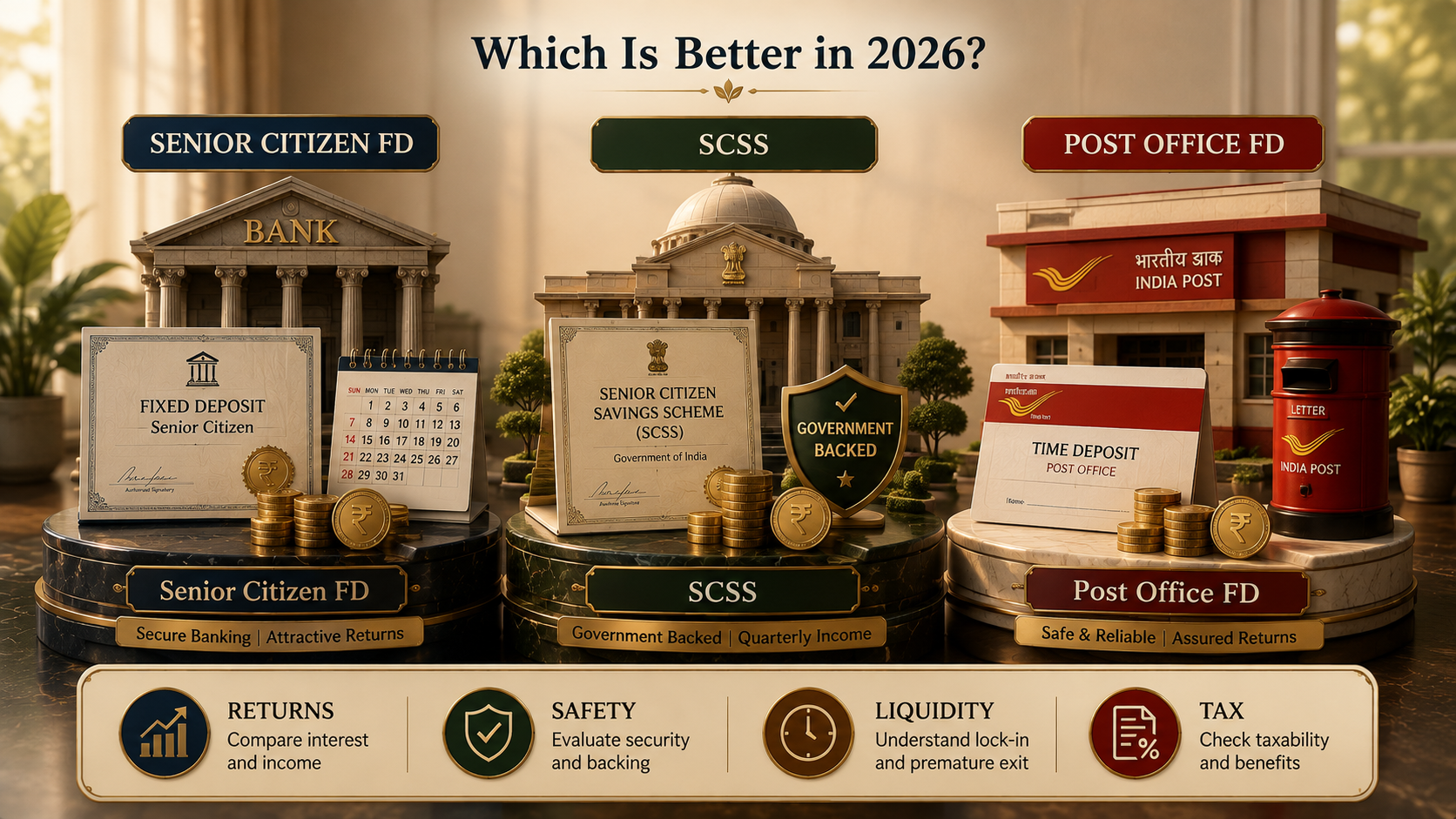
For senior citizens in India, Senior Citizen FD, SCSS and Post Office FD are three commonly compared fixed-income options. Each serves a different purpose.
A Senior Citizen FD may suit retirees who want flexible tenure, bank convenience and regular or cumulative interest options.
The Senior Citizens’ Savings Scheme, or SCSS, may suit eligible senior citizens who want a government-backed retirement income product with quarterly payouts and tax benefit under Section 80C, subject to scheme rules.
A Post Office FD, officially known as a Post Office Time Deposit, may suit conservative investors who prefer government-backed fixed deposits with tenure choices of 1 year, 2 years, 3 years and 5 years.
In simple terms:
Choose Senior Citizen FD if you want flexibility and bank convenience.
Choose SCSS if you are eligible and want a retirement-focused quarterly income product.
Choose Post Office FD if you want a simple government-backed deposit with fixed tenure options.
There is no single best option for everyone. The right choice depends on age, income requirement, tax planning, investment horizon, liquidity need and risk preference.
For a broader fixed-income view, you can also read Ultra’s guide on Best Fixed Income Investment Options in India 2026.
Senior Citizen FD vs SCSS vs Post Office FD: Overview
Senior citizens usually look for three things from fixed-income investments: capital protection, regular income and predictable returns. This is why bank FDs, SCSS and Post Office FDs are often compared.
However, these products are not identical.
A Senior Citizen FD is a bank or financial institution deposit available to eligible senior citizens, usually with a slightly higher interest rate than regular FD rates.
SCSS is a government-backed small savings scheme designed specifically for senior citizens and eligible retirees.
Post Office FD is a government-backed time deposit available through post offices, with fixed tenure options and annual interest payout.
The comparison should not be based only on interest rate. Investors should also compare safety, lock-in, tax treatment, income payout, premature withdrawal rules and suitability.
What Is a Senior Citizen FD?
A Senior Citizen Fixed Deposit is a fixed deposit offered by banks and some financial institutions to individuals above a specified age, usually 60 years and above.
Senior citizen FDs generally offer a higher rate than regular bank FDs. The additional rate varies from bank to bank.
Key Features of Senior Citizen FD
Offered by banks and eligible financial institutions
Usually available for individuals aged 60 years and above
Fixed interest rate at the time of booking
Senior citizens may get an additional rate benefit
Flexible tenure options
Monthly, quarterly, annual or cumulative payout options may be available
Premature withdrawal may be allowed with penalty
Interest is taxable as per income tax slab
Senior Citizen FDs may be suitable for retirees who want simple bank-based deposits with flexible tenure and payout choices.
Investors comparing FDs with other fixed-income options can also read Bonds vs Fixed Deposits: Returns, Risks and Tax Comparison.
What Is SCSS?
The Senior Citizens’ Savings Scheme, or SCSS, is a government-backed savings scheme designed for senior citizens and eligible retirees.
SCSS is commonly used by retirees because it offers periodic interest payout and a defined maturity period. It is generally seen as a retirement-income product rather than a short-term parking option.
Key Features of SCSS
Government-backed small savings scheme
Designed for senior citizens and eligible retirees
Fixed maturity period
Quarterly interest payout
Investment may qualify for Section 80C tax benefit, subject to limits
Interest is taxable as per applicable tax rules
Premature closure is allowed subject to scheme conditions and penalties
Investment limit applies as per scheme rules
SCSS may suit eligible senior citizens who want a retirement-focused income product with a government-backed structure.
What Is a Post Office FD?
A Post Office FD is officially known as a Post Office Time Deposit. It is offered under the National Savings Time Deposit scheme through India Post.
Post Office Time Deposits are available for fixed tenures such as 1 year, 2 years, 3 years and 5 years. Based on the Post Office FD details we used earlier, the rates for the January to March 2026 quarter were:
1-year Post Office FD: 6.90% p.a.
2-year Post Office FD: 7.00% p.a.
3-year Post Office FD: 7.10% p.a.
5-year Post Office FD: 7.50% p.a.
These rates are subject to periodic revision by the government, so investors should check the latest applicable rates before investing.
For a detailed rate-wise guide, read Post Office FD Interest Rates 2026.
Key Features of Post Office FD
Government-backed time deposit
Tenure options of 1 year, 2 years, 3 years and 5 years
Minimum investment starts from ₹1,000
Further deposits can usually be made in multiples of ₹100
Interest is calculated quarterly and paid annually
5-year Post Office FD may qualify under Section 80C
Premature withdrawal is allowed only as per scheme rules
Nomination facility is available
Post Office FD may suit conservative investors who prefer government-backed deposits and do not need frequent interest payouts.
Senior Citizen FD vs SCSS vs Post Office FD Comparison
| Factor | Senior Citizen FD | SCSS | Post Office FD |
|---|---|---|---|
| Product Type | Bank or financial institution deposit | Government-backed small savings scheme | Government-backed time deposit |
| Designed For | Senior citizens, usually 60 years and above | Senior citizens and eligible retirees | General investors, including senior citizens |
| Tenure | Flexible; varies by bank | Fixed scheme tenure, subject to extension rules | 1 year, 2 years, 3 years and 5 years |
| Interest Payout | Monthly, quarterly, annual or cumulative options may be available | Quarterly payout | Annual payout |
| Tax Benefit | 5-year tax-saving FD may qualify under Section 80C | Investment may qualify under Section 80C, subject to limits | 5-year Post Office FD may qualify under Section 80C |
| Liquidity | Premature withdrawal usually possible with penalty | Premature closure allowed subject to scheme rules | Premature withdrawal allowed only as per scheme rules |
| Safety | Depends on bank or institution | Government-backed | Government-backed |
| Best For | Flexibility and bank convenience | Retirement income through quarterly payout | Simple government-backed deposit |
Interest Rate Comparison
Interest rates can change across banks, schemes and quarters. Therefore, investors should avoid assuming that one product will always offer the highest return.
Senior Citizen FD rates vary by bank, tenure and deposit amount. Banks often offer an additional senior citizen rate over regular FD rates.
SCSS rates are notified by the government and may be reviewed periodically. The scheme is often attractive for retirees because of its government-backed structure and quarterly payout.
Post Office FD rates are also notified for specific periods and may change over time. For the January to March 2026 period, the 5-year Post Office FD rate mentioned earlier was 7.50% p.a.
| Factor | Senior Citizen FD | SCSS | Post Office FD |
|---|---|---|---|
| Rate Type | Bank-specific fixed deposit rate | Government-notified scheme rate | Government-notified time deposit rate |
| Rate Revision | Changed by banks from time to time | Reviewed periodically by the government | Reviewed periodically by the government |
| Senior Citizen Benefit | Usually offers additional senior citizen rate | Scheme itself is designed for senior citizens | No separate senior citizen rate in the standard Post Office Time Deposit structure |
| Payout Style | Flexible payout options may be available | Quarterly payout | Annual payout |
Interest Rate Takeaway
Senior Citizen FD may offer flexibility across banks. SCSS may be attractive for retirees who want quarterly income. Post Office FD may be suitable for conservative investors who prefer government-backed fixed deposit options.
Safety Comparison
Safety is a major factor for senior citizens. However, “safe” should not be used casually. Investors should understand who backs the product.
SCSS and Post Office FD are government-backed small savings products. Senior Citizen FDs are issued by banks or eligible financial institutions, so investors should check the bank’s strength, deposit insurance framework and terms before investing.
| Safety Factor | Senior Citizen FD | SCSS | Post Office FD |
|---|---|---|---|
| Backing | Bank or financial institution | Government-backed | Government-backed |
| Issuer Risk | Depends on bank or institution | Linked to government small savings scheme structure | Linked to government small savings scheme structure |
| Market Price Risk | No daily market price movement | No daily market price movement | No daily market price movement |
| Investor Check | Check bank quality and premature withdrawal rules | Check eligibility, limit and withdrawal rules | Check current rates and scheme rules |
Safety Takeaway
SCSS and Post Office FD may appeal to investors who prefer government-backed products. Senior Citizen FD may still be suitable, especially with strong banks, but investors should evaluate the institution and terms carefully.
Tax Benefits
Tax treatment can change the final return for senior citizens.
Senior Citizen FD Taxation
Interest from Senior Citizen FDs is generally taxable as per the investor’s income tax slab. TDS may apply if interest exceeds the applicable threshold. A 5-year tax-saving bank FD may qualify under Section 80C, subject to limits.
SCSS Taxation
Investment in SCSS may qualify for deduction under Section 80C, subject to the applicable limit. However, interest earned from SCSS is generally taxable as per the investor’s income tax slab.
Post Office FD Taxation
Interest from Post Office FD is generally taxable. The 5-year Post Office Time Deposit may qualify for Section 80C deduction, subject to limits.
| Tax Factor | Senior Citizen FD | SCSS | Post Office FD |
|---|---|---|---|
| Tax on Interest | Generally taxable as per slab | Generally taxable as per slab | Generally taxable as per slab |
| Section 80C Benefit | 5-year tax-saving FD may qualify | Investment may qualify, subject to limits | 5-year Post Office FD may qualify |
| TDS | May apply based on interest threshold and rules | May apply based on interest threshold and rules | May apply as per applicable rules |
| Tax Planning Use | Useful for tax-saving only if 5-year tax-saving FD is chosen | Useful for eligible retirees seeking 80C-linked retirement product | Useful if choosing 5-year Post Office FD for 80C benefit |
Tax Takeaway
SCSS and 5-year tax-saving FDs can help with Section 80C planning, but the interest is generally taxable. Senior citizens should compare post-tax returns, not only headline rates.
Liquidity and Withdrawal Rules
Liquidity is important for retirees because medical, family or emergency expenses can arise unexpectedly.
Senior Citizen FDs usually offer premature withdrawal, but banks may charge a penalty or apply a lower interest rate.
SCSS allows premature closure only as per scheme rules. Penalties may apply depending on when the account is closed.
Post Office FD premature withdrawal is also governed by scheme rules. Based on the Post Office FD details used earlier, deposits can be withdrawn only after 6 months, and the interest treatment depends on the tenure completed.
| Liquidity Factor | Senior Citizen FD | SCSS | Post Office FD |
|---|---|---|---|
| Premature Withdrawal | Usually allowed, subject to bank penalty | Allowed subject to scheme rules and penalties | Allowed only as per scheme rules |
| Best For Liquidity | Better if easy early withdrawal is important | Better for planned retirement income, not frequent withdrawals | Better for fixed tenure planning |
| Penalty Risk | Penalty or lower rate may apply | Penalty may apply based on closure timing | Lower applicable rate may apply on early closure |
| Investor Action | Check premature withdrawal penalty before booking | Check closure rules before investing | Check scheme rules before opening account |
Liquidity Takeaway
Senior Citizen FD may be better if liquidity and early access are important. SCSS and Post Office FD may be better when the investor can follow the scheme tenure and withdrawal rules.
Which Option Suits Which Investor?
| Investor Need | Option to Consider | Reason |
|---|---|---|
| Regular quarterly retirement income | SCSS | Designed for senior citizens with quarterly payout |
| Flexible tenure and bank convenience | Senior Citizen FD | Banks offer multiple tenure and payout choices |
| Government-backed fixed deposit | Post Office FD | Post Office Time Deposit is government-backed |
| Section 80C planning | SCSS, 5-year bank FD or 5-year Post Office FD | These may qualify under Section 80C, subject to limits |
| Annual interest payout | Post Office FD | Post Office FD interest is generally paid annually |
| Monthly interest payout | Senior Citizen FD | Many banks offer monthly payout options |
| Retirement-focused government scheme | SCSS | SCSS is specifically designed for senior citizens and eligible retirees |
Can You Invest in All Three?
Yes. Senior citizens do not always need to choose only one option. A retiree may use all three for different goals.
For example:
SCSS for quarterly retirement income
Senior Citizen FD for flexible tenure and emergency liquidity
Post Office FD for government-backed deposit allocation
Debt funds or bonds for investors who understand additional risks and want broader fixed-income exposure
Investors comparing traditional deposits with other fixed-income products can also read Corporate FD vs Bank FD vs Bonds: Which Is Better in 2026?.
A balanced approach may be more practical than putting the full retirement corpus into one product.
Key Risks to Check
1. Reinvestment Risk
When a deposit or scheme matures, the investor may need to reinvest at a lower interest rate.
2. Tax Risk
The post-tax return may be lower than the headline rate, especially if the senior citizen has taxable income.
3. Liquidity Risk
SCSS and Post Office FD may not be ideal for frequent withdrawals. Senior Citizen FD may offer better liquidity but with penalties.
4. Inflation Risk
Fixed-income returns may not always beat inflation after tax.
5. Concentration Risk
Investing too much in one product can reduce flexibility. Diversification across products and tenures may help.
Final Verdict
Senior Citizen FD, SCSS and Post Office FD are all useful fixed-income options, but they serve different needs.
Senior Citizen FD may be better for investors who want flexible tenure, bank convenience and payout choices.
SCSS may be better for eligible senior citizens who want a government-backed retirement income scheme with quarterly payouts.
Post Office FD may be better for conservative investors who want a simple government-backed deposit with 1-year, 2-year, 3-year and 5-year tenure choices.
The best option depends on the investor’s goal.
For regular retirement income, SCSS may be a strong option. For flexibility, Senior Citizen FD may work better. For government-backed fixed deposits, Post Office FD may be suitable.
Instead of choosing only by interest rate, senior citizens should compare:
current applicable rate
payout frequency
tax benefit
post-tax return
liquidity
premature withdrawal rules
investment limit
safety and backing
tenure suitability
For many retirees, a mix of SCSS, Senior Citizen FD and Post Office FD may be more useful than choosing only one.
Disclaimer: This article is for educational and informational purposes only and should not be treated as investment, tax or retirement planning advice. Interest rates, scheme rules, tax rules and eligibility conditions may change. Investors should verify the latest official rates and consult a qualified financial advisor or tax advisor before making any investment decision.
FAQs
1. Which is better for senior citizens: FD, SCSS or Post Office FD?
SCSS may suit senior citizens who want quarterly retirement income. Senior Citizen FD may suit those who want bank convenience and flexible tenure. Post Office FD may suit conservative investors who prefer government-backed deposits.
2. Is SCSS better than Senior Citizen FD?
SCSS may be better for eligible retirees who want a government-backed scheme with quarterly payout. Senior Citizen FD may be better if the investor wants flexible tenure, bank access and different payout options.
3. Is Post Office FD better than bank FD for senior citizens?
Post Office FD is government-backed and offers fixed tenure options. Bank FDs may offer more flexibility and senior citizen rate benefits. The better option depends on rate, tenure, payout and liquidity needs.
4. Does SCSS offer monthly income?
SCSS generally provides quarterly interest payout, not monthly payout. Investors who need monthly income may compare Senior Citizen FDs with monthly payout options.
5. Does Post Office FD offer monthly payout?
Post Office FD generally pays interest annually. It may not be suitable for investors who need monthly cash flow.
6. Is SCSS interest taxable?
Yes. SCSS interest is generally taxable as per the investor’s applicable income tax slab.
7. Is Senior Citizen FD interest taxable?
Yes. Interest from Senior Citizen FDs is generally taxable as per the investor’s income tax slab. TDS may apply if interest crosses the applicable threshold.
8. Does Post Office FD qualify for Section 80C?
The 5-year Post Office Time Deposit may qualify for Section 80C deduction, subject to applicable limits and rules.
9. Does SCSS qualify for Section 80C?
Investment in SCSS may qualify for Section 80C deduction, subject to applicable limits and rules.
10. Can senior citizens invest in both SCSS and FD?
Yes. Senior citizens may invest in both SCSS and FDs for different goals, such as quarterly income, liquidity, tax planning and capital preservation.
11. Which option is best for regular income after retirement?
SCSS may be useful for quarterly income. Senior Citizen FDs may be useful for monthly or quarterly payout, depending on bank options. The right choice depends on income frequency and liquidity needs.
12. Should senior citizens choose only the highest interest rate?
No. Senior citizens should compare safety, tax, payout, liquidity and premature withdrawal rules along with the interest rate. A higher rate may not always mean better suitability.
Recent articles
View all
IPO
Orient Cables IPO Date, Price, GMP, Review & Details
A complete guide to Orient Cables IPO 2026, covering issue size, GMP context, price band, lot size, subscription status, company profile, financials, risks and application process.
Sachin Gadekar
·
30 Sep 2026

IPO
A-One Steels IPO Date, Price, GMP, Review & Details
A complete guide to A-One Steels IPO 2026, covering issue size, GMP context, price band, lot size, subscription status, company profile, financials, risks and application process.
Sachin Gadekar
·
29 Sep 2026

IPO
Moneyview IPO GMP Details: Date, Price Band, Subscription Status, Review & How to Apply
A complete guide to Moneyview IPO 2026, covering issue size, GMP context, price band, issue price, lot size, subscription status, company profile, financials, risks and application process.
Sachin Gadekar
·
28 Sep 2026

IPO
How to Read an IPO RHP Before Applying
A beginner-friendly guide to reading an IPO Red Herring Prospectus and understanding the key sections investors should review before applying.
Sachin Gadekar
·
24 Sep 2026