Pre-IPO vs IPO: Key Differences, Risks and Investor Suitability
19 August 2026 · Sachin Gadekar
A simple guide to Pre-IPO and IPO investing, covering how they work, key differences, risks, pricing, liquidity, allotment, listing and which option may suit different investor profiles.

Pre-IPO vs IPO: Overview
Pre-IPO and IPO are often discussed together because both relate to companies that are either unlisted or close to listing. However, they are not the same type of investment.
A Pre-IPO investment usually happens before a company lists on the stock exchange. Investors buy shares in the unlisted market, often from existing shareholders, employees or early investors.
An IPO is a formal public issue where the company offers shares to the public through a regulated process. After the IPO, the shares are listed on the stock exchange, subject to successful completion of the issue and listing approvals.
The biggest differences between Pre-IPO and IPO are:
access
pricing
liquidity
information availability
risk level
allotment process
regulatory disclosures
investor suitability
For example, investors tracking IPOs such as Horizon Industrial Parks IPO Details or Lalithaa Jewellery Mart IPO Details are usually evaluating public issue opportunities. On the other hand, investors exploring unlisted company shares may be looking at the Pre-IPO market.
What Is Pre-IPO Investing?
Pre-IPO investing means investing in the shares of a company before it becomes publicly listed.
These shares are not traded on NSE or BSE like listed shares. Instead, they are typically bought through private market routes, unlisted share platforms, employee exits or existing shareholder sales, subject to applicable laws and eligibility.
Pre-IPO investing is common in companies that are expected to list in the future, but listing is not guaranteed.
Key Features of Pre-IPO Investing
Shares are usually unlisted
Access may be limited
Liquidity can be low
Valuation may be difficult to verify
Public disclosures may be limited
Exit may depend on listing, buyback or secondary sale
Pricing may vary across sellers and platforms
Investment horizon may be longer
Pre-IPO investing may sound attractive because investors get access before public listing, but early access also means higher uncertainty
What Is an IPO?
An IPO, or Initial Public Offering, is the process through which a company offers its shares to the public for the first time and gets listed on the stock exchange.
In India, IPOs are issued through a formal process involving the company, merchant bankers, exchanges, registrar and regulatory disclosures. Investors apply during the IPO subscription window, and shares are allotted based on demand and category rules.
After allotment and listing, shares can usually be bought and sold on the stock exchange, subject to market conditions.
Key Features of IPO Investing
Public issue open to eligible investors
Price band or fixed price is disclosed
RHP and IPO documents provide detailed information
Allotment process is formal
Shares list on NSE, BSE or SME exchange, depending on the issue
Post-listing liquidity may be available
Listing price can be volatile
Allotment is not guaranteed
IPO investing is generally more accessible than Pre-IPO investing, especially for retail investors.
Pre-IPO vs IPO Comparison
| Factor | Pre-IPO | IPO |
|---|---|---|
| Meaning | Buying shares of an unlisted company before public listing | Applying for shares in a public issue before listing |
| Market Type | Private or unlisted market | Public issue market |
| Access | May be limited to eligible investors, platforms or private transactions | Available to retail, HNI, QIB and other eligible categories |
| Information Availability | Limited public information in many cases | RHP and public disclosures are available |
| Pricing | Price may vary by seller, platform and demand | Price band or issue price is disclosed |
| Liquidity | Usually low before listing | Liquidity may be available after listing |
| Allotment | Depends on availability of unlisted shares | Depends on IPO subscription and allotment rules |
| Risk Level | Higher due to liquidity, valuation and listing uncertainty | Lower than Pre-IPO in transparency, but still carries market and valuation risk |
| Suitable For | Investors with higher risk appetite and longer holding period | Investors seeking regulated public issue access |
Pricing and Valuation
Pricing works very differently in Pre-IPO and IPO investments.
In a Pre-IPO transaction, the price is usually decided privately between buyer and seller, or through an unlisted share platform. The same company’s shares may be available at different prices depending on seller demand, supply, market sentiment and expected listing timeline.
In an IPO, the company announces a price band or fixed price. Investors apply within the price range, and the final issue price is decided as per the issue process.
Why Pricing Matters
A company may be attractive, but the investment may still be risky if the price is too high. This applies to both Pre-IPO and IPO investing.
| Pricing Factor | Pre-IPO | IPO |
|---|---|---|
| Price Discovery | Private negotiation or platform-driven pricing | Book-building or fixed-price mechanism |
| Transparency | May be limited | Price band and issue documents are publicly available |
| Valuation Comparison | Can be difficult due to limited data | Can be compared using RHP, peers and financials |
| Price Variation | May vary between sellers and platforms | Same issue price for allotted investors, subject to category and final price |
Pricing Takeaway
Pre-IPO investors must be careful about overpaying for unlisted shares. IPO investors should also evaluate valuation instead of applying only because of hype, GMP or subscription numbers.
Liquidity and Lock-in
Liquidity is one of the biggest differences between Pre-IPO and IPO.
Pre-IPO shares are usually illiquid. This means it may be difficult to sell them quickly before the company lists. Exit may depend on finding a buyer, company buyback, future listing or another permitted transaction.
IPO shares may become liquid after listing on NSE or BSE. However, liquidity depends on market demand, listing performance and trading volume.
Pre-IPO shares may also be subject to holding restrictions or lock-in depending on the route, shareholder category, timing and applicable regulations. Investors should check these terms before buying.
| Factor | Pre-IPO | IPO |
|---|---|---|
| Liquidity Before Listing | Usually low | Not applicable until shares are allotted and listed |
| Liquidity After Listing | May improve after listing, subject to lock-in and market demand | Usually available after listing, subject to market liquidity |
| Exit Certainty | No guaranteed exit | Exchange-based exit may be available after listing |
| Lock-in | May apply depending on route and regulations | Usually no retail lock-in after listing, except specific categories or issue terms |
Liquidity Takeaway
Pre-IPO may require a longer holding period and patience. IPOs may provide faster liquidity after listing, but listing gains are not guaranteed.
Risk Comparison
Pre-IPO and IPO investments both carry risk, but the type and level of risk differ.
Pre-IPO carries higher uncertainty because the company is not yet publicly listed. Investors may have limited access to financials, valuation details and exit options.
IPO investing has more formal disclosures, but it still carries market risk, valuation risk and listing risk.
| Risk Type | Pre-IPO | IPO |
|---|---|---|
| Liquidity Risk | High; exit may be difficult before listing | Lower after listing, but depends on trading activity |
| Valuation Risk | High; pricing may be difficult to verify | Present; issue may be expensive compared to fundamentals |
| Information Risk | High; public disclosures may be limited | Lower; RHP and offer documents are available |
| Listing Risk | High; listing may be delayed or may not happen | Present; listing may happen below issue price |
| Regulatory Risk | May apply depending on transaction route and compliance | Issue follows public market regulations, but still carries compliance-related risks |
| Market Risk | May affect future exit value | Affects listing price and post-listing performance |
Risk Takeaway
Pre-IPO may offer early access but comes with higher liquidity and information risk. IPOs are more transparent, but they still require careful evaluation
Information Availability
IPO investors usually get access to more formal information than Pre-IPO investors.
For IPOs, the RHP or offer document includes details such as:
company business model
financial statements
objects of the issue
risk factors
promoters and management
litigation
industry overview
peer comparison
valuation-related information
For Pre-IPO investments, information may be limited, delayed or not publicly available in the same format. Investors may rely on platform data, company filings, past financials or secondary market information.
| Information Factor | Pre-IPO | IPO |
|---|---|---|
| Offer Document | Usually not available like an IPO RHP | RHP or offer document is available |
| Financial Data | May be limited or less frequent | Detailed financials are disclosed |
| Risk Factors | May not be available in structured public format | Risk factors are formally disclosed |
| Peer Comparison | May be difficult | Often easier due to public disclosures |
Information Takeaway
IPO investing offers better access to structured public information. Pre-IPO investing requires extra due diligence because information may be limited.
Tax Treatment
Tax treatment can differ based on whether shares are listed or unlisted, holding period, investor category and current tax rules.
In general, Pre-IPO shares are usually unlisted before listing. Tax treatment on sale may depend on whether the shares are sold before or after listing and how long they are held.
IPO shares become listed after listing, and capital gains tax may apply depending on the holding period and sale price.
Investors should not rely on simplified tax assumptions. It is better to consult a tax advisor before making large Pre-IPO or IPO-related investments.
| Tax Factor | Pre-IPO | IPO |
|---|---|---|
| Share Status | Usually unlisted before listing | Listed after IPO listing |
| Capital Gains | Depends on holding period, sale timing and whether shares are listed or unlisted at sale | Depends on holding period and listed share tax rules |
| Documentation | Transaction documentation is important | Broker and demat records are usually available |
| Investor Action | Consult a tax advisor before sale or transfer | Track allotment, sale date and capital gains |
Who Should Consider Pre-IPO?
Pre-IPO may suit investors who:
understand unlisted share risk
can hold for a longer period
do not need immediate liquidity
can evaluate company quality with limited information
understand valuation uncertainty
are comfortable with listing uncertainty
can verify transaction documentation
want early access before a possible IPO
Pre-IPO may not suit investors who:
need quick liquidity
are new to equity investing
depend only on market rumours
cannot evaluate valuation
want guaranteed listing gains
cannot tolerate capital loss
Investors exploring company-specific opportunities can also read Ultra’s Pre-IPO articles such as OYO, boAt, NSE, Tata Capital and other unlisted share explainers when available on the blog.
Who Should Consider IPO?
IPO investing may suit investors who:
want access through a public issue
prefer formal disclosures
want post-listing liquidity
can evaluate RHP and financials
understand listing volatility
are comfortable with allotment uncertainty
want to participate in a company’s public listing journey
IPO may not suit investors who:
apply only because of GMP
expect guaranteed listing gains
do not read risk factors
cannot handle listing below issue price
invest without understanding valuation
Recent IPO detail articles like Horizon Industrial Parks IPO Details and Lalithaa Jewellery Mart IPO Details can help investors understand how IPO data such as price band, lot size, issue size, allotment and listing date is usually evaluated.
Pre-IPO vs IPO: Which Is Better?
| Investor Type | Option to Consider | Reason |
|---|---|---|
| Beginner investor | IPO | More public information and easier access |
| Investor seeking early access | Pre-IPO | Access before public listing, but with higher risk |
| Investor needing liquidity | IPO | Shares may be tradable after listing |
| Investor with long holding period | Pre-IPO or IPO | Depends on valuation, company quality and risk appetite |
| Investor relying on formal disclosures | IPO | RHP and public issue documents are available |
| Investor comfortable with illiquidity | Pre-IPO | May accept longer exit timelines and listing uncertainty |
Checklist Before Investing
| Question | Why It Matters |
|---|---|
| Do I understand the company’s business model? | Business quality affects long-term performance |
| Is the valuation reasonable? | A good company can still be a poor investment at a high price |
| How liquid is the investment? | Pre-IPO exits may be difficult; IPO liquidity starts only after listing |
| Do I understand the risks? | Both Pre-IPO and IPO investments can result in losses |
| Is the investment horizon suitable? | Pre-IPO may require longer holding periods |
| Am I relying only on GMP or hype? | GMP and market buzz are not reliable decision-making tools |
| Have I checked documents and transaction route? | Documentation is especially important in Pre-IPO transactions |
| Does this fit my portfolio allocation? | Concentration in one company or theme can increase risk |
Final Verdict
Pre-IPO and IPO investing can both offer access to companies before or around listing, but they are not the same.
Pre-IPO investing may offer early access to unlisted companies, but it comes with higher risk, lower liquidity, limited disclosures and uncertain exit timelines.
IPO investing offers public issue access with more formal disclosures, defined issue terms and potential liquidity after listing, but it still carries valuation risk, allotment uncertainty and listing volatility.
Pre-IPO may suit experienced investors who understand unlisted shares and can accept illiquidity. IPO may suit investors who prefer a more transparent and regulated public issue process.
Instead of choosing based on hype, investors should compare:
company fundamentals
valuation
liquidity
investment horizon
risk appetite
information availability
tax implications
portfolio allocation
For most investors, IPOs may be easier to understand than Pre-IPO investments. Pre-IPO may be considered only after deeper due diligence and risk assessment.
Disclaimer: This article is for educational and informational purposes only and should not be treated as investment advice, tax advice or a recommendation to invest. Pre-IPO and IPO investments carry risk, including liquidity risk, valuation risk, market risk, business risk and listing risk. Investors should read relevant documents carefully and consult a qualified financial advisor before making investment decisions.
FAQs
1. What is the difference between Pre-IPO and IPO?
Pre-IPO means buying shares of an unlisted company before public listing. IPO means applying for shares through a public issue before the company lists on the stock exchange.
2. Is Pre-IPO better than IPO?
Pre-IPO is not automatically better than IPO. It may offer early access but carries higher liquidity, valuation and information risk. IPOs are more transparent but still carry market and listing risk.
3. Is Pre-IPO risky?
Yes. Pre-IPO investing can be risky because shares are unlisted, liquidity may be low, valuation may be difficult to verify and the company may not list as expected.
4. Is IPO investing safe?
IPO investing is not risk-free. IPO shares can list below the issue price, and post-listing prices may be volatile. Investors should evaluate fundamentals and valuation before applying.
5. Can retail investors invest in Pre-IPO shares?
Retail investors may be able to buy Pre-IPO or unlisted shares through permitted routes or platforms, subject to availability, eligibility and compliance requirements.
6. Can retail investors apply for IPOs?
Yes. IPOs generally have a retail investor category, subject to issue terms and eligibility. Allotment depends on subscription levels and allotment rules.
7. Are Pre-IPO shares listed?
No. Pre-IPO shares are usually unlisted before the company lists on the stock exchange.
8. Can I sell Pre-IPO shares before listing?
It may be possible in some cases, but liquidity is usually low and exit depends on finding a buyer or an available transaction route. Lock-in or transfer restrictions may also apply.
9. Can I sell IPO shares after listing?
In most cases, retail investors can sell allotted IPO shares after listing, subject to market liquidity and applicable rules.
10. What is GMP in IPO?
GMP stands for grey market premium. It is an unofficial premium at which IPO shares may trade before listing. It is not regulated and should not be the only basis for investment decisions.
11. Which is better for beginners: Pre-IPO or IPO?
IPO investing may be easier for beginners because public disclosures, issue terms and post-listing liquidity are generally clearer. Pre-IPO investing requires deeper due diligence.
12. Should I invest in Pre-IPO only because a company may list soon?
No. Expected listing is not a guarantee. Investors should evaluate company fundamentals, valuation, liquidity, documents and risks before investing.
Recent articles
View all
IPO
Orient Cables IPO Date, Price, GMP, Review & Details
A complete guide to Orient Cables IPO 2026, covering issue size, GMP context, price band, lot size, subscription status, company profile, financials, risks and application process.
Sachin Gadekar
·
30 Sep 2026
IPO
A-One Steels IPO Date, Price, GMP, Review & Details
A complete guide to A-One Steels IPO 2026, covering issue size, GMP context, price band, lot size, subscription status, company profile, financials, risks and application process.
Sachin Gadekar
·
29 Sep 2026

IPO
Moneyview IPO GMP Details: Date, Price Band, Subscription Status, Review & How to Apply
A complete guide to Moneyview IPO 2026, covering issue size, GMP context, price band, issue price, lot size, subscription status, company profile, financials, risks and application process.
Sachin Gadekar
·
28 Sep 2026
IPO
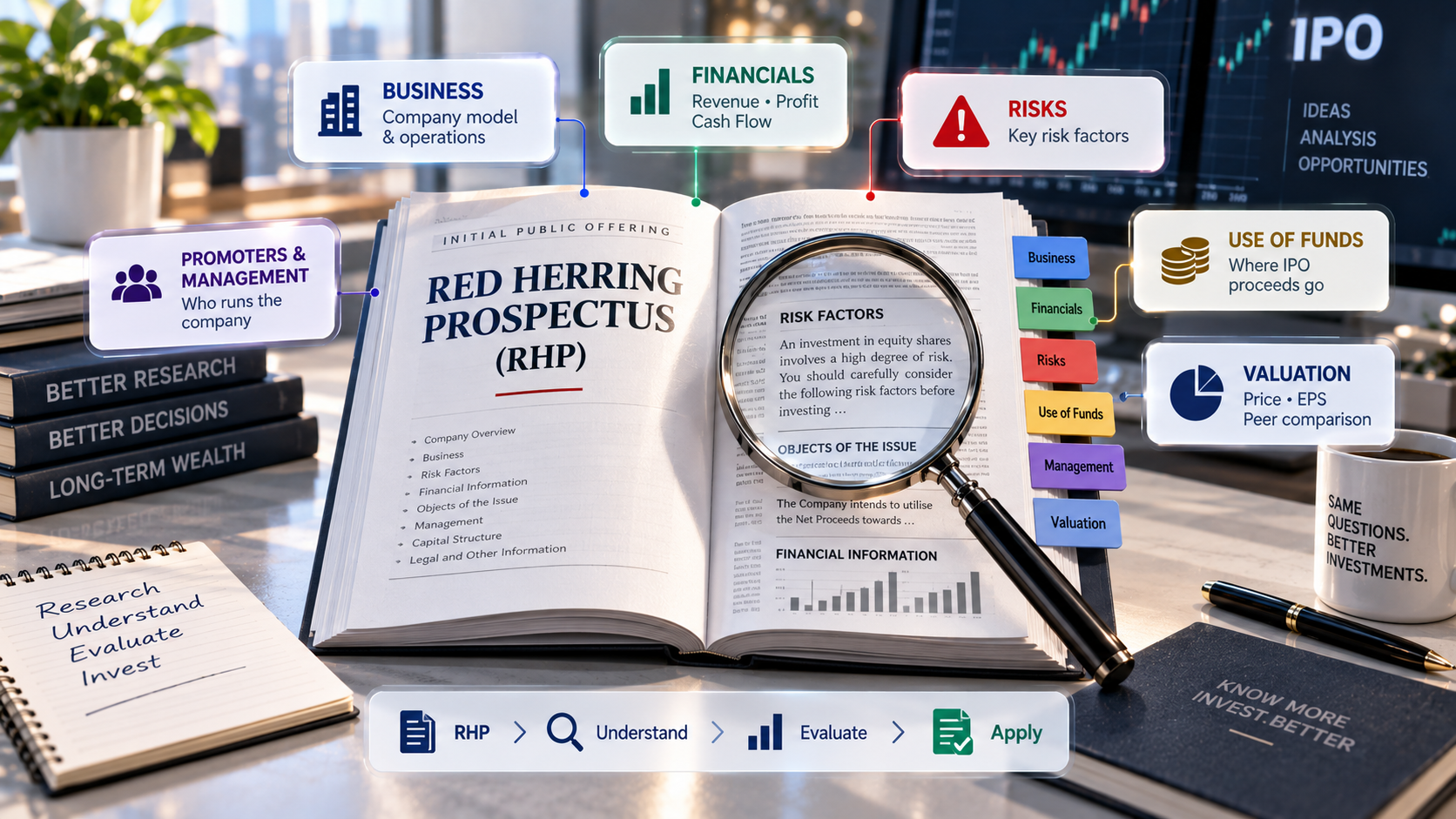
How to Read an IPO RHP Before Applying
A beginner-friendly guide to reading an IPO Red Herring Prospectus and understanding the key sections investors should review before applying.
Sachin Gadekar
·
24 Sep 2026