PMS vs Mutual Funds vs AIF in India 2026: Which Is Right for HNIs?
22 July 2026 · Sankarshan B
A complete, corpus-specific comparison of Portfolio Management Services (PMS), Mutual Funds, Alternative Investment Funds (AIF), and alternative fixed income for HNI investors in India 2026 - covering minimum investments, taxation, liquidity, ownership structure, and Ultra's specific recommendation on which vehicle belongs at which stage of an HNI portfolio.
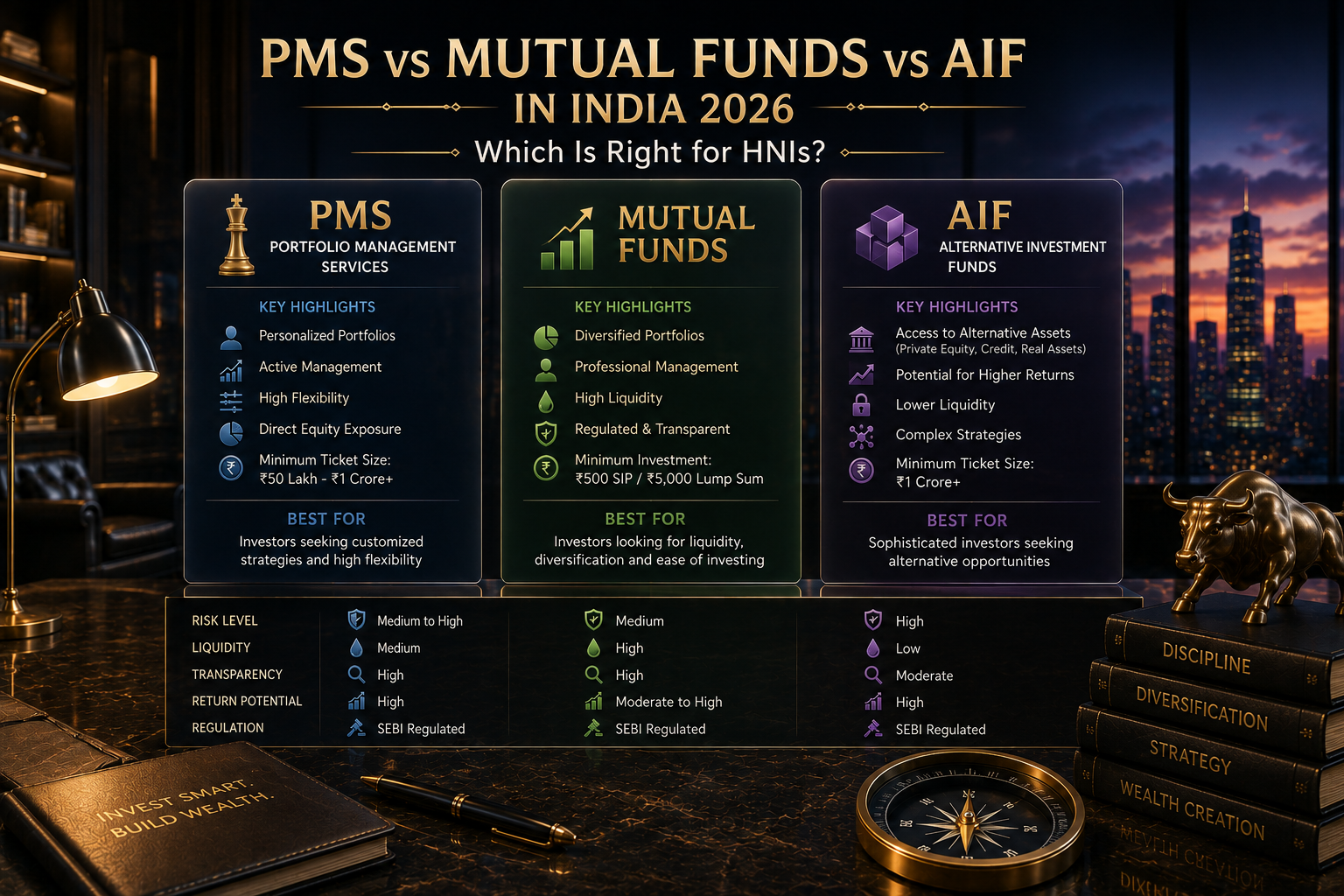
India's wealth management landscape in 2026 offers more structured investment vehicles than at any point in its history. Mutual fund AUM has reached ₹83.43 lakh crore. PMS assets under management stand at ₹41.56 lakh crore across 206,254 discretionary clients. AIF commitments have reached ₹15.74 lakh crore across 1,700+ registered AIFs - a 30% CAGR over five years.
Most articles comparing these three vehicles make the same mistake: they treat all three as competing for the same pool of investor capital, evaluated on the same criteria. They are not. PMS, mutual funds, and AIFs serve different purposes, require different corpus sizes, have different tax structures, and fit different positions in an HNI portfolio - not as alternatives to each other, but as complements at different stages of wealth accumulation.
This article builds the framework HNI investors actually need: which vehicle belongs at which corpus size, what the tax and return differences are, how to evaluate each, and - critically - where alternative fixed income instruments (invoice discounting, asset leasing, SDIs) fit in alongside the three traditional vehicles.
The Four Vehicles: What Each Is
Before comparing, the core structural difference between these vehicles needs to be clear - because it determines everything else.
Mutual Funds are pooled vehicles where your money is combined with thousands of other investors into a single NAV-priced fund. You own units of the fund - not the underlying securities directly. The fund manager takes decisions on behalf of all unitholders collectively.
Portfolio Management Services (PMS) are individually managed accounts where the securities are held directly in your name in your own demat account. You own the stocks or bonds directly - not units in a pool. The PMS manager makes investment decisions for your account specifically, though they may follow a similar strategy across clients.
Alternative Investment Funds (AIFs) are pooled vehicles like mutual funds but for sophisticated investors - with higher minimums (₹1 crore), more complex strategies, and much longer lock-in periods. Category I and II AIFs are pass-through for taxation. Category III AIFs are taxed at fund level at maximum marginal rate (~42.74%).
Alternative Fixed Income - invoice discounting, asset leasing, SDIs, corporate bonds - are direct instruments that do not fit neatly into the mutual fund / PMS / AIF taxonomy but are increasingly relevant for HNIs seeking above-FD yields without the complexity of fund structures.
The Master Comparison: All Four Structures Side by Side
| Parameter | Mutual Fund | PMS | Category II AIF (Private Credit / PE) | Alternative Fixed Income (Invoice Discounting, Asset Leasing) |
|---|---|---|---|---|
| Minimum investment | ₹500 (SIP) / ₹1,000 (lump sum) | ₹50 Lakhs (SEBI mandate) | ₹1 Crore (SEBI mandate) | ₹10,000–₹25,000 per deal |
| Ownership structure | Pooled - you own units, not underlying assets | Direct - securities held in your own demat account | Pooled - you own fund units, not underlying assets | Direct - you own the invoice claim or asset lease directly |
| Regulation | SEBI (MF Regulations); AMC licensed | SEBI (PMS Regulations); PM licensed | SEBI (AIF Regulations); Fund Manager registered | Varies - RBI (TReDS), SEBI (SDIs), instrument-specific frameworks |
| Typical strategy | Diversified equity, debt, hybrid, index, ETF - long only listed markets | Customised listed equity (concentrated or diversified); some debt/hybrid PMS | Private credit (direct lending), private equity, real estate, distressed assets - unlisted markets | Fixed income - invoice receivables, physical asset leases, loan pools (SDIs), corporate bonds |
| Return type | Market-linked NAV appreciation + dividends | Market-linked portfolio returns (alpha over benchmark) | Private credit: 12–18% gross yield; PE: 20–30%+ IRR target | Defined yield: 10–15% gross, paid on schedule |
| Liquidity | High - daily redemption (except ELSS 3-year, FoF) | Moderate - typically quarterly liquidity; no regulatory lock-in but practical restrictions | Very Low - 3–7 year lock-in; no exit before fund tenure | Low - locked to deal tenure (30–90 days for ID; 24–60 months for leasing) |
| Transparency | High - daily NAV, monthly portfolio disclosure | Very High - real-time access to own demat; every trade visible | Moderate - quarterly reports; no daily NAV; SEBI mandates semi-annual independent valuation (2026) | High - deal-level disclosure of buyer, invoice, tenure, yield |
| Fee structure | Expense ratio 0.5–2.25% p.a. (direct plans lower); no performance fee | Management fee 1–3% p.a. + profit sharing 10–20% above hurdle rate | Management fee 1–2% p.a. + carry 15–20% above hurdle rate (typically 8–10%) | Platform fee (varies); typically embedded in the net yield offered to investor |
| Taxation | LTCG 12.5% (equity, 12+ months); STCG 20% (equity, <12 months); Debt: slab rate | Pass-through - each transaction taxed in investor's hands at applicable rate (LTCG/STCG on equity; slab on debt) | Pass-through for interest/dividend income - taxed in investor hands at slab rate; equity gains at LTCG/STCG | Slab rate (interest income) - identical to FD taxation |
| SEBI regulation level | Highest - strict daily NAV, TER caps, portfolio disclosure norms | High - standardised reporting, performance presentation norms (GIPS alignment) | Moderate but improving - GARUDA fast-track, semi-annual valuation, dematerialisation (2026 reforms) | Varies by instrument - SDIs (SEBI), TReDS (RBI), corporate bonds (SEBI NCS) |
| Ideal corpus size | Any - from ₹500 to ₹10 crore+ | ₹50 Lakhs to ₹5 Crore (equity focus) | ₹3 Crore+ total corpus (so ₹1Cr AIF = 20-33% allocation, not 100%) | ₹5 Lakhs to ₹1 Crore (core fixed income layer for HNI portfolios) |
Mutual Funds: When They Are the Right Choice
Mutual funds remain the most appropriate vehicle for the majority of investors - including HNIs - for specific allocations:
When mutual funds are right:
Equity exposure below ₹50 lakhs - the PMS minimum of ₹50 lakhs means there is no meaningful alternative for structured equity exposure below this threshold. A ₹30 lakh equity allocation belongs in diversified mutual funds (large-cap index + flexi-cap + mid-cap).
Daily liquidity requirement - the emergency fund layer and any capital that may be needed at short notice should stay in liquid funds or ultra-short duration funds, not in PMS or AIF.
Passive / index investing - SBI Funds Management's 27.9% ETF market share reflects a genuine investor trend. Index funds and ETFs are best accessed through the mutual fund structure - not PMS (which is actively managed by design) or AIF (which targets private markets).
SIP discipline - the ₹500 SIP minimum and automatic investment discipline of mutual funds remain unmatched for building equity wealth systematically over long periods.
What mutual funds cannot do for HNIs:
They cannot hold your securities in your own name (pooled structure)
They cannot customise strategy to your specific tax or portfolio situation
They cannot access private markets (unlisted equity, private credit, pre-IPO)
They are subject to SEBI's concentration limits (maximum 10% in a single stock) - which caps concentration for high-conviction positions
PMS: When to Graduate from Mutual Funds
Portfolio Management Services occupy a specific niche between mutual funds and AIFs - suitable for HNIs who want professionally managed listed equity with customisation, concentration, and direct ownership that mutual funds cannot provide.
The minimum is ₹50 lakhs (SEBI mandate) - and the practical minimum for meaningful diversification within a PMS is closer to ₹1 crore. <cite index="40-1">SEBI's report of portfolio managers as of January 31, 2026 shows 2,06,254 discretionary PMS clients and total reported PMS assets of ₹41,56,175 crore across reporting categories.</cite>
When PMS is right:
You have ₹50 lakhs+ in equity allocation surplus that you want professionally managed in your own name
You want concentrated, high-conviction strategies (PMS can hold 15-20 stocks; mutual funds cannot exceed 10% per stock)
You want direct tax control - in PMS, each transaction is taxable in your hands, allowing you to harvest losses, defer gains, and plan capital gains timing in ways mutual fund unitholders cannot
You want full transparency - every trade in your demat, every position disclosed in real time
What PMS cannot do:
Access private markets (unlisted equity, private credit, real assets)
Provide the lock-in structure that enables long-tenure illiquid investments (which is what drives AIF returns in private credit and PE)
Provide the diversification of a pooled fund at low per-stock cost
Category II AIF (Private Credit and Private Equity): The Ultra-HNI Layer
Category II AIFs are the vehicle designed for private market investing - lending to unlisted companies (private credit), buying equity in private businesses (private equity), investing in real estate, or distressed assets. <cite index="33-1">AIF commitments stood at ₹15.74 lakh crore as of December 2025, with actual investments at ₹6.45 lakh crore across 1,700+ registered AIFs - a 30% CAGR over five years.</cite>
The critical minimum consideration: The ₹1 crore SEBI minimum is not just a regulatory number - it is a portfolio construction constraint. <cite index="34-1">Category II AIFs are generally suited for investors who already have meaningful listed equity exposure through mutual funds or PMS.</cite>
A ₹1 crore AIF commitment on a ₹2 crore total portfolio means 50% in a single, illiquid, 3-7 year lock-in vehicle. That is dangerous concentration. The AIF allocation makes portfolio sense only when total investable corpus is ₹3 crore or more - so the ₹1 crore AIF represents 20-33% of total, not a majority.
Private credit AIF specifically: For HNIs seeking fixed income alternatives, Category II private credit AIFs are the institutional-grade equivalent of invoice discounting - lending to mid-market companies at first-charge security, at 12-18% gross yield (10-14% net of fees). The difference: ₹1 crore minimum, 3-5 year lock-in, no liquidity before tenure, and the critical due diligence burden of verifying manager track record through credit cycles.
What to evaluate before committing to a Category II AIF:
Net IRR (after management fee and carry), not gross
Track record through 2018-19 (IL&FS/DHFL) and 2020 (COVID) credit cycles - not just recent performance
Security structure on underlying loans - first-charge vs second-charge
Concentration limits - how much of the fund can go to a single borrower
For the full Category II private credit AIF guide, read: Private Credit Funds in India: Category II AIF Guide for HNIs
Category III AIF (Hedge Funds): The Most Misunderstood Vehicle
Category III AIFs are hedge fund structures - using derivatives, long-short strategies, leverage, and complex instruments that Category II is not permitted to use.
The key structural disadvantage: <cite index="35-1">In an AIF Category III, income is taxed at max marginal rate at fund level - significant tax drag.</cite> Category III AIFs pay tax at the fund level at approximately 42.74% (maximum marginal rate including surcharge) before distributions - a meaningful disadvantage versus Category II's pass-through structure.
When Category III makes sense: Only after a well-constructed Category II private credit or PE allocation is established. Category III hedge strategies are volatility-dampening tools - useful for reducing correlation with listed equity in large portfolios. They are not a starting point for HNI alternative investing.
The manager selection problem: Most Indian "hedge funds" operating under Category III licences are long-biased with limited genuine short-selling capability. The label "hedge fund" does not guarantee hedged returns - evaluate the actual strategy, not the regulatory category.
Alternative Fixed Income: The Missing Vehicle in Most Comparisons
Every comparison article on PMS vs mutual funds vs AIF covers the same three vehicles. None includes the fourth category that has the most immediate relevance for HNI fixed income allocation: alternative fixed income instruments - invoice discounting, asset leasing, SDIs, and corporate NCDs.
Why this matters:
The choice between mutual funds, PMS, and AIF is primarily an equity and strategy decision. But a large portion of HNI portfolio allocation is fixed income - capital preservation, income generation, inflation protection. The right vehicle comparison for the fixed income portion of an HNI portfolio is not "PMS vs AIF" - it is "bank FD vs corporate bonds vs invoice discounting vs asset leasing vs Category II private credit AIF."
The key insight this table provides: For investors with ₹25 lakhs to ₹3 crore in fixed income surplus, invoice discounting and asset leasing deliver comparable or better post-tax yields to a Category II private credit AIF - at 1/40th of the minimum investment and with shorter lock-ins. The AIF layer adds value primarily for corpus sizes where the ₹1 crore minimum represents a manageable concentration (₹3 crore+ total).
Taxation Comparison: The Differences That Actually Matter
Tax treatment is the most practically important difference between these vehicles for HNI investors at 30%+ brackets.
| Vehicle | Tax on Equity Gains (LTCG) | Tax on Debt / Interest Income | Tax on Short-Term Gains | Key Tax Advantage / Disadvantage |
|---|---|---|---|---|
| Equity Mutual Fund | 12.5% (after 12 months, above ₹1.25L annual threshold) | Slab rate (debt MFs, post Finance Act 2023) | 20% (within 12 months) | LTCG exemption threshold ₹1.25L/year; grandfathering on pre-2018 gains removed |
| PMS (Equity) | 12.5% per holding (if >12 months); can offset losses across holdings | Slab rate | 20% per holding (if <12 months) | Direct control - can harvest losses, defer gains, plan timing; no ₹1.25L threshold - full 12.5% LTCG on all gains |
| Category I & II AIF | Pass-through - taxed in investor's hands at applicable rate | Pass-through - slab rate in investor's hands | Pass-through - 20% in investor's hands | Pass-through is structurally efficient for debt/private credit income - investor pays slab rate, no fund-level tax; same as holding directly |
| Category III AIF | Taxed at fund level at ~42.74% max marginal rate | Taxed at fund level at ~42.74% | Taxed at fund level at ~42.74% | Significant disadvantage - fund-level tax at maximum rate regardless of individual investor's bracket; not pass-through |
| Alternative Fixed Income (ID, Leasing, NCDs) | Not applicable (fixed income instruments) | Slab rate - identical to bank FD | Not applicable | No fee drag; full gross yield minus slab tax = investor's net return; no fund-level costs |
The critical implication of the tax comparison:
For HNIs in the 30% bracket: Category II AIF (private credit) and direct invoice discounting are taxed identically on income - both at slab rate, pass-through. The difference is purely structural: AIF pools the money and earns the yield on a ₹1 crore minimum; direct invoice discounting gives you deal-level control at ₹25,000 minimum.
For HNIs comparing equity mutual funds vs PMS: The tax difference is nuanced. Both pay 12.5% LTCG on equity gains held over 12 months. The advantage of PMS is control - you can strategically harvest losses, time gain realisation, and manage your tax year specifically. The mutual fund structure makes these decisions collectively, on behalf of all unitholders.
The Corpus-Based Decision Framework: What to Use When
| Total Investable Corpus | Equity Allocation Vehicle | Fixed Income Allocation Vehicle | Alternative Allocation Vehicle | What to Avoid |
|---|---|---|---|---|
| Below ₹25 Lakhs | Mutual Funds (SIP - large cap index + flexicap + mid cap) | Bank FD (DICGC buffer) + Corporate NCDs + REITs | Invoice Discounting (1-2 deals to learn the instrument) | PMS (below minimum); AIF (too concentrated); complex structures |
| ₹25 Lakhs – ₹1 Crore | Mutual Funds (primary) + consider PMS for ₹50L+ equity surplus | Invoice Discounting (25-30%) + Asset Leasing (15%) + AA NCDs (20%) + REITs (10%) | Invoice discounting and leasing ARE the alternatives at this level | AIF (₹1Cr minimum would be full corpus concentration); Category III AIF |
| ₹1 Crore – ₹3 Crore | Mutual Funds (index core) + PMS (concentrated equity strategy) | Invoice Discounting + Asset Leasing + AA NCDs + SDIs + REITs (7-bucket framework) | Still avoid Category II AIF - would be 33-100% of total corpus | Category II AIF until ₹3Cr+ total; Category III AIF (fund-level tax) |
| ₹3 Crore – ₹10 Crore | Mutual Funds (passive core) + PMS (active satellite) | Invoice Discounting + Asset Leasing + NCDs + SDIs + REITs (diversified) | Category II Private Credit AIF (₹1Cr = 10-33% of total - manageable concentration) | Category III AIF (fund-level tax); over-concentrating in single AIF |
| Above ₹10 Crore | Mutual Funds (passive index) + PMS (concentrated) + Category III AIF (hedge, selective) | Full 7-bucket alternative fixed income portfolio + tax-free bonds + SGBs | 2-3 Category II AIFs (private credit + PE) + co-investments | Concentrating more than 15-20% in any single AIF or PMS |
PMS vs AIF: The Key Differences Most Investors Miss
Since PMS and AIF are often compared as the two "HNI vehicles," three specific differences that most articles understate:
1. Market exposure - listed vs unlisted PMS invests almost exclusively in listed securities (stocks, bonds traded on exchanges). Category II AIF invests in unlisted companies, private loans, real estate, and other private market assets. This is the most fundamental difference - they provide exposure to different markets, not the same market with different wrappers.
2. Return drivers <cite index="34-1">A PMS primarily seeks market-linked alpha. A Category II AIF typically seeks transaction-linked outcomes. That distinction matters because the sources of returns are fundamentally different.</cite> PMS returns move with equity market sentiment. Category II private credit AIF returns are driven by loan repayment from specific borrowers - non-correlated to listed equity markets.
3. The timeline is the more important variable than the ticket <cite index="40-1">Many investors focus on the ticket and underestimate the timeline. The timeline is usually the more important variable.</cite> A ₹50 lakh PMS is recoverable in weeks if needed (quarterly liquidity in most structures). A ₹1 crore Category II AIF commitment is locked for 3-7 years without exit. The timeline constraint - not the minimum - is what makes AIFs suitable only for a specific portion of the portfolio.
How to Evaluate a PMS or AIF Before Investing
For PMS evaluation:
Track record (TWRR, not absolute returns): Time-Weighted Rate of Return, audited and presented against a relevant benchmark. Ask for performance data through the 2020 COVID correction and the 2022 global sell-off - not just bull market periods
Fee structure net of all charges: Total management fee + profit share. At 2% + 20% carry, the PMS needs to outperform a comparable index by 3-5% annually to be worth the fee
Portfolio concentration and turnover: High-turnover PMS generates more short-term capital gains (taxed at 20%) - reducing post-tax alpha versus a low-turnover approach
AUM size: Very large PMS AUM (above ₹5,000 crore) can limit ability to take meaningful positions in mid and small-cap stocks
For Category II AIF evaluation:
Net IRR, not gross: Always ask for net IRR after all fees and carry. A 16% gross yield AIF with 2% management fee and 20% carry above 8% hurdle generates approximately 12-13% net - not 16%
Credit cycle track record: Manager must have navigated at least one credit downturn (2018-19, 2020) with the same strategy
Security structure: First-charge senior secured is meaningfully safer than second-charge or unsecured. Ask specifically about the security on every loan in the current portfolio
Concentration: No single borrower should exceed 10-15% of fund AUM. Ask for current concentration data
SEBI's GARUDA context: Under the new fast-track framework (2026), some AIF schemes launch with less SEBI pre-review. Apply more rigorous independent due diligence on recently launched AIFs - particularly Track 3 (AI-only, instant launch) schemes
Ultra's Position: The Complete HNI Investment Vehicle Stack
Applying the audit principle - Ultra's specific, portfolio-level recommendation:
The right mental model is not "which vehicle is best" - it is "which vehicle belongs at which layer of a complete HNI portfolio."
The complete HNI investment vehicle stack, in order of portfolio layer:
Layer 1 - Liquidity and safety (10-15% of total corpus): Bank FDs (DICGC-covered, ₹5L per bank), liquid mutual funds, SFB FDs for higher yield within DICGC cap. This layer has one purpose: immediate accessibility without loss of principal. No PMS, no AIF, no invoice discounting here.
Layer 2 - Alternative fixed income yield engine (25-35% of total corpus for ₹25L-₹3Cr investors): Invoice discounting (Tier 1-2 buyers), asset leasing (solar/EV), AA corporate NCDs, SDIs, REITs/InvITs. This layer delivers the highest post-tax yield available at accessible minimums - without the ₹1 crore AIF threshold or the equity market risk of PMS. This is where Ultra operates and where we would prioritise most HNI fixed income surplus below ₹3 crore total corpus.
Layer 3 - Listed equity (30-40% of total corpus): Mutual funds (passive index core) for the broad equity allocation. PMS (concentrated active strategy) for ₹50L+ equity allocations where customisation, direct ownership, and tax control justify the fee. Not both - PMS is an upgrade to, not an addition to, a diversified mutual fund allocation.
Layer 4 - Private markets (10-20% of total corpus for ₹3Cr+ investors): Category II private credit AIF for institutional-grade private lending at 12-18% gross / 10-14% net. Category II PE AIF for long-horizon private equity exposure. Only when total corpus supports the ₹1 crore minimum as a 15-25% allocation - not as the majority position.
What Ultra would specifically not recommend: Beginning with a Category II AIF before the alternative fixed income layer (Layer 2) is established. The common mistake among HNIs is jumping to the most complex vehicle (AIF) without first building the foundation of well-diversified alternative fixed income that provides similar yields at lower minimums, shorter lock-ins, and greater portfolio flexibility.
For the complete ₹1 crore fixed income portfolio that represents Layer 2 in detail, read: How to Build a ₹1 Crore Fixed Income Portfolio in India (2026)
For the specific Category II private credit AIF guide when you're ready for Layer 4, read: Private Credit Funds in India: Category II AIF Guide for HNIs
Explore invoice discounting and asset leasing - Layer 2 of the complete HNI portfolio - at www.getultra.club.
FAQs
Q1. What is the difference between PMS and mutual funds in India?
The primary difference is ownership structure. In mutual funds, you own units of a pooled fund - not the underlying securities directly. In PMS, securities are held directly in your own demat account. PMS requires a SEBI-mandated minimum of ₹50 lakhs, offers customisation and concentration that mutual funds cannot, and gives direct tax control over each transaction. Mutual funds offer daily liquidity, lower minimums (₹500 SIP), and are suitable for all investor levels.
Q2. What is the minimum investment for PMS, AIF, and mutual funds in India in 2026?
Mutual funds: ₹500 via SIP (no maximum). PMS: ₹50 lakhs (SEBI-mandated minimum). Category I, II, and III AIFs: ₹1 crore per investor (SEBI-mandated minimum). Specialised Investment Funds (SIFs): ₹10 lakhs. Alternative fixed income (invoice discounting, asset leasing): ₹25,000 per deal. Portfolio Management Services (non-discretionary): ₹50 lakhs.
Q3. How is AIF taxed compared to mutual funds and PMS?
Category I and II AIFs are pass-through - income is taxed in the investor's hands at their applicable slab rate, identical to directly held instruments. Category III AIFs are taxed at fund level at approximately 42.74% maximum marginal rate before distributions - a significant disadvantage. Equity mutual funds pay 12.5% LTCG on gains held over 12 months. PMS is also pass-through - each transaction taxed in the investor's hands at applicable rate. Since Finance Act 2023, debt mutual funds are taxed at slab rate - the LTCG advantage has been removed.
Q4. Is PMS better than mutual funds for HNIs?
For equity allocations above ₹50 lakhs, PMS offers advantages mutual funds cannot: direct ownership (securities in your own demat), concentration in high-conviction positions, and full tax control over individual transactions. However, PMS fees (typically 1.5-3% + profit share) need to generate sufficient alpha to justify the cost. For most HNI equity allocations, a combination of low-cost index mutual funds (core) and a focused PMS (satellite) is more efficient than replacing mutual funds entirely with PMS.
Q5. When should an HNI invest in a Category II AIF?
Category II AIF makes portfolio sense when total investable corpus is ₹3 crore or more - so the ₹1 crore minimum represents 20-33% of the portfolio rather than a dangerous majority. AIFs should be added after a well-diversified alternative fixed income foundation (invoice discounting, asset leasing, corporate bonds) is already established. Within Category II, private credit AIFs suit HNIs seeking fixed income diversification; PE AIFs suit those with 7-12 year horizons and equity-like risk tolerance.
Q6. What is the difference between Category I, II, and III AIFs?
Category I AIFs invest in start-ups, SMEs, social ventures, and infrastructure - government concessions apply. Category II AIFs invest in private equity, private credit, real estate, and distressed assets - the largest and fastest-growing AIF category (₹15.74 lakh crore in commitments as of December 2025). Category III AIFs are hedge funds and complex derivative strategies - taxed at fund level at maximum marginal rate (~42.74%), unlike the pass-through structure of Category I and II.
Disclaimer
This article is for informational and educational purposes only and does not constitute investment advice. Regulatory details, minimum investment requirements, and tax rates are based on SEBI regulations and Income Tax Act provisions as of July 2026, subject to change. Please consult a SEBI-registered investment advisor before making investment vehicle selection decisions.
Recent articles
View all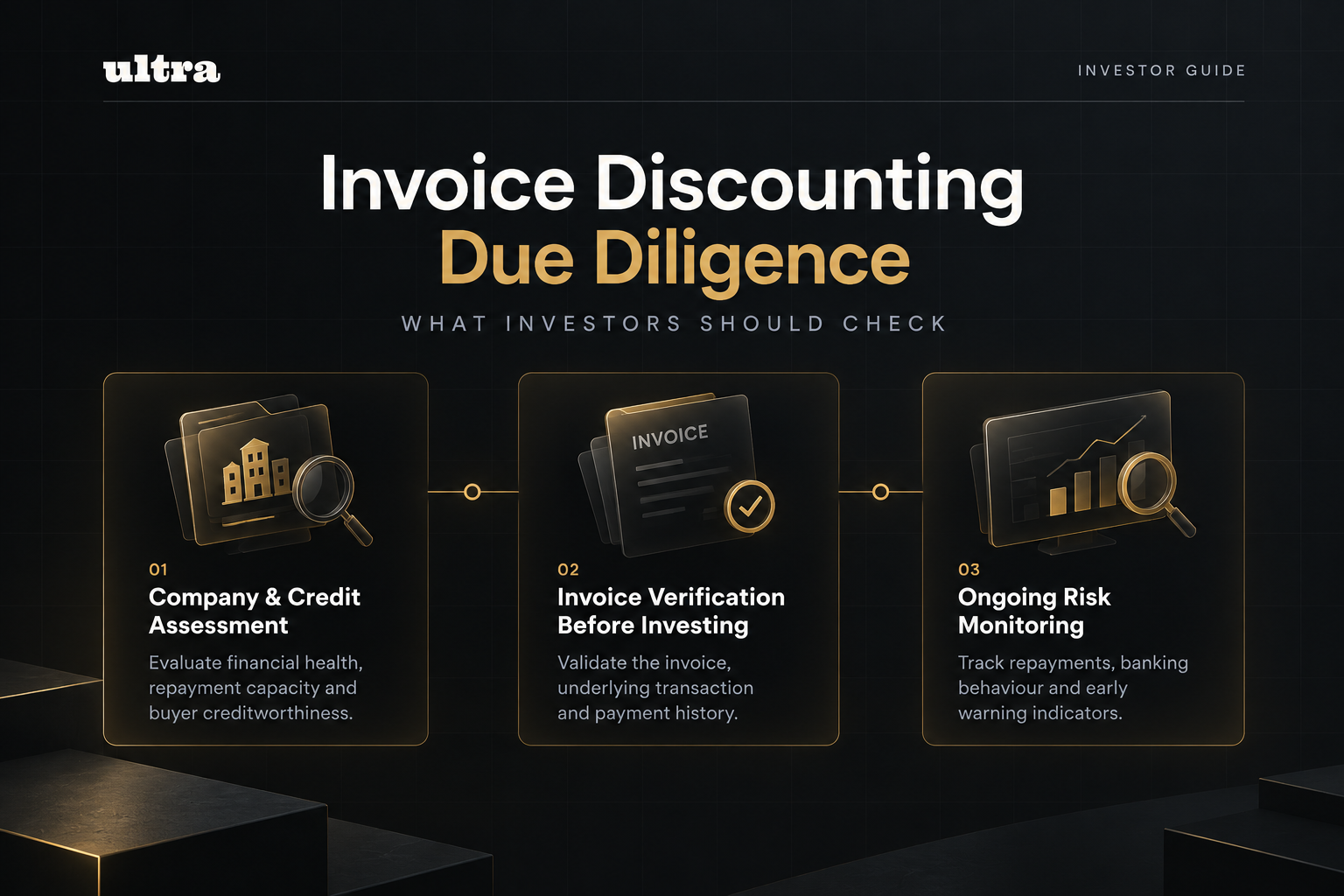
invoice discounting
Invoice Discounting Due Diligence: What Investors Should Check Before Investing
A complete guide to invoice discounting due diligence, covering what to check before you invest and how ultra reviews every business before listing its invoices
Prerna Bhardwaj
·
26 Oct 2026
invoice discounting
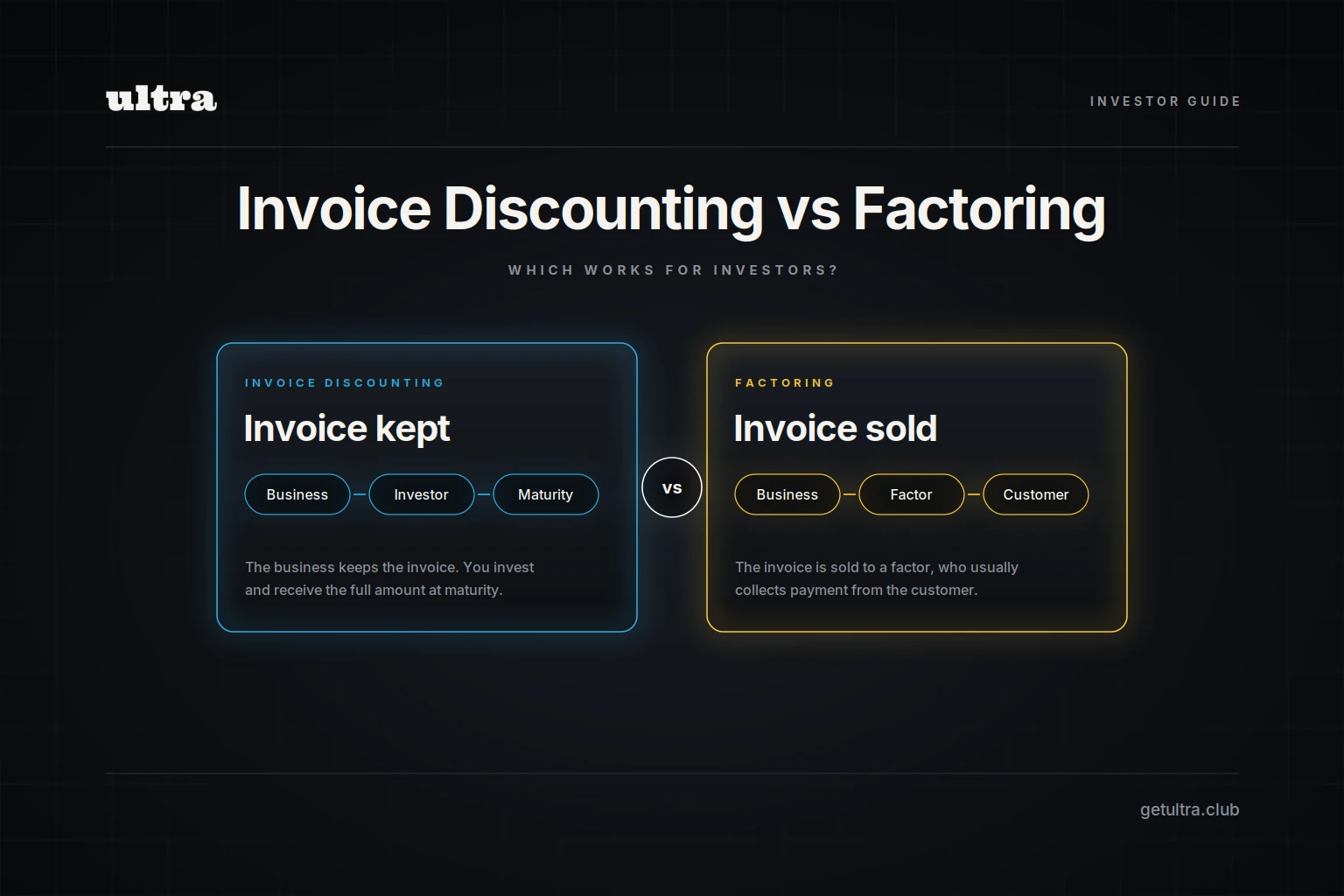
Invoice Discounting vs Factoring: Which Works for Investors?
A complete guide to invoice discounting vs factoring, covering how each works, the key differences between them and why investors choose invoice discounting on ultra.
Prerna Bhardwaj
·
22 Oct 2026
invoice discounting
Invoice Discounting Investment in India: How It Works
A complete guide to invoice discounting investment in India, covering how it works, why experienced investors consider it, where it fits in a portfolio and how to invest with ultra.
Prerna Bhardwaj
·
21 Oct 2026

IPO
Reliance Jio IPO: Date, Price, GMP, Valuation, Review & Details
A complete guide to Reliance Jio IPO 2026, covering Jio Platforms IPO details, issue size, expected date, price band status, GMP context, shareholder quota, company profile, financials, valuation and risks.
Sachin Gadekar
·
19 Oct 2026