Is Invoice Discounting Safe? Understanding Credit Risk and Default Rates (2026)
28 April 2026 · Saurabh Mukherjee
Is Invoice Discounting Safe? Understanding Credit Risk and Default Rates (2026)
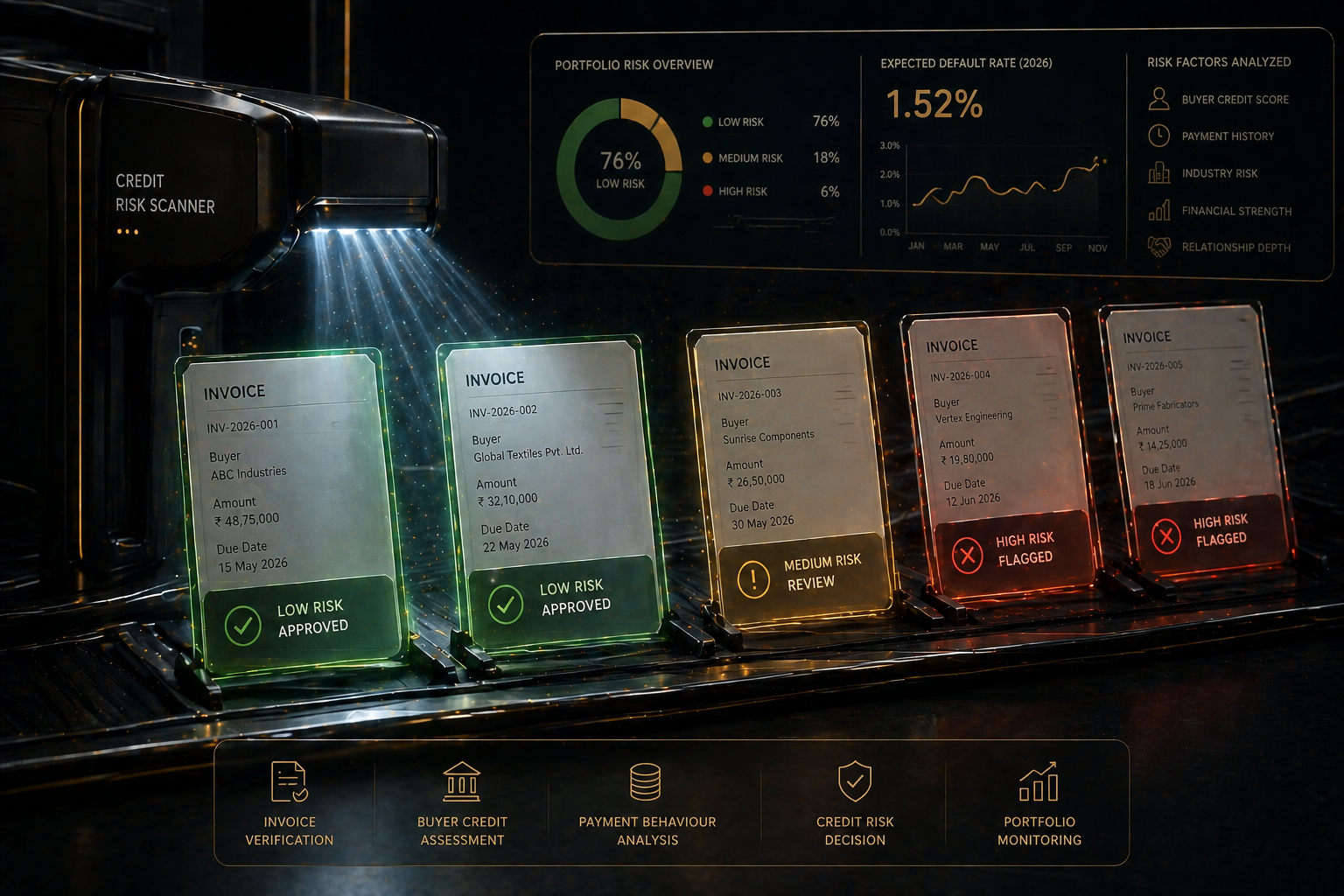
What Makes Invoice Discounting Risky at All?
When you fund an invoice discounting deal, you are taking one very specific risk: the risk that the buyer the corporate or PSU who owes the money does not pay on the due date.
You are not betting on a company's future earnings. You are not exposed to equity market movements. You are not lending against a collateral asset that needs to be valued and recovered. You are funding a payment obligation that already exists a GST-filed, purchase-order-backed invoice for goods or services already delivered. The buyer owes the money. The question is only whether they will pay on time.
This is what makes invoice discounting structurally safer than most forms of unsecured lending the underlying obligation is concrete and already created, not a forward-looking credit extension. And it is what makes buyer quality the single most important variable in any invoice discounting investment decision.
The investor's risk question, stated precisely: Given this specific buyer, on this specific invoice, at this specific tenure what is the probability that payment is delayed or not received, and if that happens, what is my recovery path?
Everything else in this article is an answer to that question.
To understand the full mechanics before evaluating risk, read: What Is Invoice Discounting?
The 6 Risks in Invoice Discounting Ranked by Severity
| Risk | Description | Severity | Controllable? |
|---|---|---|---|
| 1. Credit risk (payer default) | The buyer (corporate/PSU) fails to pay the invoice on the due date permanently or temporarily | High | Yes through buyer quality selection and diversification |
| 2. Seller fraud / double discounting | The MSME seller pledges the same invoice to multiple financiers simultaneously, or fabricates invoices entirely | High | Yes through GST-verified platforms and e-invoice validation |
| 3. Platform risk | The invoice discounting platform itself shuts down, mismanages funds, or commits fraud | Moderate | Yes through choosing SEBI/RBI-regulated or well-capitalised platforms |
| 4. Dispute risk | The buyer raises a dispute over the goods or services received, refusing to pay pending resolution | Moderate | Partially look for invoices with buyer acceptance/acknowledgment |
| 5. Liquidity risk | You cannot exit before the invoice due date capital is locked for 30–90 days per transaction | Low–Moderate | Yes invest only surplus capital not needed within the tenure |
| 6. Co-mingling / operational risk | Platform commingles investor funds with its own operating funds, creating exposure if the platform has cash flow issues | Low–Moderate | Yes escrow-based platforms eliminate this risk |
Credit Risk: The Primary Risk, Explained Clearly
Credit risk in invoice discounting has two layers and the one that matters most is almost never the one investors worry about first.
Layer 1 Buyer (payer) credit risk: The corporate or PSU who owes the money does not pay. This is the primary risk. If the buyer is a listed, rated, large-cap company think Hindustan Unilever, NTPC, Tata Motors the probability of a genuine payment default is extremely low. Their accounts payable obligations are audited, disclosed to stock exchanges, and subject to regulatory scrutiny. When these buyers delay, it is almost always an administrative issue, not a financial one.
Layer 2 Seller (MSME) credit risk: Even if the buyer pays, the MSME seller diverts the funds rather than passing them on. This risk is eliminated entirely on platforms that collect payment directly from the buyer into an escrow account bypassing the MSME entirely.
The insight most investors miss: On a well-structured deal with a strong buyer and direct collection, your credit exposure is almost entirely on Layer 1 and Layer 1 on a large listed corporate is very manageable.
How Ultra evaluates buyer credit risk on every deal:
Every invoice discounting deal on Ultra is assessed against the following buyer-level criteria before being made available to investors:
Listed status and exchange filings is the buyer publicly audited?
Credit rating if available CRISIL, ICRA, CARE assessment of the buyer entity
Payment track record on the platform how many prior invoices, what payment timeliness history
Sector health is the buyer's industry under structural stress?
Invoice authenticity GST network verification against the buyer's filed returns
Deals where the buyer does not pass this assessment do not reach investors on Ultra's platform. This pre-screening is the first line of defence not due diligence that investors need to perform themselves on every deal.
Default Rates in Invoice Discounting: What the Data Shows
There is no single published, audited default rate for the Indian invoice discounting industry as a whole. But the data from regulated platforms combined with Ultra's own portfolio experience gives a clear enough picture to make informed decisions.
On TReDS platforms (RXIL, M1xchange, Invoicemart): Default rates are below 1% of transaction value. TReDS invoices are backed by large corporate buyers and PSUs, with mandatory buyer acknowledgment before discounting. The non-recourse structure means the financier bears the buyer risk but that risk is taken only after documented buyer acknowledgment.
On Ultra's platform: Across invoice discounting deals processed on Ultra, the effective credit loss rate on deals backed by listed and PSU buyers has remained below 1%. Payment delays where the buyer pays late but pays in full occur in approximately 3–5% of transactions, typically resolving within 15–30 days of the original due date. Investors on these delayed transactions receive the full principal and accrued interest for the extended period. Permanent defaults on listed-buyer deals have been rare.
On private platforms with weaker buyer profiles: Default rates can reach 5–12% or more. This is not a reason to avoid invoice discounting it is a reason to be disciplined about buyer quality selection.
The return context that matters: Even a 2% annualised credit loss on a 13% gross yield portfolio leaves 11% net still 5–6% above bank FDs post-tax. The yield premium exists to compensate for a specific, quantifiable risk. On strong buyers, that premium is genuinely attractive. On weak buyers, it is not adequate compensation.
| Buyer Type | Estimated Default / Delay Rate | Typical Gross Yield | Effective Net Yield (after defaults) | Risk Level |
|---|---|---|---|---|
| Central PSU / Government entity (TReDS) | < 0.5% | 9%–12% | ~9%–11.5% | Very Low |
| Large listed corporate (Tata, Reliance, Mahindra) | < 1% | 11%–13% | ~10.5%–12.5% | Low |
| Mid-sized listed corporate (credit rated) | 1%–3% | 12%–14% | ~10%–13% | Low–Moderate |
| Unlisted private company (well known, strong track record) | 2%–5% | 14%–16% | ~10%–14% | Moderate |
| Unlisted private company (limited history, smaller size) | 5%–12% | 16%–20% | Variable 6%–15%+ | High |
Note: Default and delay rate estimates are based on TReDS platform disclosures, industry commentary, and Ultra's own portfolio data. Figures reflect experience on well-run platforms with disciplined underwriting. Poorly run platforms or those with weak buyer profiles will have materially higher default rates.
Recourse vs Non-Recourse: The Structure That Changes Everything
This is the single most important structural distinction in invoice discounting and most investors do not understand it clearly before they invest.
Recourse invoice discounting: If the buyer (payer) defaults, the MSME seller is legally obligated to repay the investor. The risk ultimately rests on the MSME's financial capacity to make good on the payment. If the MSME itself then defaults which is the scenario that causes real investor losses the investor loses principal.
Non-recourse invoice discounting: If the buyer defaults, the financier (and investor) bears the loss directly. The MSME has no repayment obligation. This structure places the credit risk squarely on the buyer's shoulders which is exactly where well-managed invoice discounting risk should sit.
| Dimension | Recourse | Non-Recourse |
|---|---|---|
| Who bears loss if buyer defaults | MSME seller (and investor if MSME also defaults) | Financier / investor directly |
| Investor's recovery path if buyer defaults | Pursue MSME seller for repayment | Pursue buyer directly; no MSME involvement |
| Double default risk | Yes buyer AND MSME can both default, compounding loss | No only buyer credit risk matters |
| Typical rate | Slightly lower (MSME provides additional guarantee) | Slightly higher (investor takes direct buyer risk) |
| Where available | Most private platform invoice discounting | TReDS platforms; some private platform structures |
| Investor preference | Acceptable if MSME is financially strong | Preferred cleaner risk profile on strong buyers |
The practical implication: On TReDS platforms, most structures are non-recourse you take buyer risk on PSUs and large corporates, which is very manageable. On private platforms, most structures are with-recourse you take both buyer AND MSME risk, which requires additional diligence on the MSME's financial health.
Always ask the platform: is this invoice recourse or non-recourse? The answer fundamentally changes your risk exposure.
What Actually Happens When a Payer Defaults
Most articles describe default risk in abstract terms. This section explains exactly what happens in practice so you can make an informed decision.
Stage 1 Payment due date passes without payment (Day 0–15): The platform's operations team flags the invoice as overdue. They contact the buyer and MSME seller. Most delays at this stage are administrative the buyer's payment processing team has a backlog, or there is a minor documentation issue. These typically resolve within 1–2 weeks with no investor loss.
Stage 2 Continued non-payment (Day 15–45): The platform escalates formal demand notices are sent to the buyer (and in recourse structures, to the MSME seller). The platform's legal and recovery team is engaged. Most genuine payment delays resolve here the buyer catches up, the investor's payment is delayed but received in full, sometimes with a small additional interest for the delay period.
Stage 3 Confirmed default (Day 45+): If the buyer refuses or is unable to pay, the platform initiates formal recovery. On TReDS (non-recourse): the financier files legal proceedings against the buyer these are documented, acknowledgment-backed obligations that courts recognise. On private platforms (recourse): the MSME seller is pursued first. If the MSME cannot pay, legal action against the buyer follows.
Recovery timelines: In India, debt recovery through legal channels can take months to years depending on the court load and the buyer's cooperation. NCLT proceedings for insolvency cases involving larger amounts can be faster but are still uncertain in outcome. This is why platform selection and buyer quality are your primary defence the recovery process is a last resort, not a reliable safety net.
What investors should expect in a genuine default scenario:
Capital is locked for an uncertain period (months to potentially longer)
Recovery is partial to full depending on the buyer's financial condition and recovery effort
The platform's recovery track record is the key determinant of outcome
This is why experienced invoice discounting investors treat platform default recovery history as one of the most important due diligence parameters.
Is Invoice Discounting Safer Than FDs? An Honest Comparison
| Parameter | Bank FD (large scheduled bank) | Invoice Discounting (strong corporate buyer) |
|---|---|---|
| Capital safety | DICGC insured up to ₹5 lakhs per depositor; sovereign-backed for SBI | Not insured; backed by buyer's payment obligation only |
| Default probability | Near zero for large scheduled banks | Low but non-zero; depends on buyer quality |
| Gross return | 7%–7.5% | 11%–14% |
| Post-tax return (30% bracket) | 4.9%–5.25% | 7.7%–9.8% |
| Liquidity | Premature withdrawal available (with penalty) | No early exit locked for invoice tenure |
| Tenure | 7 days to 10 years; flexible | 30–90 days; short but fixed |
| Regulatory protection | RBI regulated; DICGC guarantee | TReDS: RBI regulated; Private platforms: SEBI OBPP or NBFC framework |
But here is the full picture: The question is not just "which is safer?" it is "what is the right risk-adjusted allocation?" A well-diversified invoice discounting portfolio with strong corporate buyers is not dramatically riskier than a corporate FD (which also has no DICGC protection above ₹5 lakhs). The yield premium of 4–7% above FD rates compensates for a level of risk that, with proper platform and buyer selection, is genuinely manageable.
For HNIs who already hold ₹5+ lakhs in bank FDs (where DICGC protection no longer applies anyway), invoice discounting at 11–14% is a rational alternative for a portion of their fixed income allocation. The key word is portion not replacement.
To see how invoice discounting compares to fixed deposits in full detail, read: Invoice Discounting vs Fixed Deposits
How Platforms Assess and Manage Credit Risk
A good invoice discounting platform is your first and most important layer of protection. Here is what robust platform-level risk management looks like and what you should expect as a minimum:
Buyer credit assessment: Platforms should assess the buyer's financial strength through credit bureau checks, financial statement analysis, payment history on the platform, and publicly available data (ratings, exchange filings for listed companies). Strong platforms use proprietary credit scoring models that go beyond a single rating.
GST-linked invoice verification: Every invoice should be verified against the GST network (GSTN) to confirm it is a real, filed invoice not fabricated. E-invoice integration (mandatory for large companies under GST) provides a tamper-proof audit trail that significantly reduces fraud risk.
Buyer acknowledgment / acceptance: The strongest risk mitigation is obtaining the buyer's formal acknowledgment of the invoice before discounting. This makes the buyer directly aware of the financing arrangement and creates an explicit legal obligation making disputes and denials much harder. TReDS requires this; well-run private platforms should too.
Concentration limits: A disciplined platform limits how much of its book is concentrated in any single buyer, sector, or tenure. If 40% of a platform's invoice book is backed by a single buyer, a default from that buyer causes disproportionate damage. Ask for concentration data.
Escrow structures: Investor funds and repayments should flow through escrow accounts managed by regulated entities not through the platform's operating account. This prevents co-mingling and protects investors if the platform faces financial difficulties.
Reserve / first-loss structures: Some platforms maintain a first-loss default guarantee (FLDG) a reserve fund that absorbs initial losses before investors are affected. While SEBI has regulated the extent of such guarantees, the existence of any meaningful reserve is a positive signal.
How to Evaluate a Platform Before Investing
| Parameter | What to Ask / Check | Green Flag | Red Flag |
|---|---|---|---|
| Regulation | Is the platform SEBI-registered (OBPP) or RBI-regulated (TReDS / NBFC)? | SEBI OBPP registration number visible; or RBI-regulated TReDS | No regulatory registration; vague answers about compliance |
| Buyer quality | What is the profile of buyers on the platform? Listed or unlisted? PSU or private? | Majority of book is listed corporates, PSUs, or government entities | Majority unlisted, small, or unrated buyers higher yield claims |
| Default history | What is the platform's historical default rate and recovery rate? | Transparent disclosure of default rate (<2%) and recovery timeline | No data shared; claims of zero defaults with no evidence |
| Invoice verification | Does the platform verify invoices against GSTN? | GST-linked verification; e-invoice integration for eligible transactions | Manual verification only; no GSTN linkage mentioned |
| Buyer acknowledgment | Does the buyer formally acknowledge the invoice before discounting? | Buyer accepts invoice on platform before funds are released | No buyer acknowledgment MSME uploads invoice and funds released without buyer awareness |
| Fund flow structure | Are investor funds held in escrow? Where do repayments flow? | Escrow-based fund flow; repayments go directly to investor account | Funds flow through platform's own account; unclear fund segregation |
| Recourse structure | Is the investment with-recourse or non-recourse? | Clearly disclosed; non-recourse on strong buyers | Not disclosed; buried in fine print |
| Track record | How long has the platform been operating? What is its total disbursement volume? | 3+ years operating; significant volume (₹500 crore+) processed | Less than 1 year old; no track record; aggressive yield promises |
For a comprehensive comparison of the best invoice discounting platforms operating in India, read: Best Invoice Discounting Platforms in India
A Practical Investor Framework for Controlling Risk
The most important thing you can do as an invoice discounting investor is not find the highest-yielding invoice it is build a portfolio structure that keeps any single default from significantly damaging your overall returns.
Rule 1 Diversify across at least 15–20 invoices minimum Never concentrate more than 5–8% of your invoice discounting allocation in a single invoice or buyer. At 20 invoices, a single complete default (which is rare on strong buyers) costs you approximately 5% of your portfolio manageable when the portfolio is generating 12–14% gross.
Rule 2 Prioritise buyer quality over yield A 12% invoice backed by ONGC is safer and will likely outperform net of defaults compared to a 17% invoice backed by an unknown private company. Chase buyer quality, not headline yield. The yield difference does not compensate for the default risk on weaker buyers.
Rule 3 Prefer TReDS for your core allocation For the core of your invoice discounting portfolio 60–70% invest through TReDS platforms (RXIL, M1xchange, Invoicemart) where buyers are PSUs and large corporates, acknowledgment is mandatory, and the structure is non-recourse. This is the lowest-risk invoice discounting available.
Rule 4 Keep tenures short 30–60 day invoices are preferable to 90-day invoices. Shorter tenures mean faster capital recycling, more frequent reinvestment decisions, and less time for things to go wrong. The annualised yield difference between 30 and 90-day invoices is usually small relative to the liquidity and risk benefit.
Rule 5 Treat invoice discounting as a portfolio, not individual picks The goal is not to perfectly evaluate every single invoice it is to build a portfolio where the aggregate default experience is predictable and acceptable. Think of it like a debt mutual fund individual bond defaults happen, but portfolio-level returns are stable with proper diversification.
Rule 6 Limit your total invoice discounting allocation Invoice discounting should form 15–25% of your overall fixed income portfolio not 80%. Keep core allocations in FDs, bonds, and other regulated instruments. Invoice discounting is a yield-enhancer, not a portfolio backbone.
For more on how invoice discounting fits into a broader fixed income and alternative investment strategy, read: Invoice Discounting as an Investment
FAQs
Q1. Is invoice discounting safe for investors in India?
It is safer than many investors assume when done correctly and riskier than platforms sometimes suggest. With strong corporate or PSU buyers, GST-verified invoices, a regulated platform, and proper diversification across 15–20+ invoices, credit losses can be kept very low. It is not as safe as a bank FD, but the yield premium of 4–7% compensates for a risk level that experienced investors consider manageable.
Q2. What is the default rate in invoice discounting in India?
There is no single published industry-wide number. On TReDS platforms backed by PSUs and large corporates, effective default rates are estimated below 1%. On well-run private platforms with strong buyer profiles, defaults in the 1–3% range are typical. On platforms with weaker buyer profiles, defaults can be significantly higher. Always ask your platform directly for its historical default and recovery data.
Q3. What happens if the buyer (payer) defaults on an invoice I invested in?
The platform's recovery team initiates follow-up and legal proceedings. Initial delays (15–30 days) often resolve without loss. Confirmed defaults go through demand notices, MSME arbitration channels, or NCLT proceedings for larger amounts. Recovery timelines can range from weeks to months. In a well-structured non-recourse transaction, your legal claim is directly against the buyer a stronger position than pursuing the MSME.
Q4. What is the difference between recourse and non-recourse invoice discounting?
In recourse structures (most private platforms), if the buyer defaults, the MSME seller is obligated to repay the investor. If the MSME also cannot pay, the investor faces a loss. In non-recourse structures (most TReDS transactions), if the buyer defaults, the investor's claim is directly against the buyer the MSME is not liable. Non-recourse on strong buyers is a cleaner, lower-risk structure.
Q5. Is TReDS invoice discounting safer than private platforms?
Generally, yes. TReDS platforms are RBI-regulated, require mandatory buyer acknowledgment, are backed by large corporates and PSUs, and are typically non-recourse. Private platforms offer more flexibility and higher yields but vary significantly in underwriting quality and regulatory oversight. The safest approach is to use TReDS for your core allocation and carefully vetted private platforms for a satellite portion.
Q6. How do I protect myself from fraud in invoice discounting?
Use platforms that verify invoices against the GSTN, require buyer acknowledgment before releasing funds, operate escrow-based fund flows, and are SEBI or RBI regulated. Avoid platforms that cannot explain their invoice verification process clearly or that promise unusually high yields without clear buyer quality disclosure.
Q7. How much should I invest in invoice discounting?
Invoice discounting should form 15–25% of your overall fixed income portfolio as a yield enhancer not the majority. Within your invoice discounting allocation, spread across at least 15–20 invoices from different buyers and sectors, with no single invoice exceeding 5–8% of your invoice discounting allocation.
Disclaimer
This article is for informational purposes only and does not constitute investment advice. Invoice discounting involves credit risk and is not insured. Returns and default rates mentioned include both indicative industry estimates and Ultra's platform experience. Past performance is not a guarantee of future results. Please conduct your own due diligence before investing.
Explore invoice discounting deals on ultra with full buyer disclosure, GST-verified invoices, and escrow-protected fund flows.
Recent articles
View all
invoice discounting
Invoice Discounting Due Diligence: What Investors Should Check Before Investing
A complete guide to invoice discounting due diligence, covering what to check before you invest and how ultra reviews every business before listing its invoices
Prerna Bhardwaj
·
26 Oct 2026
invoice discounting
Invoice Discounting vs Factoring: Which Works for Investors?
A complete guide to invoice discounting vs factoring, covering how each works, the key differences between them and why investors choose invoice discounting on ultra.
Prerna Bhardwaj
·
22 Oct 2026
invoice discounting
Invoice Discounting Investment in India: How It Works
A complete guide to invoice discounting investment in India, covering how it works, why experienced investors consider it, where it fits in a portfolio and how to invest with ultra.
Prerna Bhardwaj
·
21 Oct 2026
IPO
Reliance Jio IPO: Date, Price, GMP, Valuation, Review & Details
A complete guide to Reliance Jio IPO 2026, covering Jio Platforms IPO details, issue size, expected date, price band status, GMP context, shareholder quota, company profile, financials, valuation and risks.
Sachin Gadekar
·
19 Oct 2026