Best Fintech Investment Platforms in India for HNIs: Full Comparison 2026
26 May 2026 · Sachin Gadekar
A complete, HNI-first comparison of the best fintech investment platforms in India in 2026 - covering SEBI-registered OBPPs, RBI-licensed invoice discounting platforms, AIF access platforms, and PMS providers, with platform-by-platform assessment and Ultra's specific view on which platforms serve HNIs best.
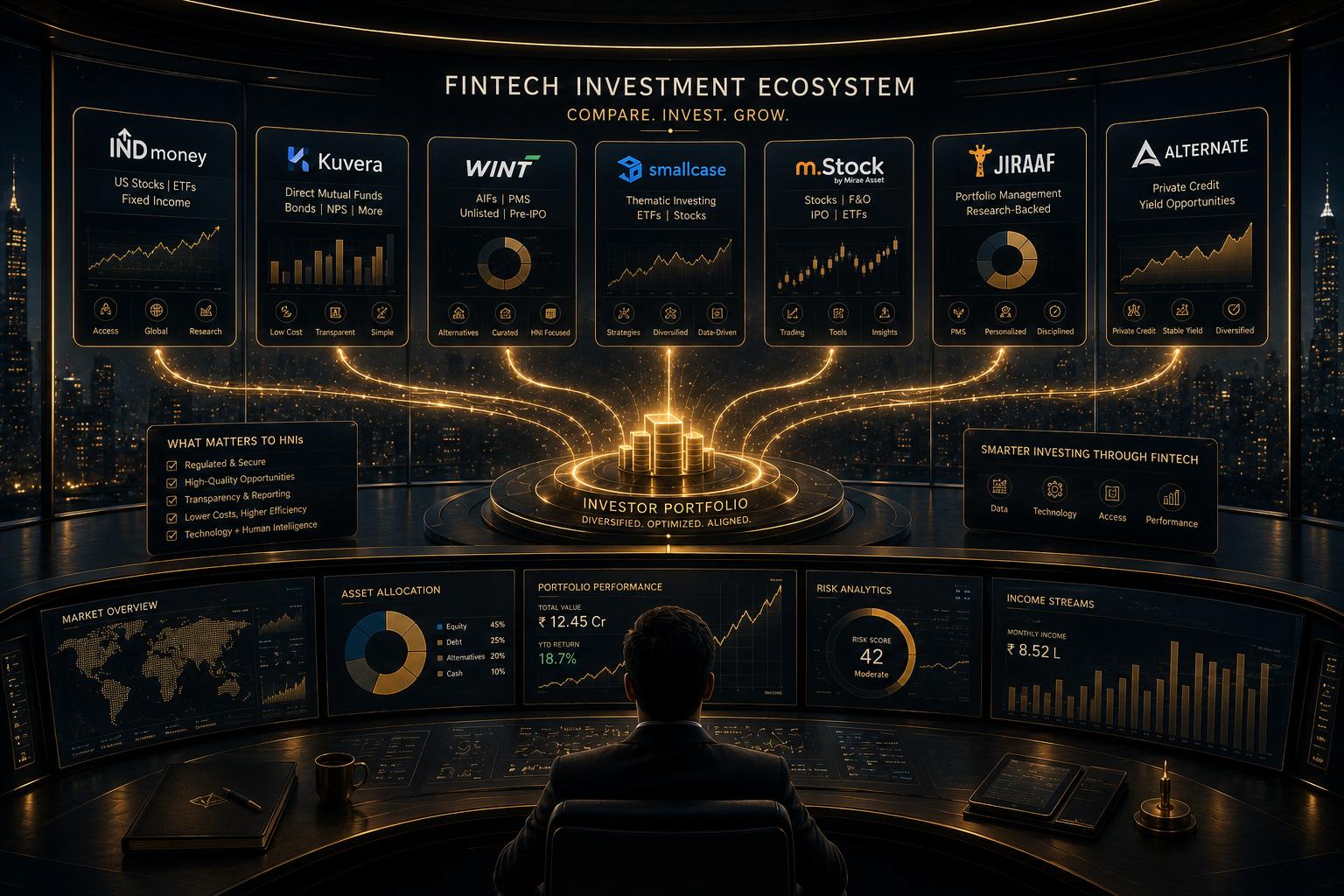
The HNI Platform Landscape in 2026: 4 Categories
The fintech investment platform landscape in India has matured significantly. What was once a fragmented space of unregulated aggregators has consolidated into five clearly defined categories, each with specific regulatory frameworks, product types, and HNI relevance.
| Category | Regulation | Primary Products | HNI Minimum | Return Range | Best For |
|---|---|---|---|---|---|
| SEBI-Registered OBPPs (Online Bond Platform Providers) | SEBI + Stock Exchange (NSE/BSE) | Corporate bonds, NCDs, G-Secs, SDIs, tax-free bonds | ₹10,000–₹1 lakh | 8%–14% gross | Fixed income core, monthly coupon income, diversified bond portfolio |
| Curated Alternative Investment Marketplaces (e.g. Ultra) | Instrument-specific - not SEBI OBPP | Invoice discounting, asset leasing, alternative fixed income | ₹10,000–₹25,000 | 10%–15% gross | Short-tenure high yield, FD replacement, HNI-curated alternative income |
| Invoice Discounting / SCF Platforms (RBI TReDS / KredX) | RBI (TReDS) or SEBI (OBPP) | Invoice discounting, supply chain finance | ₹25,000–₹1 lakh | 10%–15% gross | Short-tenure high yield, liquid alternative income |
| AIF Access Platforms | SEBI (AIF regulations) | Category II private credit, PE, real estate AIFs | ₹1 crore (SEBI mandate) | 12%–18% net (private credit); 20%+ IRR (PE, target) | Illiquid high-yield core, institutional-quality private credit |
| PMS Platforms | SEBI (PMS regulations) | Concentrated equity portfolios in listed securities | ₹50 lakhs (SEBI mandate) | 12%–22%+ (target, equity-market-linked) | Long-horizon equity wealth creation, alpha over index |
Category 1: SEBI-Registered OBPPs - Fixed Income and Bond Platforms
As of 2025, NSE had 28 registered OBPPs of which 22 were enabled and actively operating. All registered OBPPs operate under the same regulatory framework - securities in investor demat, standardised disclosures, SCORES grievance pathway - but differ significantly in product selection, credit curation, minimum investment, and HNI focus.
Important distinction: Ultra (getultra.club) is not a SEBI-registered OBPP - it is a curated alternative investment marketplace covered separately in Category 2 below. The platforms covered here are registered OBPPs offering listed bond investments under SEBI's full exchange-regulated framework.
Here is an honest assessment of the major OBPP platforms from an HNI investor's perspective:
GoldenPi India's oldest online bond platform (founded 2017, first OBPP registration January 2023). Known for the widest bond inventory - typically 5,000+ bonds across corporate, PSU, government, and tax-free categories. Strengths: breadth of selection, secondary market access, integration with Zerodha and Upstox accounts. For HNIs who want to build a comprehensive bond portfolio across rating tiers and tenures, GoldenPi's inventory depth is genuinely useful. Minimum: ₹10,000.
BondScanner is the bond investment platform from the same parent group as Ultra (Tap Invest / Sustvest Broking Private Limited) — operating as a dedicated online bond marketplace for corporate bonds, PSU bonds, G-Secs, and government securities. Zero brokerage model. Yields: 9–12% indicative. Minimum ₹10,000. BondScanner is the SEBI-registered broking entity for bond investing within the group — the fixed income complement to Ultra's alternative investment marketplace. For investors in the Ultra ecosystem who also want direct bond exposure, BondScanner provides the listed bond access on the same group's infrastructure.
WintWealth (in partnership with Zerodha) Positioned as a "safe high-yield" platform - focuses primarily on senior secured bonds and covered bonds. The Zerodha partnership means seamless integration for the large segment of HNIs already using Zerodha for equity. Strengths: curated, lower-risk selection; Zerodha ecosystem integration. Limitations for HNIs: product range is narrower than GoldenPi; the "safe" curation means some higher-yield opportunities are filtered out. Minimum: ₹10,000.
IndiaBonds Positions itself on AI-powered recommendation and portfolio analytics tools - a Bond Analyser Suite that aggregates data from FIMMDA, NSDL, CDSL, NSE/BSE, and SEBI. For HNIs who want institutional-grade bond analytics alongside the investment marketplace, IndiaBonds offers more analytical depth than most platforms. Returns range: 8–15% across product range. Minimum: ₹1,000.
Jiraaf Received SEBI OBPP registration in December 2023. Focuses on fixed income with a data-oriented approach. Product range: corporate bonds, SDIs/PTCs, high-yield FDs, T-Bills, G-Secs. Returns 8–15%. Minimum ₹1,000. For HNIs who want to actively manage a fixed income portfolio with strong analytical tools, Jiraaf is a strong option.
Grip Invest Differentiates on asset-backed products - covered bonds (bankruptcy-remote structures), lease financing, and SDIs. For HNIs interested in structured, asset-backed income beyond vanilla corporate bonds, Grip offers genuine product differentiation. Minimum: ₹10,000.
| Platform | HNI Focus | Yield Range | Minimum Investment | Differentiation | Best For HNIs |
|---|---|---|---|---|---|
| GoldenPi | Retail + HNI - widest inventory | 7%–15% | ₹10,000 | Widest bond inventory in India (5,000+ bonds); secondary market depth; multi-broker integration | HNIs building comprehensive bond portfolios across all rating tiers |
| WintWealth | Retail + HNI - safety-curated | 9%–13% | ₹10,000 | Zerodha ecosystem integration; senior secured / covered bond focus; curated lower-risk selection | Zerodha users wanting regulated fixed income alongside equity; safety-first approach |
| IndiaBonds | Retail + HNI - analytics-driven | 8%–15% | ₹1,000 | AI-powered bond recommendation engine; portfolio tracking tools; G-Secs and municipal bonds | Data-driven HNIs who want analytical tools for active bond portfolio management |
| Jiraaf | Retail + HNI - analytics + breadth | 8%–15% | ₹1,000 | Bond Analyser Suite; SDIs/PTCs alongside bonds; institutional data integration | HNIs wanting institutional-grade analytics with diverse product range |
| Grip Invest | Retail + HNI - asset-backed | 10%–15% | ₹10,000 | Covered bonds (bankruptcy remote); lease financing; asset-backed income products | HNIs specifically interested in structured, asset-backed fixed income |
For a guide to verifying any platform's SEBI registration, read: Top SEBI-Registered Investment Platforms in India 2025: Safety Checklist
Category 2: Curated Alternative Investment Marketplaces - Ultra
This category covers platforms that sit outside the SEBI OBPP framework but offer HNI investors access to high-yield alternative income instruments - specifically invoice discounting, asset leasing, and similar short-tenure products.
Ultra (getultra.club) Ultra is a curated alternative investment marketplace explicitly built for HNI and affluent investors - positioned around the tagline "investments service for affluent and HNI investors looking for opportunities beyond what is available to all." Ultra is not a SEBI-registered OBPP and does not offer listed bonds under the OBPP framework.
What Ultra offers: Invoice discounting (11–15% annualised, 30–90 day tenures), asset leasing (10–14%, monthly payouts), and access to curated alternative fixed income. The platform's primary differentiator is deal curation - screening buyer quality for invoice discounting deals and providing HNI-appropriate product access at ₹25,000 minimums.
Regulatory context: As a private alternative investment marketplace, Ultra operates under the regulatory frameworks applicable to the specific instruments it offers. Invoice discounting and asset leasing sit outside the SEBI OBPP product perimeter - they are not listed debt securities. Investors should understand this distinction before investing: the structural protections of the OBPP framework (demat custody, SCORES grievance, exchange RFQ routing) do not apply to these instruments.
Why it is still relevant for HNIs: The instruments Ultra offers - invoice discounting on strong buyers, asset leasing - fill a genuine gap that OBPP bond platforms do not cover. A 12% invoice discounting deal on a listed corporate buyer delivers more post-tax income than most AA bonds at equivalent credit quality. For HNIs who understand the instrument and the platform structure, Ultra provides a curated access point to this yield tier.
| Parameter | Ultra (getultra.club) |
|---|---|
| Platform type | Curated alternative investment marketplace |
| SEBI OBPP registration | Not an OBPP - different regulatory category |
| Primary products | Invoice discounting, asset leasing, alternative fixed income |
| Target investor | HNI and affluent investors - ₹25L+ deployment |
| Yield range | 10%–15% annualised |
| Minimum investment | ₹25,000 per deal |
| Tenure | 30–90 days (invoice discounting); 2–4 years (asset leasing) |
| Differentiation | HNI-first curation; buyer quality screening; portfolio XIRR dashboard |
| Formerly known as | Tap Invest |
KredX One of India's most established invoice discounting platforms - founded 2015, now also an RBI-licensed TReDS operator (KredX DTX). Offers both enterprise supply chain programmes (large corporate anchor buyers) and a retail investor-facing invoice discounting product. For HNIs with ₹5L+ to deploy, KredX's enterprise buyer network (including large FMCG and auto companies) offers access to high-quality underlying invoices. Returns: 11–15%.
M1xchange, RXIL, Invoicemart (TReDS Platforms) These three RBI-licensed TReDS platforms primarily serve banks and NBFCs as financiers - individual investor access is limited. However, certain structures allow HNIs to access TReDS-quality (PSU and large corporate-backed, non-recourse) invoice discounting returns through partner NBFCs or AIF structures that fund TReDS invoices. The regulatory protection on TReDS is the highest available - RBI oversight, mandatory buyer acknowledgment, non-recourse structures.
| Platform | Regulation | Buyer Quality | Yield Range | Min Investment | Recourse Structure | HNI Access |
|---|---|---|---|---|---|---|
| Ultra (getultra.club) | SEBI OBPP | Listed corporates, PSUs - curated | 11%–15% | ₹25,000 | With-recourse (MSME) on most; escrow-protected | Direct - retail and HNI app |
| KredX | SEBI OBPP + RBI TReDS (KredX DTX) | Large enterprise corporates, growing PSU base | 11%–15% | ₹1 lakh | With-recourse on KredX platform; non-recourse on TReDS | Direct for HNIs via platform |
| M1xchange / RXIL / Invoicemart (TReDS) | RBI (Market Infrastructure Institution) | PSUs, CPSEs, large listed corporates | 9%–13% | Not directly accessible to retail/HNI investors | Non-recourse (highest protection) | Indirect - through partner NBFC or AIF structures |
| CredAble | NBFC + SEBI | Large enterprise supply chains | 10%–14% | Primarily institutional; select HNI access | Varies by programme | Limited - primarily institutional capital |
Category 3: AIF Access Platforms - Private Credit and PE
For HNIs with ₹1 crore+ to deploy in illiquid alternatives, AIF platforms provide access to institutional-quality private credit and private equity funds. These are not direct investment platforms - they are marketplaces that connect HNIs with SEBI-registered Category I, II, and III AIF fund managers.
Grip Invest / Jiraaf (for SDIs) Both platforms offer Securitised Debt Instruments - pool-backed structured debt that provides diversified exposure to MSME loan pools, auto loans, and gold loans at 10–13% yields. SDIs are Category II AIF-adjacent instruments accessible at much lower minimums (₹10,000–₹1 lakh) than a full AIF commitment.
Centricity / Vivriti Asset Management Category II private credit AIF platforms targeting institutional and HNI investors at ₹1 crore minimums. Vivriti Asset Management manages one of India's larger private credit AIF books - MSME and mid-market lending at 13–16% gross. Centricity focuses on structured credit and mezzanine debt.
Edelweiss Alternatives / Kotak Alternate Asset Managers Established institutional-grade AIF managers with direct investor access for HNIs at ₹1 crore+. Edelweiss Alternatives manages Category II funds across private credit, real estate, and infrastructure. Kotak Alternate Asset Managers offers PE, real estate debt, and credit strategies. These are the "institutional shelf" options for family offices and large HNIs - not digital-first platforms but increasingly accessible online.
Stride Ventures / 9Unicorns (Venture / Cat I) Venture capital-focused Category I AIFs primarily for HNIs with startup ecosystem knowledge and long (7–12 year) investment horizons. Returns are power-law - a few outlier investments drive portfolio returns; most will return little.
| Platform / Manager | AIF Category | Strategy | Min Commitment | Target Net Return | Tenure | HNI Suitability |
|---|---|---|---|---|---|---|
| Vivriti Asset Management | Category II | Private credit - MSME and mid-market lending | ₹1 crore | 13%–16% p.a. | 3–4 years | High - regular income, defined tenure, senior secured |
| Edelweiss Alternatives | Category II / III | Real estate credit, private credit, infrastructure | ₹1 crore | 12%–18% (strategy dependent) | 3–7 years | High - institutional quality; established track record |
| Kotak Alternate Asset Managers | Category II / III | PE, real estate debt, structured credit, absolute return | ₹1 crore | 12%–20%+ (strategy dependent) | 3–7 years | High - established brand; deep deal sourcing |
| Grip Invest (SDIs) | AIF-adjacent (Cat II structures) | Securitised loan pools (auto, gold, MSME) | ₹10,000 | 10%–13% | 6–24 months | Moderate - good entry point; lower yield than full AIF |
| Centricity | Category II | Structured credit, mezzanine debt | ₹1 crore | 14%–18% | 3–5 years | High - for HNIs comfortable with structured debt complexity |
For a complete guide to AIF categories, fees, and taxation, read: What Are AIFs? A Complete Guide to Alternative Investment Funds in India
Category 4: PMS Platforms - Equity Wealth Management
For the equity allocation in an HNI portfolio, Portfolio Management Services (PMS) are the primary digital-first wealth management vehicle. SEBI mandates a ₹50 lakh minimum investment, and unlike mutual funds, PMS gives the investor direct ownership of individual securities.
Smallcase (Smallcase Technologies) Not a PMS - but the most accessible fintech equity platform for HNIs. Smallcase offers thematic, rule-based stock portfolios managed by SEBI-registered Research Analysts or Investment Advisers, at much lower minimums (₹1,000–₹10,000). For HNIs who want a digital-first, transparent equity approach without the ₹50 lakh PMS minimum, Smallcase provides a useful middle ground. Return potential: market-linked, strategy dependent.
Wright Research / Capitalmind / Green Portfolio (Digital PMS) A new generation of digitally-delivered SEBI-registered PMS providers offering quantitative or factor-based equity strategies. Lower minimums than traditional PMS (some at ₹50 lakhs as mandated), lower management fees (0.5–1% vs traditional 2–2.5%), and transparent track records. For HNIs who prefer rules-based, systematic equity management over discretionary fund manager judgement.
Traditional PMS providers (Motilal Oswal, Kotak, HDFC, SBI) The established PMS managers with large AUM, long track records, and full-service client management. These are primarily relationship-driven rather than digital-first - but many have launched digital onboarding. Target returns: 15–22% CAGR over 5-year horizons (strategy dependent, market-linked, not guaranteed).
Master Comparison: All Platforms by HNI Suitability
| Platform | Category | Regulation | Gross Return Range | Post-Tax Return (30%) | HNI Min. | Liquidity | HNI Suitability Score | Best Deployment Size |
|---|---|---|---|---|---|---|---|---|
| Ultra (getultra.club) | Curated Alternative Investment Marketplace | Instrument-specific — not SEBI OBPP | 10%–15% | 7%–10.5% | ₹25,000 | Low (30–90 day lock) | ★★★★★ | ₹25L–₹5Cr |
| GoldenPi | OBPP — Corporate Bonds | SEBI OBPP | 7%–15% | 4.9%–10.5% | ₹10,000 | Moderate (listed bonds) | ★★★★☆ | ₹25L–₹5Cr (bond portfolio) |
| BondScanner (bondscanner.com) | OBPP — Corporate + PSU + G-Sec Bonds | SEBI (Sustvest Broking Pvt Ltd) | 9%–12% | 6.3%–8.4% | ₹10,000 | Moderate (listed bonds) | ★★★★☆ | ₹10L–₹3Cr (Ultra ecosystem bond layer) |
| WintWealth | OBPP — Senior Secured Bonds | SEBI OBPP | 9%–13% | 6.3%–9.1% | ₹10,000 | Moderate | ★★★★☆ | ₹10L–₹2Cr (safety-first) |
| Jiraaf | OBPP — Bonds + SDIs | SEBI OBPP | 8%–15% | 5.6%–10.5% | ₹1,000 | Moderate | ★★★★☆ | ₹25L–₹2Cr (analytics-driven) |
| KredX | OBPP + TReDS (Invoice Discounting) | SEBI OBPP + RBI TReDS | 11%–15% | 7.7%–10.5% | ₹1 lakh | Low (30–90 day lock) | ★★★★☆ | ₹5L–₹5Cr |
| Grip Invest | OBPP — Asset-Backed + SDIs | SEBI OBPP | 10%–15% | 7%–10.5% | ₹10,000 | Low–Moderate | ★★★★☆ | ₹10L–₹2Cr (structured products) |
| Vivriti Asset Management | Category II AIF (Private Credit) | SEBI AIF | 13%–16% | 9.1%–11.2% | ₹1 crore | Very Low (3–4 yr lock) | ★★★★★ | ₹1Cr–₹5Cr (illiquid allocation) |
| Edelweiss Alternatives | Category II / III AIF | SEBI AIF | 12%–18% | 8.4%–12.6% | ₹1 crore | Very Low (3–7 yr lock) | ★★★★★ | ₹1Cr–₹10Cr (family office / large HNI) |
| Smallcase | Equity — Thematic Portfolios | SEBI RA / RIA | Market-linked (10%–20%+ CAGR target) | LTCG 12.5% on gains | ₹10,000–₹1 lakh | High (daily) | ★★★☆☆ | ₹5L–₹50L (satellite equity allocation) |
| Traditional PMS (Motilal, Kotak, HDFC) | PMS — Concentrated Equity | SEBI PMS | 15%–22%+ (target CAGR) | LTCG 12.5% on long-term gains | ₹50 lakhs | High (listed securities) | ★★★★☆ | ₹50L–₹5Cr (equity allocation) |
Choosing the Right Platform: The HNI Decision Framework
| HNI Profile | Primary Need | Recommended Platform(s) | Allocation | Why |
|---|---|---|---|---|
| ₹25L–₹1Cr corpus, 35–50 years, wants FD replacement | Higher yield with short tenure, no long lock-ins | Ultra (invoice discounting + bonds) + GoldenPi (bond portfolio) | 60% Ultra, 40% GoldenPi | Ultra provides 11–15% short-tenure income; GoldenPi adds bond diversification for longer-term yield |
| ₹1Cr–₹5Cr corpus, 45–60 years, wants income-focused portfolio | Regular monthly income + capital preservation | Ultra (30%) + GoldenPi/Jiraaf bonds (30%) + Vivriti AIF (20%) + PMS (20%) | Diversified across platforms | Ultra provides short-tenure high yield; bonds provide monthly coupons; AIF provides institutional yield; PMS provides long-term growth |
| ₹5Cr+ corpus, family office / founder, wants maximum diversification | Institutional alternatives + equity growth + income | Ultra + Edelweiss/Kotak AIFs + Traditional PMS + GoldenPi | 25% Ultra ID/bonds, 25% private credit AIF, 25% equity PMS, 25% other | Full alternative fixed income stack; institutional AIF quality; equity for long-term growth |
| NRI, ₹50L–₹5Cr in India, wants India fixed income exposure | Repatriable, tax-efficient India fixed income | Ultra (NRE account) + GoldenPi (NRE-linked bonds) + Tax-free bonds (BSE/NSE) | 40% invoice discounting, 40% AA bonds, 20% tax-free bonds | NRE routing ensures full repatriability; Ultra's invoice discounting + bonds delivers 9–12% post-TDS |
| Zerodha user, ₹25L–₹2Cr, wants minimal new accounts | Convenience + above-FD returns within existing ecosystem | WintWealth (Zerodha integration) + Ultra (supplementary high yield) | 60% WintWealth, 40% Ultra | WintWealth maximises Zerodha ecosystem convenience; Ultra adds higher yield from invoice discounting |
Post-Tax Return Comparison at HNI Tax Rates
| Platform / Instrument | Typical Gross Yield | Post-Tax (30% bracket) | Post-Tax (39% bracket — ₹2Cr+) | Post-Tax (42.74% bracket — ₹5Cr+, old regime) | Real Return vs 4.5% Inflation (30%) |
|---|---|---|---|---|---|
| Ultra — Invoice Discounting (large corporate) | 12% | 8.4% | 7.32% | 6.87% | +3.9% |
| GoldenPi / Jiraaf — AA NCD (10.5%) | 10.5% | 7.35% | 6.41% | 6.01% | +2.85% |
| WintWealth — Senior Secured Bond (9.5%) | 9.5% | 6.65% | 5.8% | 5.43% | +2.15% |
| Vivriti / Edelweiss AIF — Private Credit (14% net) | 14% net of fees | 9.8% | 8.54% | 8.01% | +5.3% |
| Tax-Free PSU Bonds (secondary, 8% YTM) | 8% (tax-free) | 8% (no tax) | 8% (no tax) | 8% (no tax) | +3.5% |
| Bank FD (comparison baseline) | 7% | 4.9% | 4.27% | 4.01% | +0.4% |
The key insight from this table: For HNIs in the 39–42.74% effective tax bracket, the post-tax spread between invoice discounting (6.87–7.32%) and bank FDs (4.01–4.27%) is approximately 2.86–3.05% annually. On ₹5 crore, that is ₹1.43–₹1.52 crore more over 10 years in post-tax wealth — purely from platform selection and instrument choice, with no increase in risk profile.
What HNIs Get Wrong When Choosing Investment Platforms
Mistake 1: Choosing platform before choosing instrument
The instrument should drive the platform, not the reverse. Decide first: do you want short-tenure high-yield (invoice discounting → Ultra, KredX), diversified bond portfolio (Bondscanner), institutional private credit (Vivriti, Edelweiss AIFs), or equity PMS? Then choose the best platform for that instrument.
Mistake 2: Comparing gross yields without tax
At 30%+ effective tax rates, a 12% invoice discounting return and a 10.5% bond coupon are not a 1.5% difference they are both taxed at slab rate and deliver 8.4% and 7.35% post-tax respectively. Always compute post-tax before comparing.
Mistake 3: Over-concentrating in one platform
An HNI with ₹2 crore in fixed income deployed entirely on one OBPP platform has concentrated operational risk even on a regulated platform. Spreading across 2–3 regulated platforms with different product specialisations (e.g., Ultra for invoice discounting + GoldenPi for bond portfolio + one AIF for private credit) provides instrument diversification, platform diversification, and access to the best of each specialist's curation.
Mistake 4: Not verifying SEBI registration before investing
SEBI's November 2025 caution about unregistered OBPPs was a direct response to platforms operating without required registration. Verify NSE OBPP list status for any bond platform before investing. This takes under 5 minutes and is non-negotiable.
Mistake 5: Treating all OBPP platforms as equivalent
All SEBI-registered OBPPs provide the same structural protections (demat custody, SCORES grievance, exchange monitoring). What varies dramatically is credit curation which deals make it onto the platform and why. An OBPP that lists every available bond regardless of quality provides no underwriting value. An OBPP that screens for buyer quality, rating, and structural soundness provides a genuine service. The registration is the same; the investment outcome differs.
FAQs
Q1. What are the best fintech investment platforms for HNIs in India in 2026?
For fixed income: Ultra (getultra.club) for invoice discounting and curated bonds (10–15% yield), GoldenPi for broadest bond inventory, Jiraaf for analytics-driven fixed income. For private credit: Vivriti Asset Management and Edelweiss Alternatives for Category II AIFs (12–16% net, ₹1 crore minimum). For equity: traditional PMS managers (Motilal Oswal, Kotak, HDFC) or digital PMS for systematic equity. The right combination depends on corpus size and income vs growth priorities.
Q2. How do I choose between platforms like Ultra, GoldenPi, and Jiraaf?
These platforms serve different purposes. Ultra is a curated alternative investment marketplace — not a SEBI-registered OBPP — offering invoice discounting and asset leasing (10–15% yield, 30–90 day tenures) for HNIs. GoldenPi and Jiraaf are SEBI-registered OBPPs offering listed bonds with demat-based custody and exchange-regulated protections. Use Ultra for short-tenure alternative income; GoldenPi for the widest bond inventory; Jiraaf for analytics-driven bond portfolio management. They are complementary — each covers a different product need.
Q3. What is the minimum investment for HNI-focused investment platforms in India?
OBPP bond and invoice discounting platforms: ₹10,000–₹25,000. Category II AIFs (private credit, PE): ₹1 crore (SEBI-mandated minimum). PMS: ₹50 lakhs (SEBI-mandated minimum). A well-diversified HNI fixed income portfolio across OBPP platforms can be built from ₹25 lakhs upwards.
Q4. Are fintech investment platforms in India safe?
Safety depends critically on regulatory registration. SEBI-registered OBPPs provide structural protections — demat custody, standardised disclosures, SCORES grievance pathway. SEBI's November 2025 alert (PR 75/2025) specifically warned about unregistered platforms operating without required registration. Always verify OBPP status on NSE's official list before investing. Registered platforms are structurally safe from platform risk; credit risk on underlying instruments remains and requires separate management.
Q5. Which fintech platform gives the highest returns for HNIs in India?
On a post-tax basis at the 30% bracket: private credit AIFs (9.8% post-tax at 14% gross net of fees), invoice discounting on strong buyers (8.4% at 12% gross), and AA NCDs (7.35% at 10.5% gross). Tax-free PSU bonds at 8% YTM deliver 8% post-tax regardless of bracket — superior for HNIs at 39–42.74% effective rates. For equity: PMS target returns are 15–22% CAGR before tax, with LTCG at 12.5% on long-term gains.
Q6. How do OBPP platforms make money?
SEBI-registered OBPPs typically earn through a spread on bond transactions (buying bonds at a slightly lower price from the issuer or seller and offering them to investors at a small markup) or through explicit platform fees on certain products. This spread is typically 0.2–0.8% on the transaction value. The spread model aligns platform incentives with deal volume rather than yield — important to understand when platforms curate higher-yielding but higher-risk instruments.
Disclaimer
This article is for informational and educational purposes only. Platform registration status and product offerings may change. This article does not constitute an endorsement of any specific platform. All investments carry risk. Please verify current platform registration directly at nseindia.com and sebi.gov.in before investing.
Build your HNI investment portfolio at ultra India's HNI-first SEBI-registered platform for invoice discounting, corporate bonds, and alternative fixed income. Pre-screened, transparent, and designed for investors who deploy at scale.
Recent articles
View all
finance
RBI Repo Rate Hike: October 2026 Policy Update, Impact on Loans, EMIs, Deposits & Markets
A simple guide to the October 2026 RBI repo rate hike, what it means for borrowers, depositors, investors, banks and the broader economy.
Sachin Gadekar
·
08 Oct 2026

IPO
Reliance Jio IPO: Date, Price, GMP, Valuation, Review & Details
A complete guide to Reliance Jio IPO 2026, covering Jio Platforms IPO details, issue size, expected date, price band status, GMP context, shareholder quota, company profile, financials, valuation and risks.
Sachin Gadekar
·
07 Oct 2026

IPO
HD Fire Protect IPO Details: Date, Price, GMP, Review & How to Apply
A complete guide to HD Fire Protect IPO 2026, covering issue size, OFS structure, price band, lot size, GMP context, company profile, financials, risks, valuation and application process.
Sachin Gadekar
·
07 Oct 2026

IPO
Nityas Gems & Jewellery IPO Details: Date, Price, GMP, Review & How to Apply
A complete guide to Nityas Gems & Jewellery IPO 2026, covering issue size, GMP context, price band, lot size, company profile, financials, risks, valuation and application process.
Sachin Gadekar
·
05 Oct 2026