What Are ESOPs? Meaning, Benefits, and How ESOPs Work in India
23 December 2025
A complete guide to Employee Stock Ownership Plans (ESOPs) in India, including allocation, benefits, taxation, and risks
Introduction
Employee Stock Ownership Plans, commonly known as ESOPs, have become an important part of compensation structures in startups and established companies alike. In India, ESOPs are increasingly used to attract talent, retain employees, and align employee interests with long-term company growth.
Despite their popularity, many employees struggle to understand what ESOPs really mean, how they are allocated, and whether they truly add value to their salary. This article explains ESOPs in a simple, structured manner, covering their meaning, benefits, allocation process, and relevance in the Indian context.
What Are ESOPs
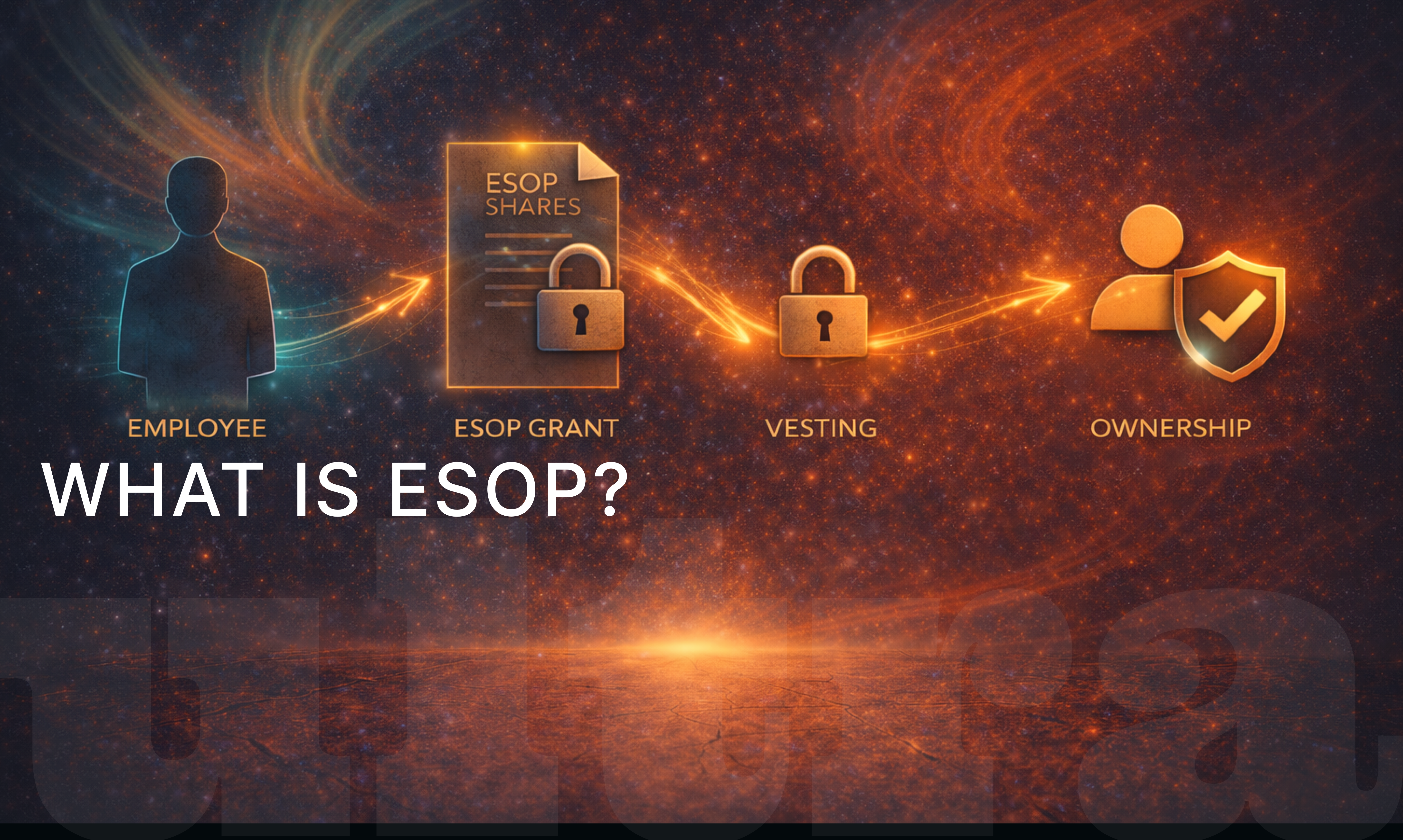
ESOPs, or Employee Stock Ownership Plans, are schemes through which a company grants its employees the right to purchase company shares at a predetermined price after meeting certain conditions.
ESOPs do not immediately give ownership of shares. Instead, they provide employees with the option to acquire shares in the future, subject to vesting conditions and company policies.
In simple terms, ESOPs allow employees to become partial owners of the company they work for.
ESOP Meaning in Salary
When ESOPs are included in a compensation package, they are usually mentioned as part of the Cost to Company (CTC). However, ESOPs are not cash salary.
The ESOP meaning in salary can be understood as follows:
ESOPs are a non-cash component of compensation
They represent potential future wealth, not guaranteed income
Their value depends on the company’s growth and share price
Employees should view ESOPs as a long-term incentive rather than immediate earnings.
Why Companies Offer ESOPs
Companies offer ESOPs for several strategic reasons:
To attract high-quality talent without high upfront salary costs
To retain employees for longer durations
To align employee performance with company growth
To conserve cash, especially in startups
By offering ownership, companies encourage employees to think like shareholders and contribute to long-term value creation.
What Are ESOPs in India
In India, ESOPs are governed primarily by the Companies Act, 2013 and relevant SEBI regulations for listed companies. Both listed and unlisted companies can issue ESOPs, subject to compliance requirements.
Key characteristics of ESOPs in India include:
Issuance through a formal ESOP scheme
Approval by shareholders
Clearly defined vesting schedules
Taxation at exercise and sale stages
ESOPs are widely used by startups, technology companies, and fast-growing private firms in India.
ESOPs for Private Companies
ESOPs for private companies are especially common in startups and growth-stage businesses. Since these companies are not publicly listed, employees cannot immediately sell their shares on a stock exchange.
In private companies:
Liquidity events occur through buybacks, mergers, or IPOs
Share valuation is determined internally or by external valuers
Exit opportunities may be limited or time-bound
Despite liquidity challenges, ESOPs in private companies can be highly rewarding if the company scales successfully.
Vesting Period and Cliff Period Explained
Vesting refers to the process by which employees earn the right to exercise their ESOPs over time.
Key concepts include:
Vesting period: The total duration over which ESOPs become exercisable
Cliff period: The minimum period an employee must complete before any ESOPs vest
For example, a four-year vesting schedule with a one-year cliff means no ESOPs vest in the first year, and a portion vests annually thereafter.
ESOP Exercise Process
Once ESOPs are vested, employees can exercise them, meaning they purchase the shares at the agreed exercise price.
The exercise process generally involves:
Submitting an exercise request
Paying the exercise price
Receiving shares in the demat account or company records
Exercise does not automatically mean profit. Gains depend on the company’s valuation at the time of sale.
ESOP Benefits for Employees
ESOP benefits for employees include:
Opportunity to build long-term wealth
Participation in company growth
Sense of ownership and motivation
Potential upside during IPOs or acquisitions
For employees who join early-stage companies, ESOPs can sometimes outperform traditional salary increments.
ESOP Benefits for Employers
Employers also benefit significantly from ESOPs:
Lower immediate cash outflow
Improved employee retention
Higher employee engagement
Alignment of employee and shareholder interests
ESOPs help companies build stable teams focused on sustainable growth.
Taxation of ESOPs in India
ESOP taxation in India occurs at two stages:
First, at the time of exercise, the difference between the fair market value and the exercise price is taxed as perquisite income.
Second, at the time of sale, capital gains tax applies based on the holding period and sale price.
Understanding ESOP taxation is crucial to accurately evaluate their real value.
Risks and Limitations of ESOPs
Despite their advantages, ESOPs come with certain risks:
No guaranteed liquidity
Share value may not increase
Complex tax implications
Dependence on company performance
Employees should avoid overestimating ESOP value and maintain balanced financial planning.
ESOPs vs Salary vs Bonuses
Unlike salary and bonuses, ESOPs:
Do not provide immediate cash
Carry higher risk and higher potential reward
Depend on long-term company success
ESOPs are best viewed as a wealth-creation tool rather than a substitute for stable income.
What Happens to ESOPs When You Leave a Company
When an employee resigns or is terminated:
Vested ESOPs usually need to be exercised within a specified time
Unvested ESOPs are forfeited
Policies vary based on company ESOP rules
Employees should carefully review exit clauses before making career decisions.
Frequently Asked Questions
Are ESOPs guaranteed income?
No, ESOPs depend on company performance and future valuation.
Can ESOPs make employees rich?
They can, but only if the company performs exceptionally well.
Do all companies in India offer ESOPs?
No, ESOPs are more common in startups and growth-oriented firms.
Can ESOPs be sold immediately?
Only if there is a liquidity event such as an IPO or buyback.
Conclusion
ESOPs are a powerful compensation tool that allows employees to participate in a company’s growth journey. Understanding what ESOPs are, how ESOP shares are allocated, and their benefits and risks helps employees make informed financial decisions.
In India, ESOPs play a vital role in startup ecosystems and private companies, offering long-term wealth creation opportunities alongside professional growth. Platforms like Ultra aim to simplify complex financial concepts like ESOPs, enabling investors and professionals to navigate ownership-based compensation with confidence.
Recent articles
View all
finance
RBI Repo Rate Hike: October 2026 Policy Update, Impact on Loans, EMIs, Deposits & Markets
A simple guide to the October 2026 RBI repo rate hike, what it means for borrowers, depositors, investors, banks and the broader economy.
Sachin Gadekar
·
08 Oct 2026

IPO
Reliance Jio IPO: Date, Price, GMP, Valuation, Review & Details
A complete guide to Reliance Jio IPO 2026, covering Jio Platforms IPO details, issue size, expected date, price band status, GMP context, shareholder quota, company profile, financials, valuation and risks.
Sachin Gadekar
·
07 Oct 2026

IPO
HD Fire Protect IPO Details: Date, Price, GMP, Review & How to Apply
A complete guide to HD Fire Protect IPO 2026, covering issue size, OFS structure, price band, lot size, GMP context, company profile, financials, risks, valuation and application process.
Sachin Gadekar
·
07 Oct 2026

IPO
Nityas Gems & Jewellery IPO Details: Date, Price, GMP, Review & How to Apply
A complete guide to Nityas Gems & Jewellery IPO 2026, covering issue size, GMP context, price band, lot size, company profile, financials, risks, valuation and application process.
Sachin Gadekar
·
05 Oct 2026