SBI Funds Management IPO 2026: Review, Price Band & Should You Subscribe?
14 July 2026 · Sankarshan B
A complete review of the SBI Funds Management IPO open July 14–16, 2026, price band ₹545-₹574, issue size ₹9,813 crore, GMP ₹95-100, FY26 financials, valuation vs listed AMC peers, key risks, and an honest subscription verdict for retail and HNI investors.

India's largest asset management company is finally going public. SBI Funds Management Limited — the AMC behind SBI Mutual Fund, a joint venture between State Bank of India and France's Amundi Asset Management — opened its IPO for subscription today, July 14, 2026.
With a price band of ₹545–₹574 per share and an issue size of approximately ₹9,813 crore, the SBI Funds Management IPO is one of the largest financial sector listings in recent years. The issue closes on July 16, with listing on NSE and BSE scheduled for July 21, 2026.
This article gives you everything you need to make the subscription decision — the verified numbers from the RHP, a peer valuation comparison, the grey market premium (GMP), key risks, and a specific subscription verdict.
SBI Funds Management IPO: Key Details at a Glance
| Parameter | Detail |
|---|---|
| IPO open date | July 14, 2026 (today) |
| IPO close date | July 16, 2026 |
| Price band | ₹545 – ₹574 per share |
| Issue size | ~₹9,813 crore (100% OFS of 17.09 crore shares) |
| Issue type | 100% Offer for Sale (OFS) — SBI Funds Management receives zero proceeds |
| Selling shareholders | State Bank of India (SBI) and Amundi India Holding |
| Lot size | 26 shares per lot |
| Minimum investment (retail) | ₹14,924 (1 lot at upper price band ₹574) |
| Basis of allotment | July 17, 2026 |
| Share credit date | July 20, 2026 |
| Listing date | July 21, 2026 on NSE and BSE |
| GMP (as of July 14, 2026) | ₹95–₹100 per share (suggesting 17–18% listing premium) |
| Implied market capitalisation | ~₹1.17 lakh crore at upper price band |
| Anchor investors (July 13) | ₹2,663 crore raised from 100+ anchors including LIC, HDFC MF, ICICI Prudential MF, Government of Singapore, Blackrock, Goldman Sachs, Fidelity, Nomura |
| Book Running Lead Managers | Kotak Mahindra Capital, Axis Capital, BofA Securities, HSBC, ICICI Securities, Jefferies India, JM Financial, Motilal Oswal, SBI Capital Markets |
| Registrar | KFin Technologies |
SBI Funds Management (SBIFM) is the asset management company (AMC) that manages SBI Mutual Fund — India's largest mutual fund by quarterly average assets under management (QAAUM). It is a joint venture between State Bank of India (74.99% stake) and Amundi Asset Management, Europe's largest AMC.
The scale in numbers:
| Metric | Figure |
|---|---|
| Mutual Fund QAAUM | ₹12.51 lakh crore |
| Total QAAUM (incl. PMS, AIF, SIF, advisory) | ₹29.04–29.46 lakh crore |
| Mutual fund industry market share | ~15.3% |
| ETF/Index fund market share | 27.9% — India's largest passive AMC |
| Total investors served | 18 million+ |
| Live SIP accounts | 16.21 million |
| Mutual fund schemes managed | 126 schemes across equity, debt, hybrid, ETF, index, liquid, FoF |
| Distribution network | 132,000+ MF distributors; digital via YONO (SBI's banking app) and InvesTap |
| QAAUM CAGR (FY24-FY26) | 17% (mutual fund QAAUM) |
| Promoters | SBI (74.99%) + Amundi India Holding |
The SBI distribution advantage: SBI's 22,000+ branch network and YONO app with 80 million+ registered users gives SBI Funds Management an unmatched last-mile distribution capability in India — particularly in Tier 2, Tier 3, and rural India, where financial inclusion is growing fastest. No other Indian AMC has access to a comparable captive distribution channel.
The Amundi advantage: Amundi manages approximately €2.2 trillion globally — making it Europe's largest AMC. The JV structure gives SBI Funds Management access to Amundi's global investment research, risk management frameworks, and international client relationships — capabilities that purely domestic AMCs lack.
SBI Funds Management FY26 Financials: Revenue, Profit, and Margins
| Metric | FY25 | FY26 | YoY Change |
|---|---|---|---|
| Revenue from Operations | ₹4,236 crore | ₹4,976 crore | +17.5% |
| Net Profit (PAT) | ₹2,540 crore | ₹3,067 crore | +20.7% |
| Net Profit Margin | ~60% | ~61.6% | Improved |
| QAAUM CAGR (FY24-FY26) | — | 17% (mutual fund AUM) | Strong structural growth |
The key positive from the financials: Unlike NSE (which saw a 15.5% PAT decline in FY26 due to F&O regulatory tightening), SBI Funds Management grew both revenue (+17.5%) and profit (+20.7%) in FY26. The AMC business is structurally benefiting from the ongoing SIP-ification of India — monthly SIP inflows into mutual funds are at record highs, and SBI MF with 16.21 million live SIP accounts is a primary beneficiary.
The asset-light model: AMC businesses are inherently high-margin — they earn management fees as a percentage of AUM (approximately 40-60 basis points on equity AUM) with minimal incremental costs as AUM grows. Every ₹1,000 of new AUM that SBI MF attracts generates recurring fee income with near-zero marginal cost. This is why net margins of 60%+ are structurally sustainable for leading AMCs.
SBI Funds Management IPO Valuation: Is ₹574 the Right Price?
At the upper price band of ₹574 per share, SBI Funds Management is valued at approximately ₹1.17 lakh crore market capitalisation.
Valuation multiples implied:
P/E on FY26 PAT (₹3,067 crore): ₹1.17 lakh crore ÷ ₹3,067 crore = ~38x
Price-to-AUM (on mutual fund QAAUM of ₹12.51 lakh crore): ₹1.17 lakh crore ÷ ₹12.51 lakh crore = ~9.4%
Is 38x P/E reasonable for an AMC?
The AMC sector in India trades at premium multiples globally — because mutual fund businesses are high-margin, capital-light, and structurally growing with India's financial inclusion wave. The question is not whether a premium is justified but whether 38x is the right premium.
The key valuation argument being made by bulls: At 17% AUM CAGR over FY24-FY26, if SBI Funds Management continues at even 12-15% AUM growth annually, earnings growth will track closely — meaning the forward P/E (on FY27 and FY28 earnings) shrinks rapidly. At 15% earnings growth from FY26, FY27 PAT would be approximately ₹3,527 crore — implying a forward P/E of ~33x. By FY28, approximately ~29x.
The key valuation concern: SEBI has been actively revising AMC regulations — including expense ratio caps, total return index mandates, and direct plan growth. Any regulatory compression of fee rates or expense ratios would directly reduce AMC profitability. This regulatory risk is the primary overhang on the entire AMC sector.
Peer Comparison: SBI MF vs HDFC AMC, Nippon India, UTI AMC
| AMC | Market Cap (approx.) | Mutual Fund AUM (approx.) | TTM P/E | Price to AUM | Revenue Growth (FY26 YoY) |
|---|---|---|---|---|---|
| SBI Funds Management (IPO price ₹574) | ₹1.17 lakh crore | ₹12.51 lakh crore | ~38x (FY26) | ~9.4% | +17.5% |
| HDFC AMC | ~₹1.05-1.10 lakh crore | ₹8.5-9 lakh crore | ~40-42x | ~12-13% | Strong — HDFC AMC is the closest private sector peer |
| Nippon India AMC | ~₹35,000-40,000 crore | ₹5-5.5 lakh crore | ~35-38x | ~7% | Solid — strong ETF franchise |
| UTI AMC | ~₹15,000-18,000 crore | ₹3.5-4 lakh crore | ~28-30x | ~4-5% | Moderate — smaller scale |
The peer comparison verdict: SBI Funds Management at 38x FY26 P/E and 9.4% price-to-AUM is offered at a meaningful discount to HDFC AMC (40-42x P/E, 12-13% price-to-AUM) — India's most comparable private sector AMC peer. The discount reflects SBI MF's government-owned promoter structure (which may attract a conglomerate discount), slightly lower historical return-on-equity versus HDFC AMC, and the regulatory risk of government interference in investment decisions.
However, the discount also means SBI Funds Management is priced more attractively than HDFC AMC on an absolute valuation basis — which is the primary bull case for subscribing at IPO.
SBI Funds Management IPO GMP Today (July 14, 2026)
The grey market premium (GMP) for SBI Funds Management IPO as of July 14, 2026 is ₹95–₹100 per share — suggesting an expected listing price of approximately ₹669–₹674 per share, a listing gain of approximately 17–18% over the upper price band of ₹574.
What the GMP tells you — and what it does not:
The GMP reflects informal grey market sentiment — demand from retail and HNI investors willing to pay a premium before allotment. A GMP of ₹95-100 on a ₹574 issue price is meaningfully positive, indicating strong retail and HNI demand expectations.
What the GMP cannot tell you:
Whether the listing gain will sustain after the first hour of trading
Whether institutional investors (who received 50% of the issue via QIB allocation) will hold or sell post-listing
The long-term investment case
The anchor book is the more reliable signal: The fact that LIC, HDFC MF, ICICI Prudential MF, Government of Singapore, Blackrock, Goldman Sachs, Fidelity, and Nomura participated in the ₹2,663 crore anchor allotment at ₹574 (the upper price band) signals strong institutional conviction. Anchor investors have a 90-day lock-in post-listing — they are not listing-day sellers. This is a meaningfully stronger validation signal than GMP.
OFS Structure: Who Is Selling and What It Means
The SBI Funds Management IPO is a 100% OFS — SBI and Amundi India Holding are selling portions of their existing stakes. SBI Funds Management itself receives zero proceeds.
SBI's rationale: SBI is monetising a portion of its 74.99% stake in SBI Funds Management. The partial exit raises capital for SBI's core banking business while retaining majority control. Importantly, SBI's MD has indicated a plan to dilute approximately 10% now and another 10% over 10 years — signalling this is a gradual, long-term monetisation, not a full exit.
Amundi's rationale: Similarly partial — Amundi India Holding is reducing its stake while remaining a strategic JV partner. Amundi's continued involvement ensures SBI Funds Management retains access to global investment research and risk management capabilities.
What OFS means for investors: Zero growth capital goes to the business. This is not a concern for SBI Funds Management specifically — the AMC generates strong internal cash flows and requires minimal capital expenditure. The OFS structure simply means existing shareholders exit while the business continues its organic growth trajectory.
Key Risks You Need to Know Before Subscribing
1. SEBI expense ratio and fee regulation risk SEBI has historically intervened to cap or reduce AMC management fees. Any future reduction in total expense ratios (TERs) would directly compress SBI Funds Management's revenue without a proportional reduction in costs — potentially squeezing margins. This is the single largest regulatory risk for the entire AMC sector.
2. Market downturn impact on AUM and fees AMC revenues are directly tied to AUM — which moves with equity market levels. A significant market correction (15-25% drawdown in Nifty) would reduce equity AUM, shrink fee income, and potentially trigger outflows as investor confidence weakens. The current market context — Sensex down 532 points today on US-Iran tensions, oil at $85-87/barrel, inflation at 4.38% — is a reminder that market volatility is not hypothetical.
3. Government ownership dynamics With SBI holding 74.99%, SBI Funds Management operates with government-affiliated promoter oversight. Investment decisions could theoretically be influenced by government priorities — for example, directing AUM into government securities or PSU bonds in ways that do not maximise investor returns. This is a structural governance risk that private sector AMCs (HDFC AMC, Nippon) do not face.
4. Competition from direct plans and passive investing SEBI's direct plan mandate (allowing investors to bypass distributors and invest directly at lower expense ratios) and the rise of zero-commission index funds and ETFs are structurally compressing fee revenue per rupee of AUM across the industry. SBI MF's 27.9% ETF market share is a hedge against this trend — but the passive revolution is real.
5. Concentration in equity AUM A disproportionate share of AMC profitability comes from equity AUM (higher TERs) versus debt/liquid AUM (lower TERs). Any regulatory restriction on equity mutual funds, F&O curb-driven market volume slowdown, or equity outflow cycle would hit profitability more than proportionally.
Brokerage Recommendations: What Analysts Are Saying
Multiple brokerages have issued subscription recommendations:
Anand Rathi Share & Stock Brokers — Subscribe for long-term Citing SBI MF's position as India's largest AMC by QAAUM, backed by SBI's distribution network and Amundi's global expertise. Strong penetration in Tier 2-3 cities and digital platforms YONO and InvesTap position it to benefit from financialisation and SIP adoption.
Beacon Investment Advisors — Subscribe Noting SBI MF's total QAAUM of ₹29.46 lakh crore including PMS and AIF mandates, QAAUM CAGR of 14.2% (FY24-26), and 17% mutual fund QAAUM CAGR. Strong ETF franchise with 27.9% market share.
Consensus view: Most brokerages are recommending Subscribe — both for listing gains (supported by 17-18% GMP) and for long-term holding given the structural growth story of India's mutual fund penetration.
The honest caveat: Brokerage recommendations should be read with an awareness that the same investment banks that are lead managers for this IPO (Kotak Mahindra Capital, ICICI Securities, Axis Capital, JM Financial, Motilal Oswal) also operate brokerage research arms — creating potential conflicts of interest in how enthusiastically they endorse the issue.
How to Apply for SBI Funds Management IPO
Online (ASBA — Application Supported by Blocked Amount):
Log in to your broking app (Zerodha, Groww, Angel One, Upstox, HDFC Securities etc.)
Navigate to IPO section → Find "SBI Funds Management IPO"
Select category (Retail — below ₹2 lakhs; NII/HNI — ₹2 lakhs to ₹10 lakhs or above)
Choose number of lots (minimum 1 lot = 26 shares at ₹14,924 at upper band)
Apply at cut-off price (recommended for retail investors — ensures allotment if price clears)
Confirm — funds blocked in your bank account until allotment
UPI-based ASBA (for retail investors):
Available through any UPI-enabled broking app
Enter UPI ID, accept mandate — funds blocked on UPI confirmation
Timeline:
Application: July 14–16, 2026
Allotment: July 17, 2026
Share credit: July 20, 2026
Listing: July 21, 2026 on NSE and BSE
Important: Apply at the cut-off price to maximise allotment probability. Applying at the lower end of the band (₹545) risks your application not being allotted if the price is discovered above ₹545.
Ultra's Position: Subscription Verdict
Applying the audit principle — Ultra's specific view, not cheerleading:
Verdict: Subscribe for long-term holding. Listing gains are likely but should not be the primary reason.
The case for subscribing:
SBI Funds Management is a structurally sound business — the largest AMC in India with 17% AUM CAGR, 60%+ net margins, SBI's unmatched distribution network, and Amundi's global investment capability. The AMC business model benefits from one of the most powerful structural tailwinds in Indian finance: the ongoing financialisation of Indian household savings, where SIPs are becoming the default savings vehicle for India's expanding middle class.
The valuation at 38x FY26 P/E is a genuine discount to HDFC AMC (40-42x) — India's most comparable listed peer. For investors who want exposure to India's mutual fund industry growth at a reasonable entry price relative to listed alternatives, the IPO offers that access.
The GMP of ₹95-100 and strong anchor book (LIC, Government of Singapore, Blackrock, Goldman Sachs) suggest reasonable listing gain probability — though today's market weakness (Sensex -532 points on US-Iran escalation, oil at $87) introduces short-term volatility risk that could affect the listing day price.
What should NOT drive the subscription decision:
The GMP alone — grey market premiums for large IPOs can narrow significantly between today and listing day, particularly in a volatile market
FOMO on a "big name" IPO — SBI Funds Management is a quality business, but quality at any price is not a strategy
Short-term listing flip — with an issue size of ₹9,813 crore and strong QIB demand, retail allotment will be limited; applying for listing gains on 1-2 lots is a high-effort, low-absolute-return exercise
The HNI/long-term investor case is stronger than the retail flip case. If you can access the HNI (NII) category (₹2 lakhs+), the allotment probability improves. For long-term investors with a 3-5 year horizon, SBI Funds Management at ₹574 buying into a 17% AUM CAGR business at a discount to HDFC AMC is a reasonable entry point.
One specific caution for today's market context: With the Sensex down 532 points as of market open, oil at $85-87/barrel on Strait of Hormuz tensions, and India CPI at an 18-month high of 4.38%, the broader market sentiment is risk-off. If equity markets continue to weaken between now and July 21, the listing day price could be below the GMP's implied ₹669-674 range. Factor this into your decision — do not assume the GMP is a guaranteed outcome.
FAQs
Q1. When does the SBI Funds Management IPO open and close?
The SBI Funds Management IPO opened for subscription on July 14, 2026 and closes on July 16, 2026. The basis of allotment will be finalised on July 17, shares will be credited on July 20, and the stock is scheduled to list on NSE and BSE on July 21, 2026.
Q2. What is the SBI Funds Management IPO price band?
The price band is ₹545 to ₹574 per equity share. The minimum lot size is 26 shares, requiring a minimum investment of ₹14,924 at the upper price band for retail investors. It is recommended to apply at the cut-off price (upper band) to maximise allotment probability.
Q3. What is the SBI Funds Management IPO GMP today?
As of July 14, 2026, the grey market premium (GMP) for SBI Funds Management IPO is approximately ₹95–₹100 per share, suggesting an expected listing price of ₹669–₹674 — a listing gain of 17-18% over the upper price band of ₹574. GMP is an informal market indicator and not a guarantee of actual listing price.
Q4. Should I subscribe to the SBI Funds Management IPO?
For long-term investors (3-5 year horizon): Subscribe. SBI Funds Management is India's largest AMC with 17% AUM CAGR, 60%+ net margins, and an unmatched distribution network through SBI's branches and YONO app. The valuation at 38x FY26 P/E is a discount to listed peer HDFC AMC (40-42x). For short-term listing flippers: The GMP suggests listing gains, but today's volatile market (Sensex -532 points, oil at $87, CPI at 4.38%) introduces uncertainty. Do not apply purely for a listing flip on a small retail lot.
Q5. What is the SBI Funds Management IPO valuation?
At the upper price band of ₹574, the implied market capitalisation is approximately ₹1.17 lakh crore. This translates to approximately 38x FY26 P/E (on PAT of ₹3,067 crore) and 9.4% of mutual fund QAAUM (₹12.51 lakh crore). This is a discount to listed peer HDFC AMC which trades at 40-42x P/E and 12-13% of AUM.
Q6. Who are the selling shareholders in the SBI Funds Management IPO?
The IPO is a 100% OFS by existing shareholders State Bank of India (SBI holds 74.99% of SBI Funds Management) and Amundi India Holding. SBI Funds Management itself receives zero proceeds. SBI's MD has indicated plans to dilute approximately 10% now and another 10% over 10 years — signalling gradual, long-term monetisation rather than a full exit.
Q7. What is SBI Funds Management's AUM and market share?
As of March 31, 2026: Mutual fund QAAUM of ₹12.51 lakh crore with approximately 15.3% industry market share — India's largest AMC. Total QAAUM including PMS, AIF, SIF and advisory mandates is approximately ₹29.04-29.46 lakh crore. ETF and index fund market share: 27.9% — India's largest passive AMC. Live SIP accounts: 16.21 million. Total investors served: 18 million+.
Disclaimer
This article is for informational and educational purposes only and does not constitute investment advice. GMP figures are indicative and sourced from grey market trackers as of July 14, 2026 — they are unofficial and subject to rapid change. IPO subscription decisions should be made based on the company's Red Herring Prospectus and independent financial analysis. All investments in IPOs carry risk including loss of principal. Please consult a SEBI-registered investment advisor before investing.
Recent articles
View all
invoice discounting
Invoice Discounting Due Diligence: What Investors Should Check Before Investing
A complete guide to invoice discounting due diligence, covering what to check before you invest and how ultra reviews every business before listing its invoices
Prerna Bhardwaj
·
26 Oct 2026
invoice discounting
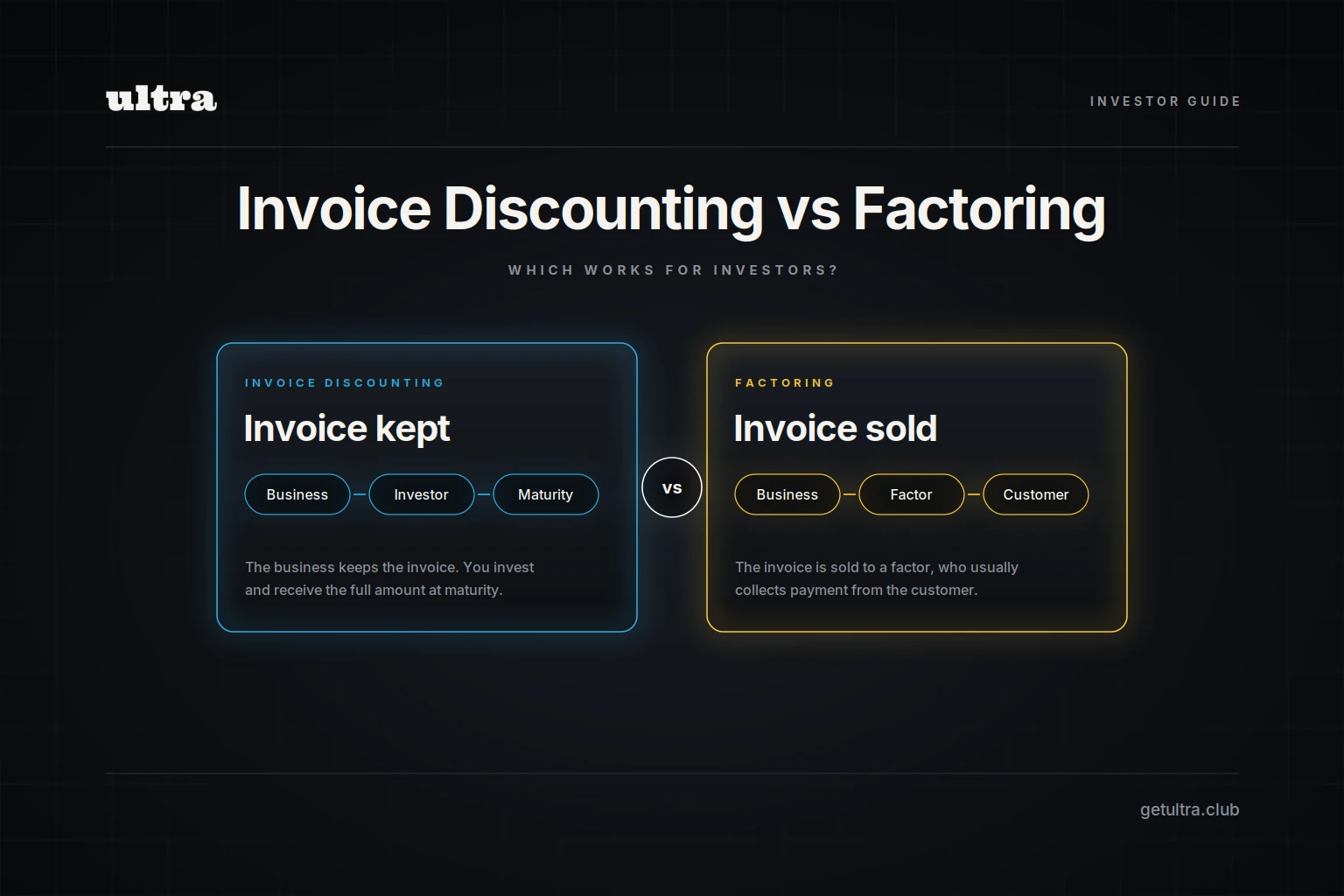
Invoice Discounting vs Factoring: Which Works for Investors?
A complete guide to invoice discounting vs factoring, covering how each works, the key differences between them and why investors choose invoice discounting on ultra.
Prerna Bhardwaj
·
22 Oct 2026
invoice discounting
Invoice Discounting Investment in India: How It Works
A complete guide to invoice discounting investment in India, covering how it works, why experienced investors consider it, where it fits in a portfolio and how to invest with ultra.
Prerna Bhardwaj
·
21 Oct 2026

IPO
Reliance Jio IPO: Date, Price, GMP, Valuation, Review & Details
A complete guide to Reliance Jio IPO 2026, covering Jio Platforms IPO details, issue size, expected date, price band status, GMP context, shareholder quota, company profile, financials, valuation and risks.
Sachin Gadekar
·
19 Oct 2026