Deep-Dive Research Report on NSE Ltd. (2025)
20 November 2025
Latest Financials, Market Share, Revenue Mix & Investment Outlook.

Company Overview
The National Stock Exchange of India (NSE Ltd.) stands as the country’s most dominant market infrastructure institution, operating India’s largest equity and derivatives markets. With near-monopoly market share in equity derivatives and a consistently growing retail investor base, NSE remains the backbone of India’s capital market ecosystem.
This deep-dive report provides a data-backed analysis of NSE’s financial performance, revenue breakdown, market share, key risks, and growth outlook for FY25–26.
Founded in 1992, NSE brought electronic trading to India, replacing the floor-based system and transforming capital markets. Today, NSE operates:
Equity Cash Market
Equity Derivatives
Currency Derivatives
Commodity Derivatives
Debt Segment
SME Platform – NSE EMERGE
Market Data & Index Licensing
Colocation & Technology Services
NSE’s flagship index, NIFTY 50, has become India’s most tracked benchmark, powering ETFs, index funds, futures, and options globally.
Latest Financial Performance (FY24–Q1 FY26)
| Particular | Q1FY26 (₹ Cr) | Q1FY25 (₹ Cr) | YoY |
|---|---|---|---|
| Total Revenue | 4,798 | 4,950 | -3% |
| EBITDA | 3,130 | 3,106 | 1% |
| PAT | 2,924 | 2,567 | 14% |
| EPS | 11.81 | 10.37 | 14% |
| ROA | 37% | 41% | -10% |
Consolidated Annual Performance (FY22–FY24)
| Particular | FY24 (₹ Cr) | FY23 (₹ Cr) | FY22 (₹ Cr) |
|---|---|---|---|
| Total Revenue | 16,352 | 12,765 | 8,874 |
| EBITDA | 11,611 | 9,428 | 6,499.26 |
| PAT | 8,306 | 7,356 | 5,198.29 |
| EPS | 167.80 | 148.61 | 105.02 |
| Dividend (per share) | 90 | 80 | 42 |
Revenue Breakdown – How NSE Makes Money
| Segment | FY23 | FY22 |
|---|---|---|
| Trading Services | 10,173 | 6,965 |
| Colocation Charges | 614 | 433 |
| Data Feed Services | 273 | 225 |
| Listing Services | 180 | 184 |
| Index Licensing Services | 150 | 116 |
| Strategic Investments | 328 | 256 |
| Other Segments | 1,047 | 695 |
| Total | 12,765 | 8,874 |
Market Metrics & Dominance
| Metric | Value |
|---|---|
| Transaction charges (Q1FY26) | ₹3,150 Cr |
| Cash market ADTV (Q1FY26) | ₹108,542 Cr |
| Equity futures ADTV (Q1FY26) | ₹168,430 Cr |
| Equity options ADTV (premium) | ₹55,514 Cr |
| Market share — cash segment | ≈93% |
| Market share — F&O / derivatives | ≈99% |
NSE vs BSE Comparison Table
| Feature | NSE (National Stock Exchange) | BSE (Bombay Stock Exchange) |
|---|---|---|
| Established Year | 1992 | 1875 |
| Full Form | National Stock Exchange | Bombay Stock Exchange |
| Benchmark Index | Nifty 50 | Sensex |
| Number of Listed Companies | ~2,100+ | ~5,500+ |
| Market Capitalization | Higher than BSE | Second-largest after NSE |
| Trading Volume | Higher volume, more liquidity | Lower relative volume |
| Order Execution Speed | Faster | High but slower compared to NSE |
| Trading Segment Leadership | Derivatives market | Equity & SME listings |
| International Recognition | Newer but globally recognized | One of the world’s oldest exchanges |
| Ideal For | Active traders, derivatives traders | Long-term investors, SME investors |
NSE vs BSE Comparison
| Particulars | NSE | BSE |
|---|---|---|
| Revenue Growth | 59% | 10% |
| PAT Growth | 41% | 11% |
| ROE | 51% | 7% |
| ROCE | 56% | 10% |
| Net Profit Margins | 65% | 28% |
| EBITDA Margins | 74% | 39% |
| EPS | 156.33 | 52.12 |
| P/E (TTM) | 29 | 44 |
| P/B | 10.84 | 8.44 |
NSE’s Competitive Moat
Controls 99% of India’s derivatives market – one of the largest globally.
93% share in cash trading, far ahead of BSE.
NIFTY-based products dominate ETF flows in India and abroad.
NSE’s sheer liquidity advantage ensures network effects—traders, institutions, and ETFs prefer the deepest venue.
Strategic Highlights Driving Growth
1. Explosion in F&O Trading
India has become the world’s largest derivatives market by contracts traded, benefiting NSE enormously.
2. Rising Retail Participation
Over 80 lakh demat accounts added monthly (industry), boosting cash + derivatives turnover.
3. Growth in Index Licensing
With NIFTY-based ETFs expanding in India, Singapore, and US markets, licensing revenues are scaling fast.
4. Technology & Co-location
Algo-based trading growth is pushing high-margin colocation revenues.
Key Risks
While NSE is financially strong, some risks remain:
1. Regulatory & Compliance Risks
Past issues related to co-location and data-sharing have led to large penalties and increased scrutiny.
2. Volume Dependency
Since ~80% of revenue comes from trading activity, any decline in market participation or regulatory tightening in F&O can reduce growth.
3. IPO Uncertainty
NSE’s long-awaited IPO remains pending regulatory clearance.
Outlook for FY26–FY27
The outlook remains highly positive driven by:
Continued surge in options trading
Increase in ETF and index adoption
Retail participation at all-time highs
Growing demand for real-time market data
Expansion in new derivatives (energy, rates)
Even conservative estimates indicate strong revenue and PAT growth with healthy margins.
Conclusion – Should Investors Track NSE Closely?
NSE is one of India’s strongest and most profitable financial institutions. Its monopolistic position in derivatives, rapidly growing data business, and scalable technology infrastructure provide long-term revenue visibility.
With robust financials, high margins, and a dominant industry position, NSE remains a high-quality exchange asset worth tracking closely—especially ahead of any potential future IPO.
Recent articles
View all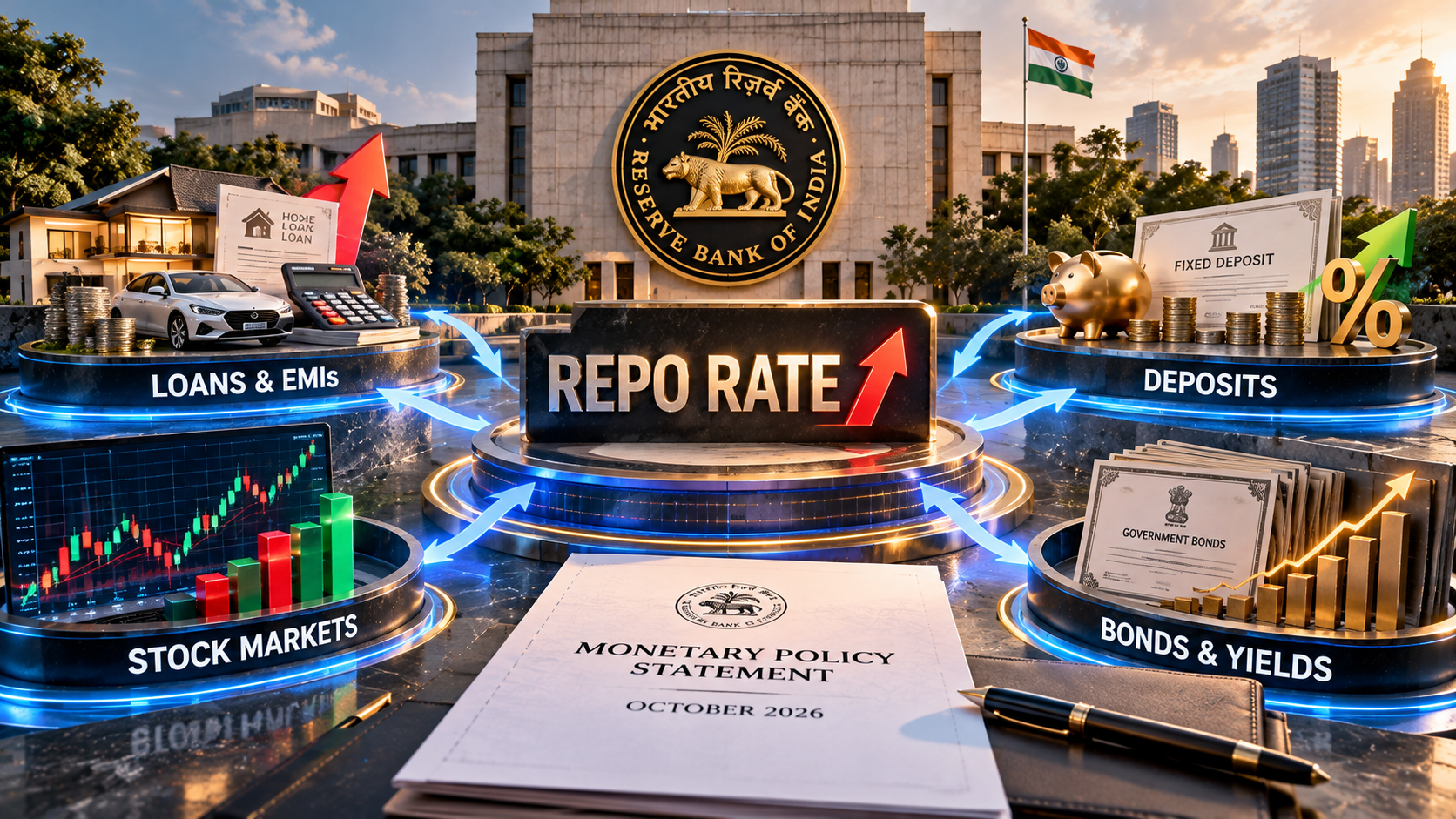
finance
RBI Repo Rate Hike: October 2026 Policy Update, Impact on Loans, EMIs, Deposits & Markets
A simple guide to the October 2026 RBI repo rate hike, what it means for borrowers, depositors, investors, banks and the broader economy.
Sachin Gadekar
·
08 Oct 2026

IPO
Reliance Jio IPO: Date, Price, GMP, Valuation, Review & Details
A complete guide to Reliance Jio IPO 2026, covering Jio Platforms IPO details, issue size, expected date, price band status, GMP context, shareholder quota, company profile, financials, valuation and risks.
Sachin Gadekar
·
07 Oct 2026

IPO
HD Fire Protect IPO Details: Date, Price, GMP, Review & How to Apply
A complete guide to HD Fire Protect IPO 2026, covering issue size, OFS structure, price band, lot size, GMP context, company profile, financials, risks, valuation and application process.
Sachin Gadekar
·
07 Oct 2026

IPO
Nityas Gems & Jewellery IPO Details: Date, Price, GMP, Review & How to Apply
A complete guide to Nityas Gems & Jewellery IPO 2026, covering issue size, GMP context, price band, lot size, company profile, financials, risks, valuation and application process.
Sachin Gadekar
·
05 Oct 2026