M1xchange Acquires C2FO India: What the TReDS Consolidation Means for Invoice Discounting Investors
06 July 2026 · Sachin Gadekar
A complete investor-facing analysis of the M1xchange–C2FO India acquisition announced July 3, 2026 -what happened, the combined scale, what TReDS consolidation means for the quality and volume of invoice discounting deal flow, and Ultra's specific view on how this affects HNI investors in the invoice discounting space.
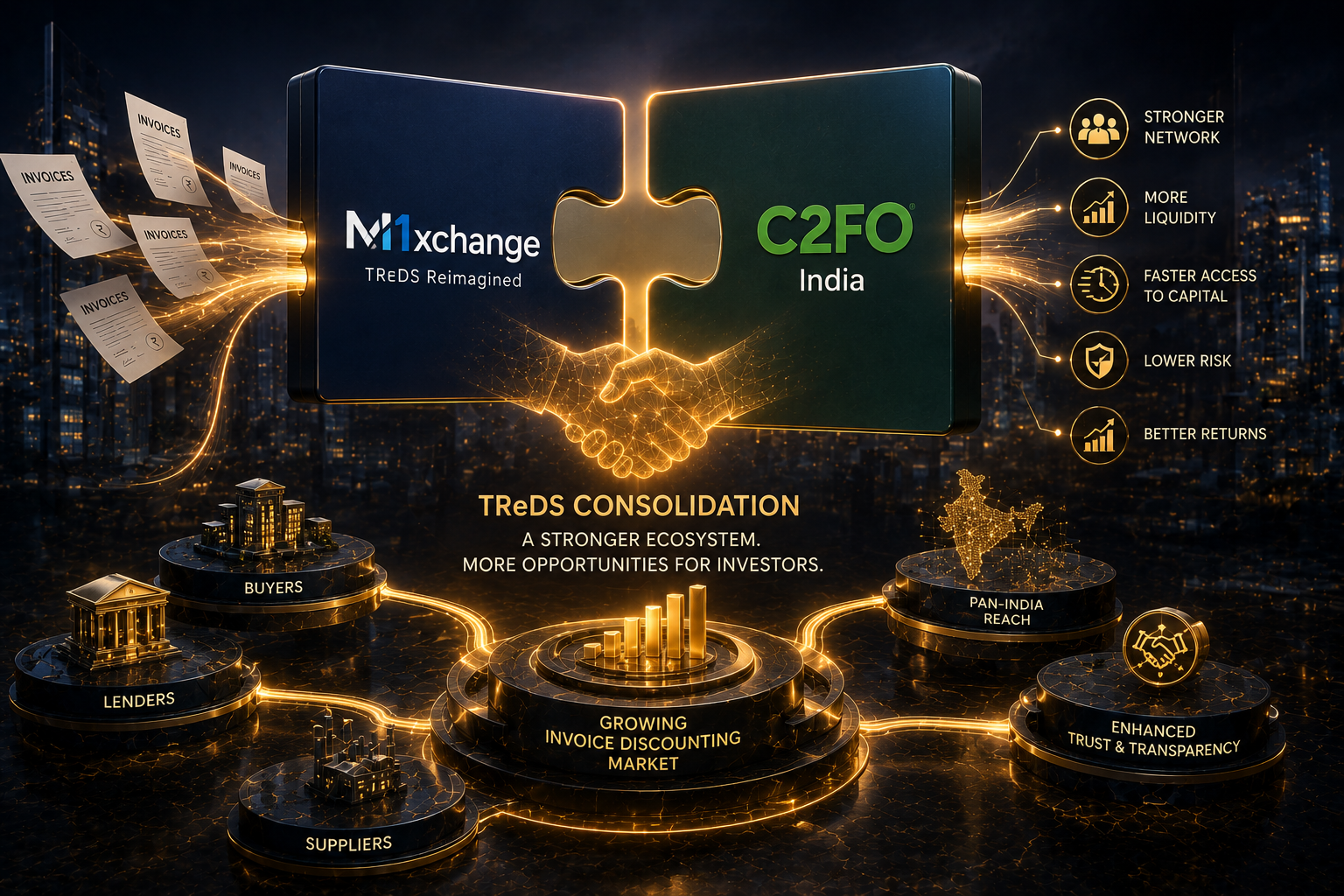
On July 3, 2026, Mynd Fintech -the supply chain financing arm of M1xchange, India's largest TReDS platform by transaction volume -announced the acquisition of C2FO India Technologies, a subsidiary of US-based Pollen Inc. (C2FO). The deal brings together two of the most significant players in India's early payment and invoice discounting ecosystem under one roof.
Every news article published on this acquisition so far has been written for corporates and MSMEs -what the combined platform means for working capital management, how buyer supplier relationships will change, what happens to the C2TReDS licence. None has answered the question that HNI investors in invoice discounting should be asking: what does this consolidation mean for the quality, volume, and pricing of invoice discounting deal flow?
This article answers that question directly.
The Deal: What Actually Happened on July 3, 2026
Mynd Fintech completed a 100% acquisition of C2FO India Technologies for an undisclosed amount. As part of the transaction:
Approximately 100 C2FO India employees have moved to Mynd Fintech
140 corporate clients of C2FO India -including nearly 50% of Nifty 50 companies -have joined the combined entity
C2FO India's 200,000+ MSME suppliers who used the platform for early payment access are now served through Mynd Fintech
The combined entity expects to process approximately ₹60,000 crore in annual transactions across buyer and supplier financing
The acquisition combines three distinct capabilities under one entity:
Mynd Fintech's UFX platform -a unified supply chain finance platform for corporates and financial institutions
M1xchange's TReDS infrastructure -India's largest RBI-licensed TReDS platform by cumulative volume (₹2.65 lakh crore+ facilitated)
C2FO's dynamic discounting technology -early payment programmes for large corporate buyers, used globally to facilitate over $500 billion in early payments
The deal was framed by Sundeep Mohindru (Promoter and Director, M1 Group) as a step toward building a "comprehensive digital working capital ecosystem in India" that delivers liquidity and efficiency across corporate, financial institution, and MSME sectors.
Who Is M1xchange and Who Was C2FO India?
Understanding the two entities -their distinct market positions before the merger -is essential context for understanding what the combined entity can do.
M1xchange:
India's most active TReDS platform by transaction volume -<cite index="22-1">an RBI-licensed TReDS platform that helps businesses access working capital by facilitating invoice financing</cite>
Promoted by BSE (Bombay Stock Exchange) and operated by Mynd Solutions
Cumulative invoice financing facilitated: over ₹2.65 lakh crore
Turned profitable in FY25, posting a net profit of ₹12 crore
Already had a strategic corporate investor -Jindal Stainless acquired a 9.62% stake in M1xchange, reflecting growing interest from large corporate buyers in the platform
Primary strength: deep MSME supplier network, strong PSU and large corporate buyer relationships, regulated TReDS infrastructure
C2FO India:
Indian subsidiary of US-based Pollen Inc. (C2FO), which has facilitated over $500 billion in early payments globally since 2008
Operated a dynamic discounting marketplace -a model where large corporate buyers offer early payment to their suppliers in exchange for a discount on the invoice value, with no third-party financier involved
Also operated C2TReDS -an RBI-licensed TReDS platform in its own right, representing the third active TReDS licence in India alongside RXIL and M1xchange
<cite index="25-1">Serves nearly half of the Nifty 50 and supports some 200,000 suppliers across sectors including cement and pharmaceuticals</cite>
Primary strength: enterprise buyer relationships at the very top of India's corporate hierarchy (Nifty 50), global dynamic discounting technology, 100+ specialist supply chain finance professionals
The complementarity is precise: M1xchange had depth on the MSME supplier and PSU side; C2FO India had depth on the large corporate buyer side. The merger combines both networks.
The Combined Scale: What the Numbers Mean
| Metric | M1xchange (Pre-Acquisition) | C2FO India | Combined Entity |
|---|---|---|---|
| Annual transaction volume | ₹1+ lakh crore (FY25-26) | Part of the ₹60,000 crore combined target | ~₹60,000 crore+ across buyer and supplier financing |
| Large corporate / buyer clients | Broad PSU and listed corporate base | 140 corporate clients including ~50% of Nifty 50 | Largest large-corporate buyer network in India's SCF ecosystem |
| MSME suppliers served | Large MSME supplier base via TReDS | 200,000+ suppliers | 200,000+ suppliers (expanded by M1xchange's existing MSME reach) |
| TReDS licences | 1 (M1xchange) | 1 (C2TReDS -likely to be surrendered) | 1 (M1xchange; C2TReDS may be surrendered) |
| Financier access | Large bank and NBFC network | Part of integrated platform | Access to 80+ banks and NBFCs |
| Technology capability | TReDS marketplace + UFX supply chain finance | Dynamic discounting + early payment technology ($500B+ global track record) | TReDS + dynamic discounting + early payment + UFX -full-stack working capital |
The single most important number: C2FO India serves approximately 50% of Nifty 50 companies. These are India's 50 largest listed corporates -the exact buyer profile that represents Tier 1 invoice discounting in the HNI investment context. When these buyers' invoice financing activity consolidates onto a single, larger platform backed by 80+ financiers, the liquidity depth and deal volume at the top end of buyer quality increases materially.
Why This Consolidation Is Happening Now
Three structural forces are driving this specific merger at this specific moment:
1. The CPSE mandate is expanding TReDS volumes faster than any single platform can capture alone. The Union Budget 2026-27 requirement for all Central Public Sector Enterprises to use TReDS has created a surge in institutional buyer participation -from approximately 10% of TReDS volume (pre-mandate) toward a meaningfully higher share. No single platform has comprehensive relationships with all CPSEs and all major Nifty 50 corporates simultaneously. By combining M1xchange's PSU depth with C2FO India's Nifty 50 coverage, the merged entity covers a broader sweep of the highest-quality buyer inventory in India's supply chain finance market.
2. Dynamic discounting and TReDS serve overlapping but distinct buyer needs. TReDS involves a third-party financier (bank or NBFC) advancing funds against supplier invoices -the buyer pays on the original due date. Dynamic discounting allows the buyer itself to pay early using its own surplus cash in exchange for a discount. Some buyers prefer one model in some situations and the other in different circumstances. C2FO's technology enables both; Mynd Fintech previously only operated TReDS. The combined entity can now serve any buyer's preference.
3. Platform scale drives financier competition, which drives better MSME rates. More buyers and more suppliers on a single platform means more invoice volume being auctioned per day. More auction volume attracts more financier bids. More competing bids drives discount rates down (better for MSMEs) and deal flow volume up (better for financiers and investors). The network effect in marketplace finance is significant -and consolidation accelerates it.
What Changes in the TReDS Ecosystem
The M1xchange-C2FO India merger has a direct structural effect on India's three-platform TReDS ecosystem.
Before the merger: India had three active RBI-licensed TReDS platforms:
RXIL (SIDBI + NSE joint venture) -₹2 lakh crore+ cumulative financing
M1xchange (BSE/Mynd Solutions) -₹2.65 lakh crore+ cumulative financing
C2TReDS (C2FO India) -smaller, focused on Nifty 50 enterprise buyers
After the merger: If C2TReDS surrenders its TReDS licence (as reported as likely), India moves from three to two active TReDS platforms -RXIL and a substantially enlarged M1xchange. This is a significant structural shift in what has been a competitive three-player market for the past several years.
The competitive dynamic implication: A two-platform TReDS market with one dominant player (M1xchange with Nifty 50 coverage + PSU depth + 200,000 suppliers + 80+ financiers) concentrates market power more heavily than the previous three-platform structure. This is a normal phase in the maturation of marketplace infrastructure businesses globally -similar to how exchange and clearinghouse consolidation played out in global capital markets. For the ecosystem broadly, it increases network effects and liquidity depth. The regulatory implication (whether SEBI/RBI is comfortable with a two-platform market) is worth monitoring.
The C2TReDS Licence Question
One of the most practically significant aspects of this acquisition is unresolved: what happens to C2TReDS -C2FO India's own RBI-licensed TReDS platform?
Industry reporting indicates C2FO India may surrender the C2TReDS licence following the acquisition. This would have two effects:
Effect 1 -Client migration: Corporates and suppliers currently transacting on C2TReDS would need to migrate to M1xchange or RXIL. For M1xchange, this represents an immediate expansion of its active transaction base -migrating C2TReDS clients who have already proven willingness to use TReDS platforms.
Effect 2 -Market structure: India's TReDS market would consolidate from three to two platforms. M1xchange, with its combined Nifty 50 + PSU + MSME coverage and 80+ financier access, would be the clear market leader by buyer quality and transaction volume. RXIL -backed by SIDBI and NSE -would remain a strong second player with its own government and institutional relationships.
The licence surrender is not yet confirmed -this remains the key regulatory variable to watch over the next 30-60 days as the integration proceeds.
What This Means for Invoice Discounting Investors: The Direct Impact
This is the section that no other article on this acquisition has written. The investor-specific impact analysis:
Impact 1 -Expanded Nifty 50 buyer inventory on the M1xchange ecosystem.
C2FO India's 140 corporate clients including ~50% of Nifty 50 companies are now accessible through the M1xchange infrastructure. For invoice discounting investors, Nifty 50 buyers represent the gold standard of buyer credit quality -large, listed, audited, regulatory-obligated entities whose payment defaults would be public events with severe reputational consequences. As this buyer inventory becomes active on a larger, more liquid TReDS platform with 80+ competing financiers, the volume of high-quality large-corporate buyer deals in the broader invoice financing ecosystem expands.
Impact 2 -More competing financiers drives market pricing transparency.
C2FO India's dynamic discounting model brought buyer-side liquidity (buyers paying with their own cash). M1xchange's TReDS model brings third-party financier liquidity (banks and NBFCs advancing funds). The combined platform offering both options to the same buyer universe creates a more competitive, transparent pricing environment -where the discount rate on any given invoice is tested against a larger pool of capital sources. For investors on retail/HNI invoice discounting platforms that draw from this ecosystem, better price discovery at the institutional level is a long-term positive signal for market efficiency.
Impact 3 -Confirmation of the invoice discounting asset class as mainstream.
The M1xchange-C2FO acquisition is a large, institutionally-backed consolidation event in a market that some characterised as "niche" or "unproven" as recently as 2022. <cite index="29-1">The combined offering gives corporates and their supplier networks a single, integrated gateway to early payment and receivables financing, replacing what has traditionally been a fragmented set of financing relationships</cite>. When Nifty 50 corporates, 200,000+ MSME suppliers, and 80+ banks and NBFCs are part of a single consolidated ecosystem, the institutional validation of invoice discounting as an asset class is unambiguous.
Impact 4 -Consolidation narrows the number of institutional TReDS players.
From an investor due diligence perspective, the move from three to potentially two TReDS licences means that the quality differentiation between platforms will increasingly come from technology, buyer relationships, and financier breadth -rather than from regulatory distinctiveness. Investors should monitor whether the combined M1xchange entity's market concentration attracts any RBI or SEBI review over the coming quarters.
What this does NOT change for individual investors:
Individual investors on retail/HNI invoice discounting platforms (like Ultra) do not access TReDS directly -TReDS is institutional infrastructure for banks and NBFCs. The consolidation improves the structural depth of the broader invoice financing market that these platforms draw from, but it does not change the deal-level diligence requirements (buyer identity, invoice verification, fund flow protection) that determine investor outcomes on individual transactions.
The Broader TReDS Consolidation Trend
| Development | Date | Significance for Invoice Discounting Market |
|---|---|---|
| Union Budget 2026-27: CPSE TReDS mandate | February 2026 | All CPSEs required to route MSME payments through TReDS -expanding near-sovereign buyer inventory from ~10% to a growing share of TReDS volumes |
| GeM-TReDS integration | 2025-26 | Government e-Marketplace procurement linked to TReDS -expanding visibility of government contract-linked receivables |
| RXIL crosses ₹2 lakh crore cumulative | Mid-2025 | Validates TReDS market depth; RXIL and M1xchange together now represent ₹4.65+ lakh crore in cumulative institutional invoice financing |
| SEBI dematerialisation mandate for SDIs | April 2026 | Improves secondary market infrastructure for securitised invoice discounting pools -complementary to TReDS growth |
| M1xchange acquires C2FO India | July 3, 2026 | Consolidates Nifty 50 + PSU buyer coverage; expands combined entity to ₹60,000 crore+ annual volume; strengthens market to 2-platform structure |
The consistent thread: India's invoice discounting and supply chain finance market is maturing rapidly -from a fragmented, multi-player ecosystem toward a consolidated, institutionally-backed infrastructure with regulatory oversight, standardized processes, and growing scale. Each of these developments individually signals maturity; together, they represent a fundamental shift in the asset class's institutional standing.
Ultra's Position: What HNI Investors Should Take From This
Applying the audit principle -Ultra's specific view, not generic market commentary:
The M1xchange-C2FO acquisition is the most significant validation event for the invoice discounting asset class in 2026 -and HNI investors should read it as a structural positive, with one specific caveat.
The positive case is direct: C2FO India's 140 Nifty 50 corporate clients represent the highest tier of buyer credit quality in India's invoice financing market. The consolidation of this buyer network onto M1xchange's TReDS infrastructure -backed by 80+ competing financiers -means the supply of Tier 1 buyer invoice deals in the institutional ecosystem is expanding. As institutional TReDS platforms grow in scale and buyer coverage, the overall quality and volume of the invoice discounting opportunity set that retail and HNI platforms curate from strengthens. This is a durable tailwind, not a short-term event.
The caveat is equally direct: TReDS consolidation improves the institutional market infrastructure -it does not eliminate the need for deal-level diligence on the retail/HNI side. The quality of an invoice discounting investment still depends on the specific buyer (Tier 1 vs Tier 2 vs unrated), the invoice verification process (GSTN-verified vs not), and the fund flow protection (escrow-protected vs platform-intermediated). A larger, more consolidated TReDS ecosystem does not mean every invoice discounting deal is now lower risk -it means the highest-quality end of the market is getting larger and more liquid.
What Ultra would recommend: Use the consolidation as confirmation that invoice discounting is a mainstream, institutionally-validated fixed income instrument -not as a signal to reduce diligence on individual deals. Specifically maintain the discipline of: (1) restricting allocations to Tier 1-2 buyer quality profiles, (2) diversifying across 15-20 deals rather than concentrating in 3-5, and (3) verifying buyer identity and invoice authenticity on every transaction regardless of platform.
For a complete primer on how TReDS works and how it relates to the invoice discounting opportunity for individual investors, read: TReDS in India: What It Is and How Investors Can Benefit
For the returns and risk profile of invoice discounting specifically on Tier 1-2 buyers, read: Invoice Discounting Returns: What 10-12% Yields Actually Look Like
FAQs
Q1. What is the M1xchange-C2FO India acquisition?
On July 3, 2026, Mynd Fintech (the supply chain financing subsidiary of M1xchange, India's largest TReDS platform) completed a 100% acquisition of C2FO India Technologies for an undisclosed amount. The deal brings 140 corporate clients including ~50% of Nifty 50 companies, 200,000+ MSME suppliers, and C2FO's global dynamic discounting technology under the M1xchange ecosystem. The combined entity expects to process ₹60,000 crore+ in annual transactions.
Q2. What is M1xchange and why does it matter for invoice discounting?
M1xchange is an RBI-licensed TReDS (Trade Receivables Discounting System) platform promoted by BSE and operated by Mynd Solutions -India's largest TReDS platform by cumulative transaction volume (₹2.65 lakh crore+ facilitated). TReDS platforms are the institutional market infrastructure through which banks and NBFCs competitively bid to finance MSME invoices approved by large corporate and government buyers. M1xchange's scale and buyer relationships make it the primary institutional benchmark for invoice financing volumes and pricing in India.
Q3. What is C2FO India and what did it bring to the deal?
C2FO India was the Indian subsidiary of US-based Pollen Inc. (C2FO), which has facilitated over $500 billion in early payments globally. C2FO India operated a dynamic discounting marketplace where large corporate buyers (including ~50% of Nifty 50 companies) offered early payment to their 200,000+ MSME suppliers using their own cash, in exchange for a negotiated discount. It also operated C2TReDS, an RBI-licensed TReDS platform. The combination brings Nifty 50 buyer relationships and dynamic discounting technology into the M1xchange ecosystem.
Q4. What happens to the C2TReDS licence after the acquisition?
Industry reporting indicates C2FO India may surrender the C2TReDS licence following the acquisition, which would reduce India's active TReDS platforms from three (RXIL, M1xchange, C2TReDS) to two (RXIL and M1xchange). This remains unconfirmed -the licence surrender would require RBI notification and a client migration plan for existing C2TReDS users. Investors should monitor this development over the next 30-60 days as integration proceeds.
Q5. Does the M1xchange-C2FO acquisition directly affect HNI investors in invoice discounting?
Not directly -individual investors on retail/HNI invoice discounting platforms do not access TReDS platforms directly (TReDS participants are RBI-regulated banks and NBFCs). However, the consolidation expands the supply of Nifty 50-backed, Tier 1 buyer invoice deals in the institutional ecosystem that curated retail platforms draw from, and validates invoice discounting as a mainstream, institutionally-backed asset class. It does not change deal-level diligence requirements.
Q6. What is dynamic discounting and how is it different from invoice discounting on TReDS?
Invoice discounting on TReDS involves a third-party financier (bank or NBFC) advancing funds to an MSME against an approved invoice -the buyer pays the financier on the original due date. Dynamic discounting is a buyer-funded model where the corporate buyer itself pays its suppliers early using the buyer's own surplus cash, receiving a discount on the invoice in return -no third-party financier involved. C2FO India specialised in dynamic discounting; M1xchange specialises in TReDS-based third-party financing. The combined entity can now offer both models to the same corporate buyer universe.
Disclaimer
This article is for informational and educational purposes only and does not constitute investment advice. Deal details are based on publicly available news reporting as of July 3-6, 2026. The C2TReDS licence status and integration timeline are subject to regulatory confirmation. Please verify current information directly with relevant parties before making investment decisions.
For HNI investors building invoice discounting allocations on the back of this expanding Tier 1 buyer ecosystem, explore curated deals at www.getultra.club -pre-screened buyer quality, transparent yields, and portfolio tracking built in.
Recent articles
View all
IPO
Orient Cables IPO Date, Price, GMP, Review & Details
A complete guide to Orient Cables IPO 2026, covering issue size, GMP context, price band, lot size, subscription status, company profile, financials, risks and application process.
Sachin Gadekar
·
30 Sep 2026

IPO
A-One Steels IPO Date, Price, GMP, Review & Details
A complete guide to A-One Steels IPO 2026, covering issue size, GMP context, price band, lot size, subscription status, company profile, financials, risks and application process.
Sachin Gadekar
·
29 Sep 2026

IPO
Moneyview IPO GMP Details: Date, Price Band, Subscription Status, Review & How to Apply
A complete guide to Moneyview IPO 2026, covering issue size, GMP context, price band, issue price, lot size, subscription status, company profile, financials, risks and application process.
Sachin Gadekar
·
28 Sep 2026

IPO
How to Read an IPO RHP Before Applying
A beginner-friendly guide to reading an IPO Red Herring Prospectus and understanding the key sections investors should review before applying.
Sachin Gadekar
·
24 Sep 2026