How You Can Vest Your ESOP Shares in India: Complete Step-by-Step Guide
22 December 2025
A Practical Guide to ESOP Vesting, Taxation, and Exercise Rules in India
Introduction
Employee Stock Option Plans (ESOPs) have become a popular way for companies in India, especially startups and listed firms, to reward and retain employees. However, many employees receive ESOPs without fully understanding how you can vest your ESOP shares in India and what steps are involved before they actually own the shares.
This article explains the ESOP vesting process in India in a simple and structured manner. You will learn about vesting periods, schedules, taxation, exercise rules, and what happens to your ESOPs when you leave a company.
What Are ESOPs
ESOPs are employee benefit plans where a company grants its employees the option to buy company shares at a pre-decided price, known as the exercise price.
Key points about ESOPs:
ESOPs are not shares initially
They are options to buy shares later
Ownership is achieved only after vesting and exercise
ESOPs align employee interests with the company’s long-term growth.
What Does Vesting Mean in ESOPs
Vesting refers to the process by which an employee earns the right to exercise ESOPs over time.
Until ESOPs are vested:
You cannot exercise them
You do not own the shares
You cannot sell or transfer them
Vesting ensures employees stay with the company for a specified period.
Why ESOP Vesting Is Important
Understanding vesting is critical because:
It determines when you can own shares
It impacts your tax liability
It affects your decision when switching jobs
It influences your long-term wealth creation
Many employees lose ESOP benefits simply due to a lack of clarity on vesting rules.
Typical ESOP Vesting Structure in India
Most Indian companies follow a time-based vesting structure.
A standard structure includes:
Total ESOP grant
Vesting period
Vesting schedule
Exercise window
Companies define these terms clearly in the ESOP policy or grant letter.
Cliff Vesting vs Graded Vesting
There are two common vesting methods in India.
Cliff Vesting
No ESOPs vest until a minimum period is completed
Usually 1 year
If you leave before the cliff period, you lose all ESOPs
Graded Vesting
ESOPs vest gradually over time
Common after the first-year cliff
Example: 25 percent per year over four years
Most startups use a mix of cliff and graded vesting.
Vesting Period in ESOP Explained
The vesting period is the total time required for all ESOPs to vest.
Typical vesting periods in India:
3 years
4 years
5 years
A popular structure is:
1-year cliff
Remaining ESOPs vest monthly or annually over the next 3 years
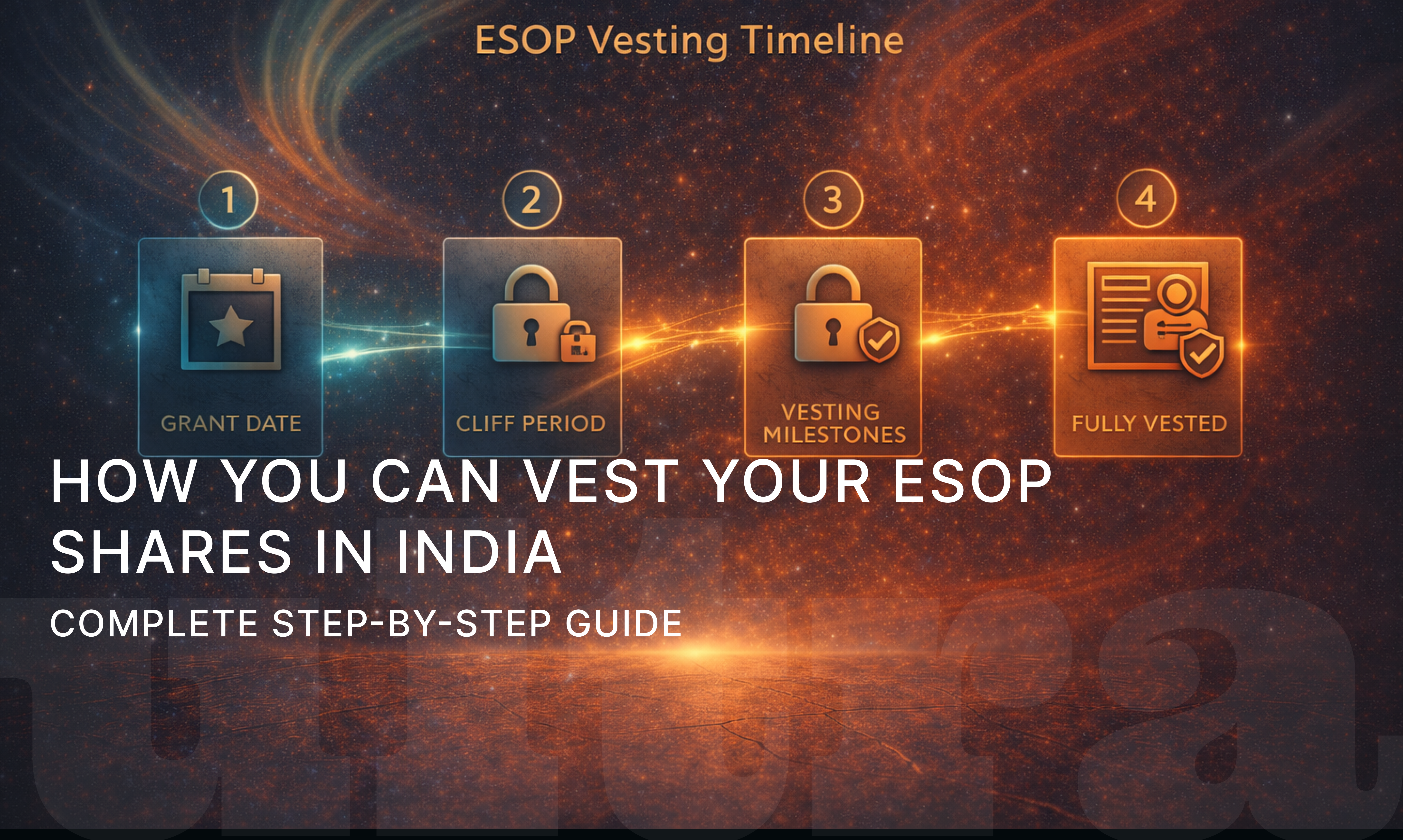
ESOP Vesting Timeline Example
Assume:
Total ESOPs granted: 1,000
Vesting period: 4 years
Cliff: 1 year
Example:
End of Year 1: 250 ESOPs vest
End of Year 2: 250 ESOPs vest
End of Year 3: 250 ESOPs vest
End of Year 4: 250 ESOPs vest
You can only exercise the ESOPs that have vested.
What Happens After ESOPs Are Vested
Once ESOPs vest:
You gain the right to exercise them
You can purchase shares at the exercise price
Vesting does not automatically mean share ownership
You must take an additional step to exercise the options.
ESOP Taxation in India
ESOP taxation in India happens at two stages:
At the time of exercise
At the time of sale
Understanding taxation is essential for financial planning.
ESOP Taxation at Vesting vs Sale
Tax at Exercise
Difference between fair market value and exercise price
Treated as perquisite income
Taxed as salary
Tax at Sale
Capital gains tax applies
Holding period determines short-term or long-term gains
Listed and unlisted shares have different capital gains rules.
ESOP Vesting for Startup Employees
Startups often offer ESOPs as a major compensation component.
Important points for startup ESOPs:
Liquidity may be limited
Buyback events enable exits
Vesting is crucial before fundraising or IPO
Employees should track vesting closely during funding rounds.
What Happens to ESOPs When You Leave a Company
Your vested and unvested ESOPs are treated differently.
Unvested ESOPs usually lapse
Vested ESOPs must be exercised within a defined time
Exercise window ranges from 30 days to several years
Missing the exercise deadline may lead to forfeiture.
Common ESOP Vesting Mistakes to Avoid
Avoid these common errors:
Not understanding vesting schedule
Ignoring exercise deadlines
Overlooking tax implications
Assuming vesting equals ownership
Leaving company before cliff period
Awareness helps maximize ESOP benefits.
Important Points to Check in Your ESOP Agreement
Before accepting ESOPs, review:
Vesting period and cliff
Exercise price
Exercise window post exit
Buyback or liquidity clauses
Tax responsibility
Clarifying these terms prevents future confusion.
Frequently Asked Questions (FAQs)
Q1. Can ESOPs vest if I leave the company early?
No, unvested ESOPs generally lapse when you leave.
Q2. Is vesting the same for all employees?
No, vesting terms depend on company policy and role.
Q3. Do I pay tax when ESOPs vest?
No, tax applies at exercise and sale, not at vesting.
Q4. Can ESOP vesting be accelerated?
Yes, in some cases like mergers or acquisitions.
Q5. Are ESOPs regulated in India?
Yes, ESOPs are governed by company law and SEBI guidelines.
Conclusion
Understanding how you can vest your ESOP shares in India is essential to fully benefit from employee stock options. Vesting determines when ESOPs become usable, while exercise and taxation decide their real financial value.
By knowing the vesting structure, timelines, and tax implications, employees can make informed career and financial decisions. ESOPs, when managed correctly, can become a powerful long-term wealth creation tool.
Recent articles
View all
finance
RBI Repo Rate Hike: October 2026 Policy Update, Impact on Loans, EMIs, Deposits & Markets
A simple guide to the October 2026 RBI repo rate hike, what it means for borrowers, depositors, investors, banks and the broader economy.
Sachin Gadekar
·
08 Oct 2026

IPO
Reliance Jio IPO: Date, Price, GMP, Valuation, Review & Details
A complete guide to Reliance Jio IPO 2026, covering Jio Platforms IPO details, issue size, expected date, price band status, GMP context, shareholder quota, company profile, financials, valuation and risks.
Sachin Gadekar
·
07 Oct 2026

IPO
HD Fire Protect IPO Details: Date, Price, GMP, Review & How to Apply
A complete guide to HD Fire Protect IPO 2026, covering issue size, OFS structure, price band, lot size, GMP context, company profile, financials, risks, valuation and application process.
Sachin Gadekar
·
07 Oct 2026

IPO
Nityas Gems & Jewellery IPO Details: Date, Price, GMP, Review & How to Apply
A complete guide to Nityas Gems & Jewellery IPO 2026, covering issue size, GMP context, price band, lot size, company profile, financials, risks, valuation and application process.
Sachin Gadekar
·
05 Oct 2026