How to Fill Delivery Instruction Slip (DIS) in CDSL: Step-by-Step Guide
22 December 2025
A Complete Guide to Filling CDSL Delivery Instruction Slip for Share Transfer
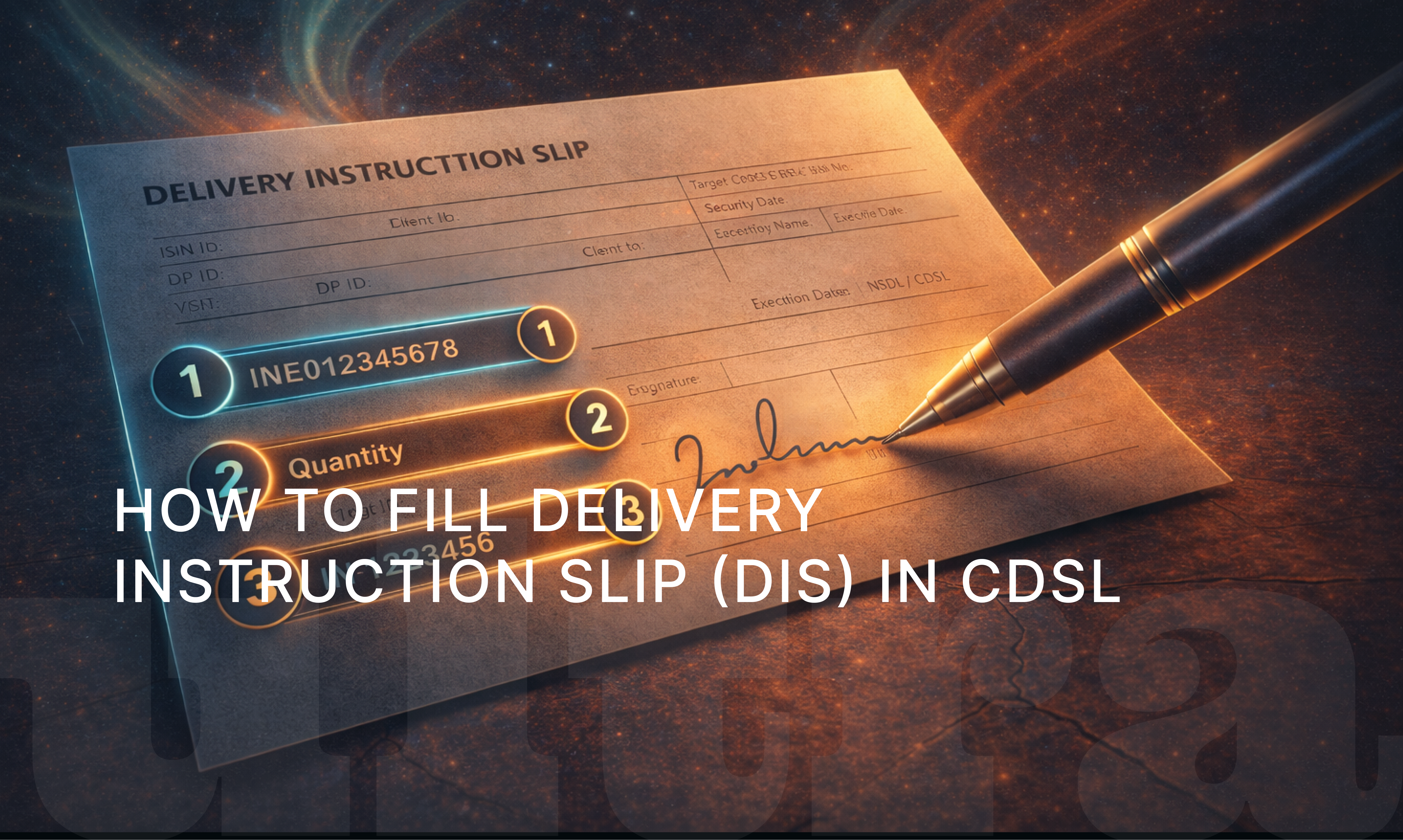
Introduction to Delivery Instruction Slip (DIS)
Even though online share transfers have become common, Delivery Instruction Slip (DIS) remains an important tool for investors, especially when online access is unavailable or restricted. Knowing how to fill delivery instruction slip CDSL correctly is crucial to ensure smooth and error-free transfer of securities.
This guide explains the CDSL DIS format, each field in detail, common mistakes to avoid, and the complete submission process.
A Delivery Instruction Slip is a physical form provided by your Depository Participant (DP) that allows you to instruct the depository to transfer shares from your demat account to another demat account.
It is mainly used for:
Off-market share transfers
Gift or family transfers
Account closure transfers
Situations where online transfer is not enabled
What Is a CDSL Delivery Instruction Slip
A CDSL Delivery Instruction Slip is a standardized document prescribed by Central Depository Services Limited. It authorises the DP to debit securities from your demat account and credit them to the beneficiary demat account.
Each DIS booklet is linked to your demat account and contains serially numbered slips to prevent misuse.
When Is a DIS Required
You need a CDSL DIS in the following cases:
MyEasiest facility is not activated
Transfer to another demat account manually
Transfer during technical downtime
Joint account holders prefer physical authorisation
Legacy or compliance-based transfers
Even today, many investors and institutions rely on DIS for controlled share movement.
Types of Delivery Instruction Slips
CDSL broadly recognises two types of DIS:
Market Instruction Slip
Used when selling shares on the stock exchange through a broker.
Off-Market Instruction Slip
Used when transferring shares outside the stock exchange, such as gifting or moving shares between demat accounts.
This article focuses on off-market DIS, as it requires careful manual filling.
Key Details Mentioned on a CDSL DIS Slip
A standard CDSL DIS contains the following sections:
DP ID and Client ID
ISIN of the security
Quantity of shares
Target DP ID and Client ID
Reason for transfer
Execution date
Signature(s) of account holder(s)
Every field must be filled accurately to avoid rejection.
Step-by-Step Guide on How to Fill Delivery Instruction Slip CDSL
Below is the detailed step-by-step process on how to fill delivery instruction slip CDSL correctly.
Step 1: Write the Execution Date
Mention the date on which you want the shares to be transferred.
The date should not be a holiday
Avoid post-dated slips unless permitted by your DP
Step 2: Enter Your DP ID and Client ID
Fill in your DP ID and Client ID, which together form your demat account number.
DP ID: 8 characters
Client ID: 8 digits
These details must exactly match your demat account.
Step 3: Select the Transfer Type
Tick or mention:
“Off-Market Transfer”
This is mandatory for non-exchange transfers.
Step 4: Fill the ISIN of the Security
Enter the ISIN (International Securities Identification Number) of the share you want to transfer.
One ISIN per line
Use official ISIN from contract note or demat statement
Do not write company names instead of ISIN
Step 5: Enter the Quantity of Shares
Mention the exact number of shares to be transferred against each ISIN.
Quantity must be available as free balance
Pledged or locked-in shares cannot be transferred
Step 6: Enter Target DP ID and Client ID
This is the beneficiary demat account where shares will be credited.
Ensure beneficiary account is active
Double-check DP ID and Client ID
Incorrect details may result in rejection or delays
Step 7: Mention the Reason for Transfer
Specify the reason clearly, such as:
Gift
Own account transfer
Family transfer
Account consolidation
Some DPs require a reason for regulatory reporting.
Step 8: Sign the DIS Slip
Sign exactly as per records with your DP.
Joint accounts require signatures of all holders
Signature mismatch may lead to rejection
Do not overwrite or use correction fluid.
Sample Explanation of Each Field in DIS
To understand how to fill delivery instruction slip CDSL accurately, always cross-check:
ISIN with demat statement
Client ID with beneficiary confirmation
Quantity with free holdings
Even a single-digit error can delay the transfer.
How to Submit a Filled DIS Slip
After filling the DIS:
Submit it physically to your DP office
Some brokers allow courier submission
Carry identity proof if submitting in person
Your DP will verify the slip and process the transfer.
Charges Applicable for DIS-Based Transfers
Charges vary depending on the DP and broker.
Common charges include:
Off-market transfer fee
DP transaction charges
Courier or handling charges
Check your DP tariff sheet before submission.
Common Mistakes While Filling CDSL DIS
Avoid these frequent errors:
Wrong ISIN
Incorrect beneficiary DP ID
Quantity mismatch
Unsigned or partially signed slip
Overwriting or corrections
Most DIS rejections occur due to manual errors.
Safety Tips While Using Physical DIS
Frequently Asked Questions (FAQs)
Q1. Is DIS mandatory for off-market share transfer?
No, online transfer via MyEasiest is an alternative, but DIS is still valid.
Q2. Can I cancel a submitted DIS?
Once processed, cancellation is usually not possible.
Q3. Can I use one DIS for multiple shares?
Yes, multiple ISINs can be entered in one slip if space permits.
Q4. Is DIS accepted for inter-depository transfer?
Yes, but additional details may be required.
Q5. What happens if DIS is filled incorrectly?
The DP may reject the slip, causing delays.
Conclusion
Understanding how to fill delivery instruction slip CDSL is essential for investors who still rely on physical share transfers. While online platforms have simplified the process, DIS remains relevant in many scenarios.
By carefully filling each field, double-checking beneficiary details, and following submission guidelines, investors can ensure a smooth and secure transfer of shares using CDSL DIS.
Recent articles
View all
finance
RBI Repo Rate Hike: October 2026 Policy Update, Impact on Loans, EMIs, Deposits & Markets
A simple guide to the October 2026 RBI repo rate hike, what it means for borrowers, depositors, investors, banks and the broader economy.
Sachin Gadekar
·
08 Oct 2026

IPO
Reliance Jio IPO: Date, Price, GMP, Valuation, Review & Details
A complete guide to Reliance Jio IPO 2026, covering Jio Platforms IPO details, issue size, expected date, price band status, GMP context, shareholder quota, company profile, financials, valuation and risks.
Sachin Gadekar
·
07 Oct 2026

IPO
HD Fire Protect IPO Details: Date, Price, GMP, Review & How to Apply
A complete guide to HD Fire Protect IPO 2026, covering issue size, OFS structure, price band, lot size, GMP context, company profile, financials, risks, valuation and application process.
Sachin Gadekar
·
07 Oct 2026

IPO
Nityas Gems & Jewellery IPO Details: Date, Price, GMP, Review & How to Apply
A complete guide to Nityas Gems & Jewellery IPO 2026, covering issue size, GMP context, price band, lot size, company profile, financials, risks, valuation and application process.
Sachin Gadekar
·
05 Oct 2026