Government Bonds vs Corporate Bonds in India: Which Is Right for Your Portfolio? (2026)
13 April 2026 · Sankarshan B
A complete, investor-focused comparison of government bonds and corporate bonds in India with real 2026 yield data, risk analysis, tax treatment, and a portfolio allocation framework for every investor type.

What Are Government Bonds in India?
Government bonds officially called Government Securities (G-Secs) are debt instruments issued by the Government of India (Central Government) or state governments to raise money for public expenditure. When you buy a government bond, you are lending money to the government. In return, the government pays you a fixed coupon (interest) at defined intervals and returns your principal at maturity.
Government bonds in India are managed and issued by the Reserve Bank of India (RBI) on behalf of the government. They carry a sovereign guarantee which means the default risk is effectively zero. The Government of India can, in theory, always print currency to repay its debt, making these the safest fixed income instruments in the country.
They are traded on the BSE and NSE, and retail investors can now access them directly through the RBI Retail Direct platform without any broker or fees.
Types of Government Bonds in India
| Type | Issuer | Tenure | Current Yield (2026) | Best For |
|---|---|---|---|---|
| Dated G-Secs (Fixed Rate) | Central Government of India | 5 to 40 years | 6.7%–7.3% | Long-term capital safety; institutional and retail investors |
| Treasury Bills (T-Bills) | Central Government of India | 91, 182, or 364 days | 6.4%–6.8% | Short-term parking of funds; liquidity with safety |
| State Development Loans (SDLs) | State Governments | 10 to 30 years | 7.3%–7.5% | Slightly higher yield than G-Secs with near-sovereign safety |
| RBI Floating Rate Savings Bonds | Reserve Bank of India | 7 years | 8.05% (resets every 6 months) | Inflation-linked sovereign income; retail investors |
| Sovereign Gold Bonds (SGBs) | Government of India | 8 years (exit from year 5) | 2.5% fixed + gold price appreciation | Gold exposure with sovereign safety and LTCG exemption at maturity |
| Tax-Free Bonds (secondary market) | PSUs NHAI, PFC, IRFC | Until maturity (2029–2035) | 5.5%–6.75% (tax-free) | High-bracket investors; equivalent to ~9%+ pre-tax at 30% slab |
What Are Corporate Bonds in India?
Corporate bonds are debt instruments issued by private companies, public sector undertakings (PSUs), NBFCs, and financial institutions to raise money for business purposes expansion, working capital, debt refinancing, or infrastructure projects.
When you buy a corporate bond, you lend money to a company. The company commits to paying you a fixed coupon rate at regular intervals (monthly, quarterly, or annually) and returning your principal at maturity. Unlike government bonds, corporate bonds are not backed by sovereign guarantee their safety depends entirely on the financial health of the issuing company.
This is why credit ratings (AAA, AA, A, BBB, assigned by CRISIL, ICRA, CARE) are critical to evaluating corporate bonds. A higher rating means lower default risk and correspondingly lower yield. A lower rating means higher default risk and higher yield to compensate.
Corporate bonds are accessible through SEBI-registered Online Bond Platform Providers (OBPPs), your demat account via NSE/BSE, or broker platforms.
Types of Corporate Bonds in India
Corporate bonds come in several structural forms:
Non-Convertible Debentures (NCDs): The most common form in India. Listed on exchanges, available in primary (new issue) and secondary (existing bond) markets. Can be secured (backed by assets) or unsecured.
Secured Bonds: Backed by specific assets of the issuer property, receivables, or cash flows. In default, investors have a legal claim to these assets.
Unsecured Bonds / Debentures: Not backed by specific collateral. Higher risk, therefore higher yield.
PSU Bonds: Issued by Public Sector Undertakings like REC, PFC, and NTPC. Carry AAA ratings and are often called "quasi-sovereign." Higher yield than G-Secs with near-equivalent safety.
Perpetual Bonds / AT1 Bonds: Issued primarily by banks, with no maturity date. Very high coupon, but carry write-down risk in regulatory stress scenarios. For sophisticated investors only.
Government Bonds vs Corporate Bonds: 8-Point Comparison
| Parameter | Government Bonds | Corporate Bonds |
|---|---|---|
| Issuer | Central / State Government; managed by RBI | Private companies, PSUs, NBFCs, financial institutions |
| Safety / Credit Risk | Sovereign guarantee virtually zero default risk | Depends on issuer rating (AAA = very low; BBB = moderate) |
| Returns (2026) | 6.7%–8.05% depending on instrument and tenure | 8%–13.7% depending on credit rating and tenure |
| Credit Rating | Not rated sovereign guarantee is implicit | Rated by CRISIL, ICRA, CARE (AAA to D) |
| Liquidity | High active secondary market; RBI Retail Direct; traded on NSE/BSE | Variable AAA bonds liquid; lower-rated bonds may be hard to sell early |
| Minimum Investment | ₹1,000 (RBI Retail Direct); ₹10,000 typical on broker platforms | ₹1,000 per unit (face value); ₹10,000 typical minimum for primary issues |
| Tenure | 91 days (T-Bills) to 40 years (long-dated G-Secs) | 1 year to 10+ years; most NCDs are 2–5 years |
| Tax Treatment | Interest taxable at slab rate (except tax-free bonds); LTCG 12.5% on listed bonds | Interest taxable at slab rate; LTCG 12.5% on listed bonds held >12 months |
| Coupon Frequency | Semi-annual (most G-Secs); quarterly/semi-annual for savings bonds | Monthly, quarterly, semi-annual, or annual issuer's choice |
| How to Buy | RBI Retail Direct (free), broker platforms, NSE/BSE via demat | SEBI-registered OBPPs (Ultra, GoldenPi, Jiraaf), broker platforms, NSE/BSE |
Government Bond Interest Rates in India (2026)
Government bond interest rates also called yields are set by the market through auctions and secondary market trading, not fixed arbitrarily. Here are the current benchmark yields for key government instruments in 2026:
10-year G-Sec yield: approximately 6.69–6.70% (as of March 2026), reflecting stable inflation at ~2% and an RBI repo rate of 5.25%
State Development Loans (SDLs): approximately 7.3–7.5% a spread of 50–80 basis points above central G-Secs for the marginally higher state-level credit
RBI Floating Rate Savings Bonds: 8.05% p.a., reset every 6 months, tied to NSC rate + 0.35% spread
T-Bills (91-day): approximately 6.4–6.5%
Tax-Free PSU Bonds (secondary market): coupon rates of 7.64–8.75% (old series) but trading at effective YTMs of 5.5–6.75% valuable only as a post-tax play for 30% bracket investors
The 10-year G-Sec is the benchmark bond for the entire Indian debt market all other instruments (corporate bonds, SDL, RBI bonds) are priced as spreads above this
How to Buy Government Bonds in India
There are four main routes to buying government bonds:
1. RBI Retail Direct (recommended for retail investors) The simplest and cheapest route. Visit rbiretaildirect.org.in, complete e-KYC, open a Retail Direct Gilt (RDG) account, and buy G-Secs, T-Bills, SDLs, and SGBs directly. Zero fees, no broker, minimum ₹10,000. Backed by the RBI itself.
2. Broker Platform (Zerodha, HDFC Securities, ICICI Direct) Most major brokers now offer G-Sec investing through their bond section. Higher convenience (integrated with your existing demat account) but may have small transaction charges.
3. NSE / BSE Secondary Market Buy and sell existing G-Secs through your demat account just like stocks. Good for investors who want specific maturities or yields.
4. Debt Mutual Funds (Gilt Funds) If you want G-Sec exposure without holding individual bonds gilt mutual funds invest exclusively in government securities and offer daily liquidity. Note: not the same as owning individual bonds returns are not fixed and NAV fluctuates.
How to Buy Corporate Bonds in India
1. SEBI-Registered Online Bond Platform Providers (OBPPs) Platforms like Ultra (getultra.club), GoldenPi, Jiraaf, Wint Wealth, and BondScanner are SEBI-registered OBPPs. They list curated corporate bonds and NCDs with full transparency rating, yield, tenor, coupon frequency, secured/unsecured status. Most support both primary (new issues) and secondary market bonds.
2. Primary Market (NCD Public Issues) When a company launches a public NCD issue, you can apply through ASBA or UPI via your bank or broker. The process is identical to applying for an IPO.
3. NSE / BSE Secondary Market Buy listed NCDs directly through your trading account. Use the bond's ISIN to search and place a buy order. Good for accessing specific bonds at market-determined yields.
4. Broker Bond Sections HDFC Securities, ICICI Direct, Kotak Securities, and Angel One have dedicated bond sections offering curated corporate bond inventory.
Taxation: Government Bonds vs Corporate Bonds
| Income Type | Government Bonds | Corporate Bonds |
|---|---|---|
| Coupon / Interest income | Taxable at slab rate (except tax-free bonds under Section 10(15)) | Taxable at slab rate; TDS 10% if interest > ₹5,000/year |
| LTCG on listed bonds (held > 12 months) | 12.5% without indexation | 12.5% without indexation |
| STCG on listed bonds (held ≤ 12 months) | Taxed at applicable slab rate | Taxed at applicable slab rate |
| Tax-Free Bond coupon | Fully tax-exempt (NHAI, PFC, IRFC old series under Section 10(15)(iv)(h)) | Not applicable (corporate bonds are not tax-free) |
| Sovereign Gold Bond redemption at maturity | Capital gains at maturity fully exempt from tax | Not applicable |
Which Is Right for Your Portfolio?
There is no universally correct answer the right choice depends on your specific situation. Here is a decision framework:
Choose Government Bonds if:
Capital safety is your absolute top priority and you cannot afford any credit risk
You are a retiree or senior citizen building a sovereign-guaranteed income floor
You want the highest possible liquidity (G-Secs are more liquid than most corporate bonds)
You are in a high tax bracket and can benefit meaningfully from tax-free bond yields
You are investing for a very long horizon (10–40 years) and want to lock in sovereign rates
Choose Corporate Bonds if:
You want meaningfully higher returns (200–400 bps more) and can accept moderate credit risk
You need regular monthly or quarterly income most G-Secs pay semi-annually, while NCDs offer more flexible payout options
You are comfortable evaluating credit ratings and monitoring issuer health
You want shorter tenures (1–3 years) with higher yields not readily available in G-Secs
You are an HNI investor building a diversified fixed income portfolio
The honest answer for most investors: You need both. Government bonds form the safe core of a fixed income portfolio. Corporate bonds starting with AAA/AA-rated issuers form the yield-enhancing satellite. The proportion between them should be calibrated to your risk tolerance, income needs, and tax situation.
Portfolio Allocation Framework
| Investor Profile | Government Bonds | AAA/AA Corporate Bonds | A/BBB Corporate Bonds | Expected Blended Yield |
|---|---|---|---|---|
| Retiree / Ultra-conservative | 60%–70% | 30%–40% | 0% | 7.5%–8.5% |
| Conservative (working, 45+) | 40%–50% | 40%–50% | 5%–10% | 8.5%–9.5% |
| Moderate (working, 30–45) | 20%–30% | 40%–50% | 20%–30% | 9.5%–10.5% |
| HNI / Yield-focused | 10%–20% | 40%–50% | 30%–40% | 10%–11.5% |
FAQs
Q1. Which is safer government bonds or corporate bonds?
Government bonds are safer they carry a sovereign guarantee with virtually zero default risk. AAA-rated corporate bonds from PSUs like REC and PFC come close, but they are not technically sovereign. For absolute capital safety, government bonds win.
Q2. Which gives higher returns government bonds or corporate bonds?
Corporate bonds. The 10-year G-Sec yields approximately 6.7% in 2026, while AAA corporate bonds yield 8–9.5% and high-yield bonds yield 11–13.7%. The higher yield compensates for the higher credit risk.
Q3. How do I buy government bonds in India?
The easiest route is RBI Retail Direct (rbiretaildirect.org.in) free, direct, no broker needed. You can also buy through your broker's bond section or via NSE/BSE through your demat account.
Q4. What is the minimum investment in government bonds in India?
₹1,000 on RBI Retail Direct. Most broker platforms have a minimum of ₹10,000.
Q5. Are government bonds better than FDs?
Both have their merits. Government bonds typically offer 0.5–1% more than large bank FDs, with higher liquidity (you can sell G-Secs on exchanges) but without DICGC insurance. For amounts above ₹5 lakhs, government bonds often offer better risk-adjusted returns than FDs.
Q6. Can I invest in both government and corporate bonds?
Absolutely and most investors should. Government bonds provide the safe foundation; corporate bonds (starting with AAA/AA) add meaningful yield without dramatically increasing risk. Platforms like Ultra allow you to access both in one place.
Q7. What is the interest rate on government bonds in India in 2026?
The 10-year G-Sec benchmark yield is approximately 6.69–6.70% in early 2026. RBI Floating Rate Savings Bonds pay 8.05%, and State Development Loans yield approximately 7.3–7.5%.
Q8. Are corporate bond investments safe in India?
AAA and AA-rated corporate bonds from established issuers are considered low to moderate risk. India's corporate bond market has seen very few AAA-level defaults historically. The key is staying within investment-grade ratings, using SEBI-registered platforms, and diversifying across issuers.
Recent articles
View all
IPO
Fusion CX IPO Details: Date, Price, GMP, Review & How to Apply
A complete guide to Fusion CX IPO 2026, covering issue size, price band, lot size, GMP context, company profile, financials, valuation, risks and application process.
Sachin Gadekar
·
12 Oct 2026
finance
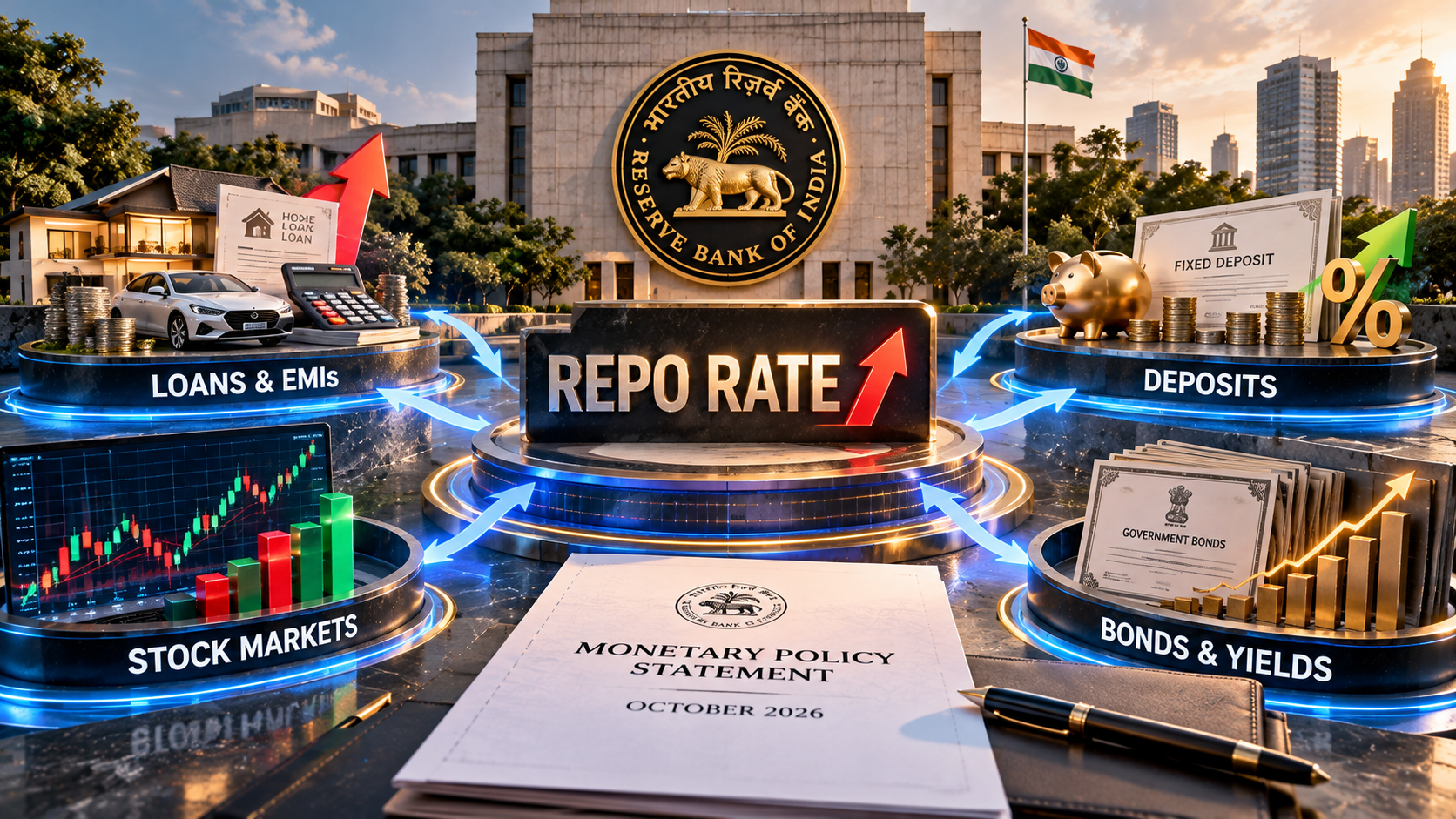
RBI Repo Rate Hike: October 2026 Policy Update, Impact on Loans, EMIs, Deposits & Markets
A simple guide to the October 2026 RBI repo rate hike, what it means for borrowers, depositors, investors, banks and the broader economy.
Sachin Gadekar
·
08 Oct 2026

IPO
HD Fire Protect IPO Details: Date, Price, GMP, Review & How to Apply
A complete guide to HD Fire Protect IPO 2026, covering issue size, OFS structure, price band, lot size, GMP context, company profile, financials, risks, valuation and application process.
Sachin Gadekar
·
07 Oct 2026

IPO
Reliance Jio IPO: Date, Price, GMP, Valuation, Review & Details
A complete guide to Reliance Jio IPO 2026, covering Jio Platforms IPO details, issue size, expected date, price band status, GMP context, shareholder quota, company profile, financials, valuation and risks.
Sachin Gadekar
·
07 Oct 2026