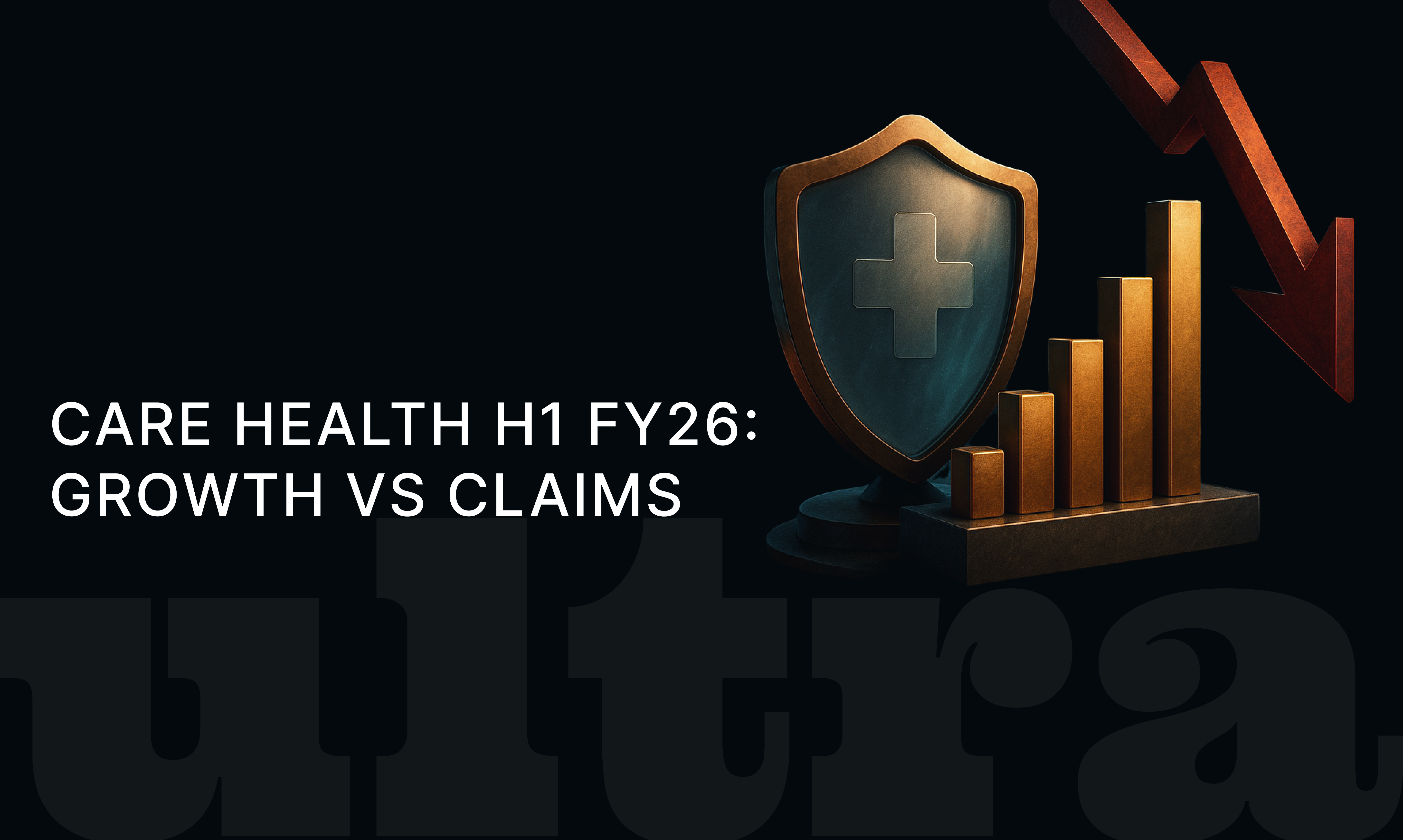
Care Health H1 FY26: Growth Is Strong, But Claims Are Growing Even Faster
21 November 2025
A deep dive into Care Health Insurance’s H1 FY26 results—premium growth, rising claims, profitability pressure, and what it means for investors.
Introduction
India’s standalone health insurance segment has been expanding at a rapid pace, driven by increased healthcare awareness, rising out-of-pocket medical expenses, and post-pandemic demand for comprehensive coverage. Among the key players in this space is Care Health Insurance, backed by Religare Enterprises and two major public sector banks.
H1 FY26 numbers show that the company continues to grow its premium base at a solid pace — but beneath this growth lies a concerning trend: claims are rising faster than premiums, putting significant pressure on underwriting profits.
This deep-dive report breaks down Care Health’s H1 FY26 performance, the rising claims problem, cost pressures, and whether the company’s current path is sustainable. For investors tracking the unlisted market, insurance sector trends, or broader financial dynamics, this analysis provides a clear and structured view of where Care Health stands today.
Premium Growth Continues, But Risk Retention Declines
During April–September 2025 (H1 FY26), Care Health Insurance reported ₹3,377 crore in gross written premiums (GWP), up from ₹3,137 crore in H1 FY25. This 7.6% YoY growth is consistent with the broader industry trend, where retail health continues to be the dominant driver.
However, this headline growth does not tell the full story.
Care Health has shifted more risk to reinsurers, ceding a larger proportion of premiums compared to previous years. While reinsurance is a standard practice in health insurance — especially to manage large claims or catastrophic risks — increasing ceded premiums indicate that the insurer is either:
Facing higher uncertainty around claims,
Expecting rising medical inflation, or
Rebalancing its risk mix due to portfolio pressure.
In other words, top-line growth is strong, but the company is keeping less of this risk on its own balance sheet.
Investment Income: The Shock Absorber
If there is one segment that has supported Care Health during this claims-heavy period, it is investment income.
H1 FY26 investment income: ₹222 crore
H1 FY25 investment income: ₹161 crore
High interest rates and a larger investment base have boosted returns. For many insurers, especially in tough underwriting years, investment income acts as a cushion that prevents deeper losses. Care Health is experiencing exactly this dynamic.
Without this investment income, the company’s profitability would have been significantly weaker.
Claims: The Biggest Pressure Point
The biggest challenge for Care Health — and one that is common across the health insurance industry — is rising claims. Claim payouts jumped from ₹2,043 crore to ₹2,480 crore in one year. This nearly ₹440 crore increase in claims has dramatically impacted underwriting margins. Some of the reasons behind this sector-wide spike include:
Medical inflation, rising 12–15% annually.
Higher hospitalization rates as elective procedures normalize post-pandemic.
Increase in fraud detection, which when identified, still inflates operational overhead.
Claims from retail health policies, which historically carry higher loss ratios compared to group policies. Care Health’s portfolio is heavily skewed towards individual retail health insurance — a segment with high premiums but also high claims.
Rising Costs Add Additional Pressure
Beyond claims, two major cost heads have put additional strain on the company:
Commission payouts: ₹627 crore
Operating expenses: ₹573 crore
Distribution costs remain high due to the company’s strategic focus on agents and partners. While digital acquisition channels have grown, the health insurance space still depends heavily on offline agents who receive substantial commissions.
Combined with higher medical payouts, this cost structure has resulted in:
An underwriting loss of nearly ₹70 crore in H1 FY26
versus a marginal loss of ~₹3.6 crore in H1 FY25
This indicates deterioration in the insurer’s core profitability.
Profitability: Technically Positive, Fundamentally Weak
Even with higher premiums and stronger investment returns, the company reported a much lower profit after tax (PAT) in H1 FY26.
H1 FY26 PAT: ₹17 crore
H1 FY25 PAT: ₹61 crore While the company is not in the red, the underlying story is not encouraging:
Premiums are rising.
Claims are rising faster.
Underwriting losses are widening.
Investment income is masking deeper structural issues. Insurers can survive a few years of high claims, but a prolonged imbalance can create solvency pressure.
Combined Ratio Above 100%: A Warning Signal
The combined ratio (claims + operating expenses relative to net earned premiums) has now crossed 1, meaning:
Care Health pays more in claims and expenses than it earns from premiums.
This ratio is one of the most important metrics for evaluating an insurer’s efficiency. A number above 1 suggests long-term unsustainability unless the company:
Increases underwriting discipline,
Adjusts pricing,
Reduces operational inefficiencies,
Or redesigns products for better risk segmentation.
Care Health — H1 FY25 vs H1 FY26 Key Indicators
| Key Indicator | H1 FY25 (₹ Cr) | H1 FY26 (₹ Cr) | Trend |
|---|---|---|---|
| Gross Premiums | 3,137 | 3,377 | ⬆️ Growth |
| Claims | 2,043 | 2,480 | ⬆️ Faster growth |
| Underwriting Result | -3.6 | -70 | ⬇️ Deterioration |
| PAT | 61 | 17 | ⬇️ Sharp decline |
| Investment Income | 161 | 222 | ⬆️ Supportive |
Key Risks to Watch
Investors tracking the unlisted markets or evaluating the insurance sector should watch for:
1. Claim Ratio Stabilization
If claims keep rising faster than premiums, Care Health may face sustained underwriting losses.
2. Reinsurance Dependence
Higher ceding of premiums protects against volatility but erodes profitability.
3. Combined Ratio
A ratio >100% for consecutive years is a red flag.
4. Solvency Health
Capital buffers could come under pressure if underwriting losses deepen.
5. Pricing Revisions
Premium hikes could restore balance, but may also affect customer acquisition.
Ultra’s Take (Insight for Investors)
Health insurance will continue to grow as India moves toward higher medical awareness and increasing hospitalization costs. Companies like Care Health are structurally important to this ecosystem.
However, investors should focus not only on premium growth but also on loss ratios, underwriting health, cost structures, and reliance on investments.
At Ultra, we regularly publish insights on India’s financial and investment landscape, including unlisted markets, fintech, infrastructure, and alternative investing.
Explore deep-dive investment research and insights on ultra.
FAQs
1. Why are Care Health’s claims rising so fast?
Claims are rising mainly due to medical inflation, higher hospitalization rates, and increased procedure costs. Retail health insurance products typically have higher claim ratios.
2. Is Care Health still profitable?
Yes, but only due to investment income. Underwriting operations posted a significant loss in H1 FY26.
3. What does a combined ratio above 100% mean?
It means the company is paying out more in claims and expenses than it earns through premiums — a sign of stress in the core business.
4. Does premium growth guarantee profitability for insurers?
No. Insurers must manage claims efficiently and maintain healthy loss ratios. Premium growth without profitable underwriting can be unsustainable.
Recent articles
View all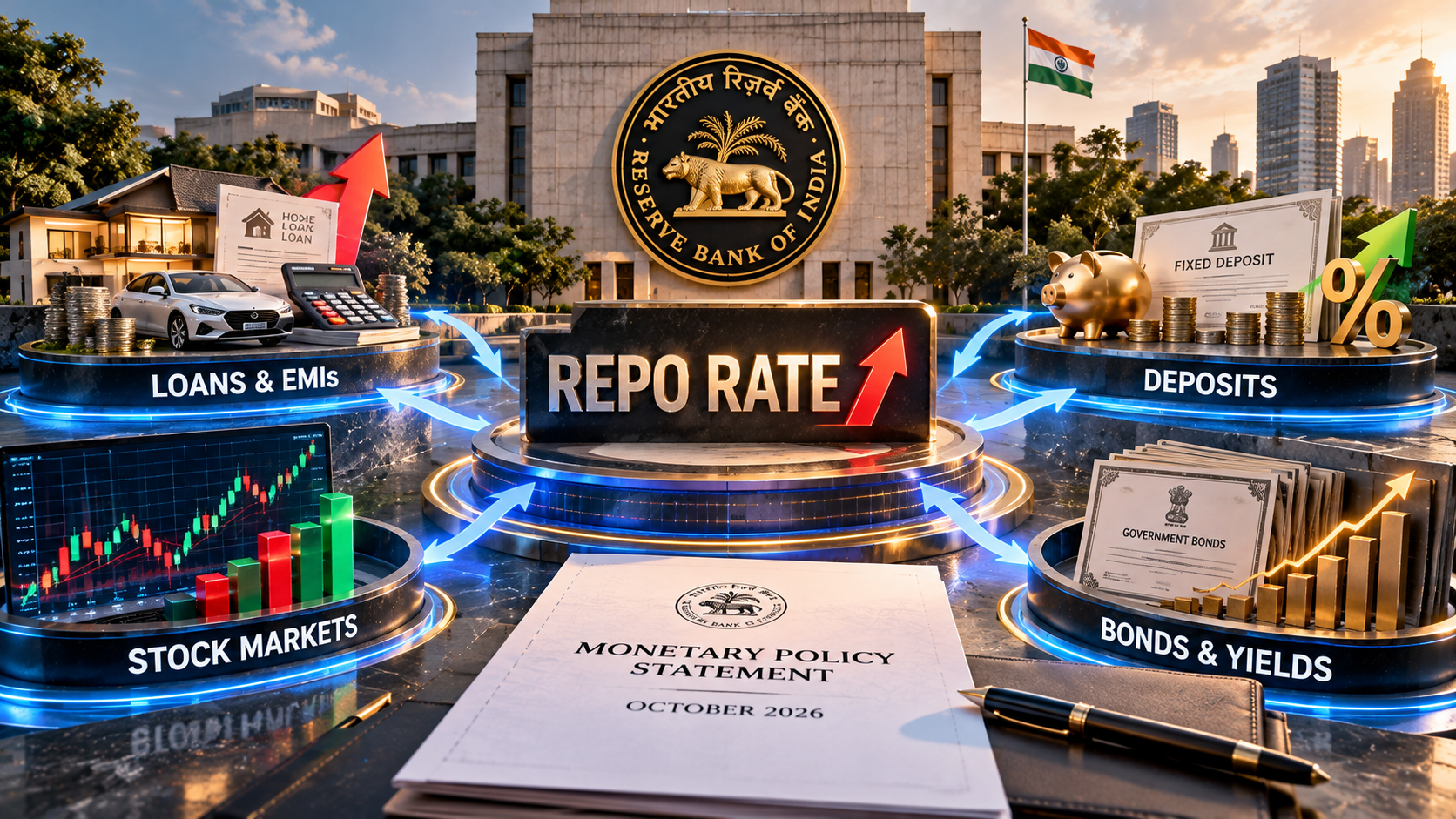
finance
RBI Repo Rate Hike: October 2026 Policy Update, Impact on Loans, EMIs, Deposits & Markets
A simple guide to the October 2026 RBI repo rate hike, what it means for borrowers, depositors, investors, banks and the broader economy.
Sachin Gadekar
·
08 Oct 2026

IPO
Reliance Jio IPO: Date, Price, GMP, Valuation, Review & Details
A complete guide to Reliance Jio IPO 2026, covering Jio Platforms IPO details, issue size, expected date, price band status, GMP context, shareholder quota, company profile, financials, valuation and risks.
Sachin Gadekar
·
07 Oct 2026

IPO
HD Fire Protect IPO Details: Date, Price, GMP, Review & How to Apply
A complete guide to HD Fire Protect IPO 2026, covering issue size, OFS structure, price band, lot size, GMP context, company profile, financials, risks, valuation and application process.
Sachin Gadekar
·
07 Oct 2026

IPO
Nityas Gems & Jewellery IPO Details: Date, Price, GMP, Review & How to Apply
A complete guide to Nityas Gems & Jewellery IPO 2026, covering issue size, GMP context, price band, lot size, company profile, financials, risks, valuation and application process.
Sachin Gadekar
·
05 Oct 2026