Best Trading Platforms in India in 2026: Fee Comparison Included
24 June 2026 · Sankarshan B
Compare brokerage charges, platform features and investor suitability across Zerodha, Groww, Dhan, Upstox, Angel One, 5paisa and HDFC Sky.
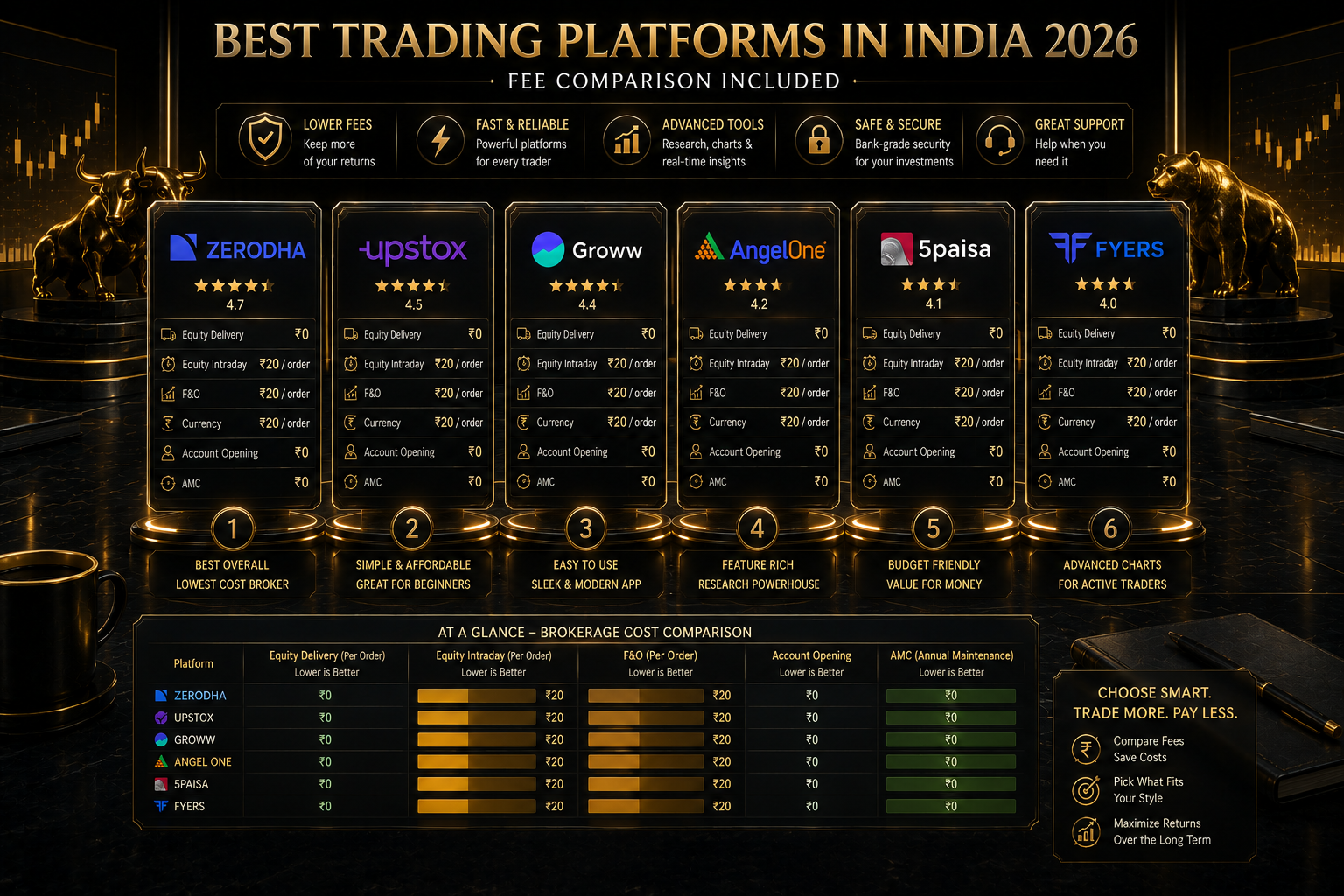
Selecting the best trading platform in India is no longer only about finding the lowest brokerage fee. Investors must also consider order execution, platform reliability, charting tools, product availability, customer support and the total cost of maintaining an account.
Some platforms are designed for first-time investors who want a simple interface. Others provide advanced charts, options trading tools and application programming interfaces for experienced traders. A platform that works well for long-term equity investing may not necessarily be the right choice for frequent intraday or derivatives trading.
This guide compares some of the leading trading platforms in India based on their standard brokerage structures, key features and suitable use cases.
Important: Brokerage plans, account charges and promotional offers can change. Confirm the latest charges on the broker’s official website before opening an account or placing a trade.
Best Trading Platforms in India in 2026
The platforms covered in this comparison are:
Zerodha
Groww
Dhan
Upstox
Angel One
5paisa
HDFC Sky
The list is not a ranking based only on cost. Each platform has been evaluated based on pricing simplicity, usability, trading tools, product range and the type of investor it may suit.
Quick Fee Comparison
The following figures represent the standard or headline brokerage plans generally offered by the platforms. Taxes, statutory charges, demat charges and optional subscription plans are not included.
| Platform | Equity Delivery | Equity Intraday | Equity Futures | Equity Options | Best Suited For |
|---|---|---|---|---|---|
| Zerodha | ₹0 brokerage | ₹20 or 0.03% per executed order, whichever is lower | ₹20 or 0.03% per executed order, whichever is lower | ₹20 per executed order | Cost-conscious investors and active traders |
| Groww | ₹20 or 0.1% per executed order, whichever is lower | ₹20 or 0.1% per executed order, whichever is lower | ₹20 per executed order | ₹20 per executed order | Beginners and mobile-first investors |
| Dhan | ₹0 brokerage | ₹20 or 0.03% per executed order, whichever is lower | ₹20 or 0.03% per executed order, whichever is lower | ₹20 per executed order | Active traders seeking advanced tools |
| Upstox | ₹20 or 2.5% per executed order, whichever is lower | ₹20 or 0.05% per executed order, whichever is lower | ₹20 or 0.05% per executed order, whichever is lower | ₹20 per executed order | Mobile-first traders and derivatives users |
| Angel One | ₹20 or 0.1% per executed order, whichever is lower | ₹20 or 0.03% per executed order, whichever is lower | ₹20 or 0.03% per executed order, whichever is lower | ₹20 per executed order | Investors seeking research and assisted features |
| 5paisa | ₹20 per executed order under the standard plan | ₹20 per executed order under the standard plan | ₹20 per executed order under the standard plan | ₹20 per executed order under the standard plan | Users interested in bundled trading plans |
| HDFC Sky | ₹20 per executed order under the standard plan | ₹20 per executed order under the standard plan | ₹20 per executed order under the standard plan | ₹20 per executed order under the standard plan | Investors seeking a bank-backed financial ecosystem |
A low headline brokerage rate does not automatically make a broker the cheapest. The total cost depends on trade size, frequency, demat charges, account maintenance fees and additional services used.
1. Zerodha
Best for: Cost-conscious investors and experienced traders
Zerodha remains one of the most widely recognised discount brokers in India. Its pricing structure is relatively straightforward, with zero brokerage on equity delivery and flat or percentage-based charges for intraday and derivatives orders.
Its main trading platform, Kite, provides charts, watchlists, order types and market data in a relatively clean interface. Zerodha also offers access to direct mutual funds through Coin and educational content through Varsity.
Key advantages
Zero brokerage on equity delivery under the standard plan
Simple and transparent pricing structure
Strong charting and trading interface
Extensive investor education resources
Suitable for both long-term investors and active traders
Points to consider
Investors requiring extensive relationship-manager support may prefer a full-service broker
Demat and account-related charges may apply separately
Advanced traders may need external tools for specialised strategies
Official pricing reference: Zerodha Charges
2. Groww
Best for: Beginners and investors who prefer a simple mobile interface
Groww is designed around ease of use. Its uncluttered interface can make it easier for new investors to discover stocks, mutual funds and other products without navigating a highly technical trading terminal.
Unlike platforms that offer free equity delivery, Groww generally charges brokerage on delivery transactions under its standard pricing model. Investors who make frequent small delivery purchases should account for this while comparing overall costs.
Key advantages
Beginner-friendly user interface
Simple onboarding and investment journey
Stocks and mutual funds available through one platform
Useful for investors who prioritise convenience over advanced tools
Points to consider
Equity delivery is not necessarily brokerage-free
Advanced charting and strategy tools may be less extensive than trader-focused platforms
Frequent investors should calculate the cumulative effect of per-order charges
Official pricing reference: Groww Pricing
3. Dhan
Best for: Active traders and users looking for specialised trading tools
Dhan is positioned strongly towards active market participants. In addition to its main platform, it offers dedicated interfaces and tools for trading equities, options and other market segments.
Its standard pricing has traditionally included zero brokerage on equity delivery and flat or percentage-based charges for intraday and derivatives transactions.
Key advantages
Zero brokerage on equity delivery under the standard plan
TradingView and advanced chart-based workflows
Tools designed for options and active traders
Application programming interface access for eligible users
Detailed order and risk-management features
Points to consider
The number of tools may initially feel complex for first-time investors
Investors focused only on occasional stock purchases may not use many advanced features
API, data and specialised features may have separate conditions
Official pricing reference: Dhan Pricing
4. Upstox
Best for: Mobile-first traders and derivatives users
Upstox provides a modern trading interface across mobile and web. It caters to both investors and traders, although its tools and product presentation have a strong trading orientation.
Its standard pricing generally follows a per-order structure for equity delivery, intraday and derivatives transactions.
Key advantages
Mobile-first trading experience
Charts and tools for active market participants
Access to equities, derivatives and other investment products
Relatively straightforward brokerage model
Points to consider
Equity delivery may attract brokerage
Small delivery transactions can face a higher effective percentage cost
Additional account, demat and order-related charges should be reviewed
Official pricing reference: Upstox Pricing
5. Angel One
Best for: Investors looking for research, recommendations and a broad product range
Angel One combines discount-style brokerage with research and assisted investing features. It may appeal to investors who want access to market insights alongside their execution platform.
The platform provides stocks, derivatives, commodities, mutual funds and other financial products through its digital interface.
Key advantages
Research and market-analysis features
Broad financial product range
Suitable for investors who value guidance and screeners
Mobile and web-based trading access
Points to consider
Standard brokerage may apply to equity delivery
Introductory offers may differ from regular pricing
Investors should distinguish between educational content, research and regulated investment advice
Official pricing reference: Angel One Brokerage
6. 5Paisa
Best for: Investors interested in subscription plans and bundled services
5paisa offers a standard per-order brokerage structure, along with optional plans that may provide lower trading costs or access to additional services.
Its suitability depends on trading frequency. An active trader may benefit from evaluating the available subscription plans, while an occasional investor may prefer the simplicity of the standard plan.
Key advantages
Flat-fee structure under the standard plan
Optional subscription and bundled plans
Access to equities, derivatives, mutual funds and other products
Research and advisory-related features may be available
Points to consider
Subscription plans should be evaluated against actual trading frequency
Paying for a plan may not be economical for occasional traders
Delivery investors can compare the cost with zero-delivery-brokerage alternatives
Official pricing reference: 5paisa Pricing
7. HDFC Sky
Best for: Investors seeking a bank-backed platform and integrated financial ecosystem
HDFC Sky combines a digital brokerage platform with the familiarity of a large financial-services group. It may appeal to investors who value brand familiarity, integrated services and a relatively simple flat-fee structure.
Key advantages
Flat brokerage structure under the standard plan
Backed by an established financial-services group
Access to multiple investment and trading products
May be convenient for investors already using related banking services
Points to consider
Flat brokerage on delivery can become material for frequent small investments
Investors should compare annual maintenance and demat charges
The platform may not offer the same specialised trader ecosystem as dedicated trading-first brokers
Official pricing reference: HDFC Sky Pricing
Charges Beyond Brokerage
Brokerage is only one component of the total cost of trading. Two brokers offering the same ₹20 headline brokerage can still result in different final costs.
Securities Transaction Tax
Securities Transaction Tax, or STT, is levied on eligible transactions in equities and derivatives. The applicable rate depends on the type of transaction.
Exchange transaction charges
Stock exchanges charge transaction fees for orders executed through their systems. These charges can vary by exchange and market segment.
Goods and Services Tax
GST is generally charged on brokerage and certain transaction-related services. It is not calculated on the total value of securities purchased.
Stamp duty
Stamp duty is typically charged on the purchase side of eligible securities transactions. The amount depends on the instrument and transaction type.
SEBI and regulatory charges
Small regulatory charges may be collected on eligible exchange transactions.
Demat debit charges
When shares are sold from a demat account, the depository participant may charge a debit transaction fee. This is commonly called a DP charge and can materially affect small delivery trades.
Account maintenance charges
Some brokers charge annual or periodic demat account maintenance fees. Certain basic service demat accounts may receive different pricing subject to eligibility.
Other possible charges
Investors should also check for:
Call-and-trade charges
Auto square-off charges
Margin funding interest
Pledge and unpledge charges
Payment gateway charges
Delayed payment fees
Research or platform subscription fees
Charges for physical statements or account closure
Best Trading Platform by Investor Type
| Investor Requirement | Platforms to Consider | Reason |
|---|---|---|
| Beginner-friendly investing | Groww, Zerodha | Simple interfaces and relatively easy investment journeys |
| Zero-brokerage equity delivery | Zerodha, Dhan | Standard plans have traditionally offered ₹0 brokerage on equity delivery |
| Advanced charts and active trading | Dhan, Zerodha, Upstox | Trading-oriented interfaces, charts and order-management tools |
| Options trading | Dhan, Zerodha, Upstox | Derivatives-focused tools and flat per-order pricing |
| Research and assisted features | Angel One, 5paisa | Research, screeners and optional service plans |
| Bank-backed ecosystem | HDFC Sky | Integration with a broader financial-services group |
| Occasional long-term investing | Zerodha, Dhan, Groww | Choice between zero-delivery brokerage and simpler user experience |
How to Choose a Trading Platform
Start with your investment style
A long-term investor may prioritise zero brokerage on delivery, portfolio reporting and ease of use. An intraday or derivatives trader may place greater importance on execution speed, charts, order types and risk-management tools.
Calculate the effective cost
Do not compare platforms using only the advertised brokerage amount. Estimate the number of monthly orders, average transaction value and applicable demat charges.
For example, a ₹20 delivery brokerage can be insignificant on a large transaction but expensive on a ₹1,000 purchase.
Review platform reliability
A low-cost account offers little value if the platform becomes difficult to access during volatile markets. Consider order execution, uptime communication, login security and customer-support channels.
Check the available products
Not every platform offers the same range of equities, derivatives, mutual funds, bonds, exchange-traded funds, commodities or initial public offerings.
Choose a broker that supports the instruments you actually plan to use.
Evaluate customer support
Support becomes especially important during fund-transfer issues, rejected orders, corporate actions, demat discrepancies or account modifications.
Check whether support is available through tickets, telephone, email or relationship managers.
Understand reports and taxation
A good platform should make it easy to access contract notes, profit-and-loss statements, capital-gains reports, ledger statements and tax-related summaries.
Review security controls
Look for secure login options, two-factor authentication, order confirmations and clear account activity records. Never share passwords, one-time passwords or trading credentials with another person.
Trading and Long-Term Investing
Trading platforms make market access easier, but ease of execution should not be confused with lower investment risk.
Equities and derivatives can experience significant price fluctuations. Derivatives may involve leverage and can lead to losses exceeding the amount initially expected by an inexperienced trader.
Investors building a long-term portfolio may consider balancing market-linked investments with assets that provide greater cash-flow visibility or lower price volatility.
Depending on risk appetite and financial goals, this may include fixed deposits, bonds and other fixed-income opportunities. The purpose of diversification is not to eliminate risk, but to avoid relying entirely on a single asset class or investment strategy.
On ultra, investors can explore a range of fixed-income and alternative investment opportunities alongside their existing equity portfolio.
Explore investment opportunities: https://getultra.club/
Frequently Asked Questions
Which is the best trading platform in India in 2026?
There is no single best platform for every investor. Zerodha and Dhan may appeal to cost-conscious or active traders, while Groww may suit beginners. Angel One and 5paisa may appeal to investors seeking research or bundled services, while HDFC Sky may suit users who prefer a bank-backed ecosystem.
Which trading platform offers zero brokerage on equity delivery?
Zerodha and Dhan have traditionally offered zero brokerage on equity delivery under their standard plans. Pricing policies can change, so investors should confirm the current charges on the official websites.
Is a zero-brokerage platform completely free?
No. Even when brokerage is zero, statutory and transaction-related costs can still apply. These can include STT, exchange charges, GST, stamp duty, SEBI charges and demat debit charges.
Which trading app is suitable for beginners?
Groww is commonly preferred by beginners because of its simple interface. Zerodha Kite and Upstox are also relatively accessible, although they provide more trading-oriented tools.
Which platform is suitable for options trading?
Dhan, Zerodha and Upstox provide tools used by active derivatives traders. However, options trading involves substantial risk and may not be suitable for inexperienced investors.
Can I open accounts with multiple brokers?
Yes. An investor may maintain trading and demat accounts with multiple brokers. However, each account can create additional maintenance costs, reports and compliance communication.
Is lower brokerage always better?
Not necessarily. Reliability, order execution, customer service, reporting, platform tools and demat charges can matter more than saving a small amount on brokerage.
What is the difference between a trading account and a demat account?
A trading account is used to place buy and sell orders. A demat account holds securities such as shares in electronic form after they are purchased.
What should long-term investors prioritise?
Long-term investors should consider delivery brokerage, demat charges, portfolio reporting, corporate-action tracking, tax reports, security and ease of placing systematic investments.
Final Verdict
The best trading platform in India depends on what you intend to do with it.
Zerodha and Dhan stand out for zero-brokerage equity delivery and trader-focused tools. Groww offers a simpler experience for beginners, while Upstox caters to mobile-first active users. Angel One and 5paisa combine execution with research or optional plans, and HDFC Sky may appeal to investors seeking the familiarity of a large financial group.
Before choosing a platform, compare the complete cost rather than only the headline brokerage. Review statutory charges, demat fees, account maintenance costs, platform reliability and the quality of reports and support.
Most importantly, choose a platform that matches your investment strategy instead of allowing the platform’s features to determine how frequently you trade.
Disclaimer
This article is for educational purposes only and should not be considered investment advice or a recommendation to open an account with any particular stockbroker. Brokerage fees, taxes, product availability and platform features are subject to change. Verify all charges and regulatory details directly with the respective broker before investing or trading. Investments in securities markets are subject to market risks. Read all related documents carefully before investing.
Recent articles
View all
IPO
How to Read an IPO RHP Before Applying
A beginner-friendly guide to reading an IPO Red Herring Prospectus and understanding the key sections investors should review before applying.
Sachin Gadekar
·
24 Sep 2026
IPO
IPO Price Band and Lot Size Explained for Beginners
A simple guide explaining how IPO price bands and lot sizes work, why they matter for retail investors and what to check before applying for an IPO.
Sachin Gadekar
·
23 Sep 2026
IPO
What Is IPO GMP and Why It Can Be Misleading?
A simple guide explaining IPO GMP, grey market premium, expected listing price, common misconceptions, risks and what investors should check before applying for an IPO.
Sachin Gadekar
·
22 Sep 2026

IPO
Fresh Issue vs OFS in IPO: What Investors Should Know
A simple guide explaining fresh issue, offer for sale, IPO proceeds, dilution, promoter selling and what retail investors should review before investing in an IPO.
Sachin Gadekar
·
21 Sep 2026