Best FD Interest Rates in India 2026: Bank-Wise Comparison
22 June 2026 · Saurabh Mukherjee
The most complete bank-wise comparison of FD interest rates in India for 2026, covering PSU banks, private banks, small finance banks, corporate FDs, and NBFCs with senior citizen rates, special schemes, post-tax return analysis, and Ultra's verdict on where FDs belong (and don't belong) in an HNI portfolio.
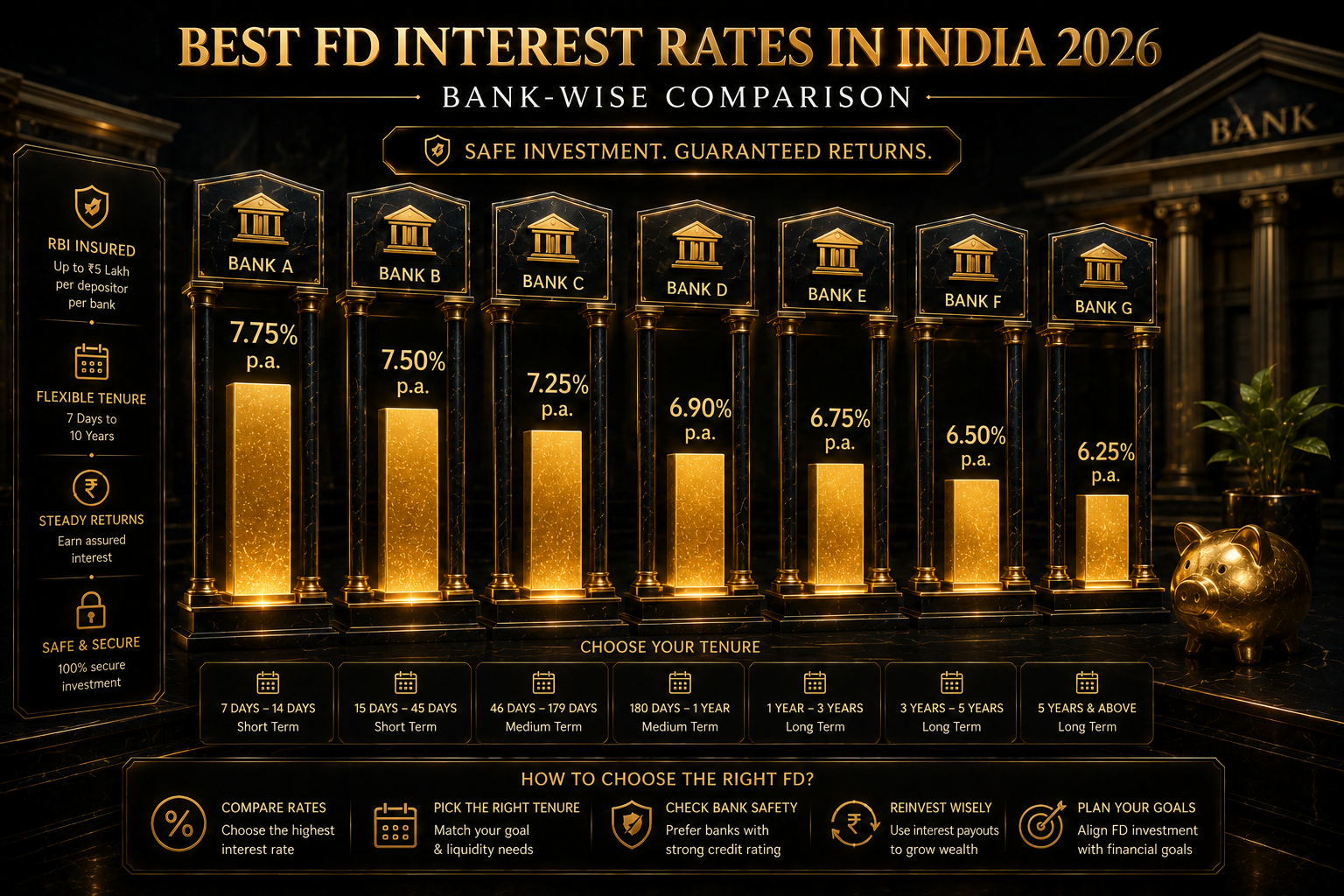
The RBI has kept the repo rate unchanged at 5.25% following a series of cuts in 2025 that brought it down by 125 basis points. With rates stabilised and potentially heading lower if inflation continues its decline June 2026 is likely a near-peak window for FD rates. Locking in current rates on medium-to-long tenures before any further RBI easing is the correct tactical move for FD investors right now.
This article compiles the best FD interest rates in India across all bank categories PSU banks, private sector banks, small finance banks, and NBFCs with current June 2026 data, senior citizen and super senior citizen rates, special scheme details, and a clear post-tax comparison across income brackets.
What this article does that most FD comparison pages do not: It also tells you honestly where FDs belong in an HNI portfolio and where they do not, with the post-tax real return calculations that make the case.
The 2026 FD Rate Context: Where We Are in the Rate Cycle
Understanding the rate cycle matters for FD investors because it determines both the current opportunity and the risk of waiting.
What happened in 2025: The RBI cut the repo rate by a cumulative 125 basis points across multiple policy meetings in 2025, bringing it from 6.50% to 5.25%. Banks passed these cuts through to deposit rates with a lag most major rate revisions happened between April and June 2025, with further smaller adjustments through early 2026.
Where we are now (June 2026): The RBI held the repo rate at 5.25% at its latest Monetary Policy Committee meeting, reflecting a balanced inflation and growth outlook CPI inflation near 2-4% and GDP growth at approximately 7.4%. With the RBI in a neutral stance, FD rates have broadly stabilised.
The tactical implication: This is likely a near-peak window for FD rates in the current cycle. If the RBI moves to further easing in late 2026 or 2027, new FD rates will soften. Investors who lock in medium-term FDs (2-5 years) at current rates will outperform investors who wait and then book FDs at lower rates.
The critical caveat for HNIs: Rate cycle timing matters most for investors primarily using FDs as a core instrument. For HNIs at 30%+ tax brackets, the post-tax return on even the best bank FD (approximately 4.44-4.71%) barely keeps pace with inflation making the rate cycle consideration secondary to the more fundamental question of whether FDs should be the primary vehicle at all.
Best PSU Bank FD Interest Rates 2026
Public sector banks offer the safety of implicit government backing alongside DICGC insurance at the cost of generally lower interest rates than private banks and SFBs.
| Bank | Highest Standard Rate (General) | Highest Standard Rate (Senior Citizen) | Best Special Scheme | Special Scheme Tenure |
|---|---|---|---|---|
| Punjab & Sind Bank | 6.75% | 7.25% | 6.75% (666-day tenure) | 666 days |
| Bank of India (BOI) | 6.80% (1-year) | 7.30% (1-year) / 7.45% (super senior) | 7.25% general / 7.90% super senior (Star Dhan Vriddhi) | 333 days |
| Canara Bank | 6.85% (1-3 year band) | 7.35% (1-3 year band) | 7.25% general / 7.90% super senior (non-callable) | 444 days |
| Union Bank of India | 6.65% | 7.15% | 7.05% (special tenure) | Varies |
| Bank of Baroda | 6.60% | 7.10% | 7.15% (Baroda Tiranga scheme) | 400 days |
| Canara Bank | 6.60% | 7.10% | — | — |
| State Bank of India (SBI) | 6.60% | 7.10% (Sbi We-care for senior citizens) | Amrit Vrishti scheme (444 days, now standard) | 444 days |
| Punjab National Bank (PNB) | 6.60% | 7.10% | 6.60% standard (no active special scheme) | — |
PSU bank FD key takeaways for 2026:
Canara Bank and Bank of India offer the most competitive PSU bank FD rates for general citizens, both above 6.80% on key tenures, with special schemes reaching 7.25%+ for general and 7.90% for super senior citizens
SBI and PNB despite being the largest PSU banks by deposits are not the highest-rate options in 2026 (both at 6.60% peak standard)
Punjab & Sind Bank offers the highest standard PSU rate at 6.75% on its 666-day tenure worth considering for investors specifically targeting this mid-tenure window
For detailed rate cards: BOI FD Interest Rates 2026 | Canara Bank FD Interest Rates 2026
Best Private Bank FD Interest Rates 2026
Private sector banks generally offer 20-50 basis points higher FD interest rates than PSU banks, with more innovative scheme structures and stronger digital onboarding.
| Bank | Highest Rate (General) | Highest Rate (Senior Citizen) | Peak Tenure | Notable Feature |
|---|---|---|---|---|
| HDFC Bank | 7.20% | 7.75% | Select special tenure | Highest peak rate among large private banks; SeniorCare FD with additional 0.25% extra above senior citizen rates |
| Kotak Mahindra Bank | 6.80% | 7.30% | 2 years to less than 3 years | Strong 2-3 year tenure positioning; 841-day special scheme previously at higher rates |
| Federal Bank | 6.80% | 7.30% | Select tenures | Competitive rates across mid-tenure band; strong NRI FD offering |
| ICICI Bank | 6.50% | 7.10% | 3 years 1 day to 5 years (revised June 9, 2026) | iDeposit online FD with 0.10% additional rate; ICICI Golden Years FD for senior citizens |
| IDFC First Bank | 6.50% | 7.00% | 400-500 days | Competitive in the 1-2 year tenure band |
| Axis Bank | 6.45% | 7.20% | 5-10 years (senior citizen peak); 1.3+ years (general peak) | Digital FD with 25% no-penalty premature withdrawal; Auto FD sweep facility |
Private bank FD key takeaways for 2026:
HDFC Bank leads private banks at 7.20% general / 7.75% senior — significantly above its listed peers
Kotak and Federal Bank are competitive at 6.80% general / 7.30% senior — 20-35bps above ICICI and Axis
Axis Bank's Digital FD is the standout product for investors who want above-standard rates with partial liquidity (25% no-penalty early withdrawal)
ICICI's June 9, 2026 revision brought its peak rate to 6.50% for general citizens on the 3-year+ tenure band
For detailed rate cards: Axis Bank FD Interest Rates 2026 | HDFC Bank FD Interest Rates 2026
Best Small Finance Bank FD Interest Rates 2026
Small Finance Banks (SFBs) offer the highest FD interest rates in India — often 100-200 basis points above major PSU and private banks while still being DICGC-insured up to ₹5 lakhs per depositor.
| Bank | Highest Rate (General) | Highest Rate (Senior Citizen) | Tenure for Peak Rate | DICGC Covered |
|---|---|---|---|---|
| Suryoday Small Finance Bank | 8.10% | 8.60% | 5 years | Yes — up to ₹5L |
| Utkarsh Small Finance Bank | 8.10% | 8.60% | Select tenures | Yes — up to ₹5L |
| Shivalik Small Finance Bank | 7.80% | 8.30% | Select tenures | Yes — up to ₹5L |
| Jana Small Finance Bank | 7.77% | 8.27% | Select tenures | Yes — up to ₹5L |
| Unity Small Finance Bank | 7.75% | 8.25%–8.50% | 1001 days | Yes — up to ₹5L |
| Ujjivan Small Finance Bank | 7.50% | 8.00% | 12–24 months | Yes — up to ₹5L |
SFB FD key takeaways for 2026:
SFBs offer the highest FD rates in India — up to 8.10% for general citizens at Suryoday and Utkarsh, and up to 8.60% for senior citizens
All SFBs are DICGC-insured up to ₹5 lakhs — the same protection as PSU and private banks
The critical limitation: The DICGC cap of ₹5 lakhs per depositor per bank means SFBs are only suitable for allocations up to ₹5 lakhs per bank — above this, the high rate comes without deposit insurance protection
For HNIs with ₹50+ lakhs to deploy, the SFB rate advantage is only available on the first ₹5 lakhs — making them suitable for a diversified "high-yield safety" slice, not the primary allocation
For detailed rate cards: Unity Small Finance Bank FD Interest Rates | Suryoday FD Interest Rates
Best Corporate / NBFC FD Rates 2026
Corporate FDs from NBFCs offer rates higher than most bank FDs, but without DICGC insurance. Credit rating is the primary safety signal.
| Issuer | Highest Rate (General) | Highest Rate (Senior Citizen) | Credit Rating | Min Investment |
|---|---|---|---|---|
| Shriram Finance | 7.55% | 8.05% (8.15% for senior women) | AA+/Stable (Ind-Ra, ICRA) | ₹5,000 |
| Bajaj Finance | 7.40% | 7.75% | AAA/Stable (CRISIL, ICRA) | ₹15,000 |
| Mahindra Finance | 7.00% | 7.35% | FAAA (CRISIL) | ₹5,000 |
For the complete corporate FD analysis including the DICGC gap and safety considerations, read: Best Corporate FD Rates 2026: Bajaj, Mahindra, Shriram Compared
Best FD Rates for Senior Citizens 2026
Senior citizens (60+ years) receive an additional 0.25%-0.75% over standard FD rates across most banks, making FDs significantly more competitive for this segment.
| Bank / Institution | Category | Senior Citizen Peak Rate | Tenure for Peak Rate | Additional Super Senior Premium |
|---|---|---|---|---|
| Suryoday Small Finance Bank | Small Finance Bank | 8.60% | 5 years | Not specified (check with bank) |
| Utkarsh Small Finance Bank | Small Finance Bank | 8.60% | Select tenures | Not specified |
| Shriram Finance | NBFC | 8.05% (8.15% senior women) | Select tenures | +0.10% for women depositors |
| Unity Small Finance Bank | Small Finance Bank | Up to 8.50% | 1001 days | Varies |
| Bajaj Finance | NBFC | 7.75% | 36-60 months | Not specified |
| HDFC Bank | Private Bank | 7.75% | Select special tenure | SeniorCare FD: +0.25% extra |
| Canara Bank (444-day scheme, super senior) | PSU Bank | 7.85%-7.90% (non-callable) | 444 days | +0.10%-0.15% over senior rate |
| BOI (Star Dhan Vriddhi, super senior) | PSU Bank | 7.90% | 333 days | +0.65% over standard (super senior) |
| Kotak Mahindra Bank | Private Bank | 7.30% | 2-3 years | Not specified |
| SBI | PSU Bank | 7.10% | Select tenures (We-care scheme) | Not specified |
Senior citizen FD strategy for 2026: The highest absolute rates for senior citizens are at SFBs (Suryoday, Utkarsh at 8.60%) but the DICGC ₹5 lakh cap limits the effective deployment. For senior citizen investors with larger corpus, the strategy should be: ₹5 lakhs in the highest-rate SFB (8.60%), ₹5 lakhs each across 2-3 other SFBs or high-rate NBFCs (Bajaj Finance 7.75%), and the remainder in PSU bank special schemes (BOI Star Dhan Vriddhi at 7.90%, Canara 444-day at 7.85-7.90%) for the DICGC-protected layer above ₹5 lakhs.
Best Special Scheme FD Rates 2026: 444, 555, 666-Day Deposits
Banks periodically launch special tenure FDs with "odd" tenures like 333, 444, 555, 666, 888, or 999 days — that offer rates above their standard rate card for that tenure band.
| Bank | Scheme Name | Tenure | General Rate | Senior Citizen Rate | Premium Over Standard |
|---|---|---|---|---|---|
| BOI | Star Dhan Vriddhi | 333 days | 7.25% | 7.75% (7.90% super senior) | +0.50% over standard |
| Canara Bank | 444-Day Special FD | 444 days | 7.25% | 7.75% (7.90% super senior, non-callable) | +0.40% over standard |
| Bank of Baroda | Baroda Tiranga Deposit | 400 days | 7.15% | 7.65% | +0.55% over standard 1-year rate |
| Punjab & Sind Bank | 666-Day Special | 666 days | 6.75% | 7.25% | Highest standard PSU rate at this tenure |
| PNB | 444-Day Special Tenure | 444 days | 6.60% | 7.10% | Standard; no additional premium currently |
| Unity Small Finance Bank | 1001-Day Special | 1001 days | 7.75% | Up to 8.50% | Above standard SFB card for this tenure |
The special scheme opportunity: BOI's Star Dhan Vriddhi and Canara's 444-day scheme stand out among PSU banks offering 7.25% for general citizens and up to 7.90% for super senior citizens. These are the highest DICGC-protected rates available to senior and super senior PSU bank FD investors in 2026.
Always verify scheme availability before booking: Special schemes are subject to withdrawal at the bank's discretion. Confirm directly at your branch or via the bank's app before booking.
Post-Tax FD Returns: The Number That Actually Matters
The gross FD rate is the marketing number. The post-tax return is the number that determines whether your money is actually growing in real terms. Here is the honest picture:
| Annual Income | Effective Tax Rate | Post-Tax on 6.60% FD (SBI/PNB) | Post-Tax on 6.85% FD (Canara) | Post-Tax on 7.25% Special Scheme | Post-Tax on 8.10% SFB | Real Return vs 4.5% Inflation (6.85% FD) |
|---|---|---|---|---|---|---|
| Up to ₹7L (zero tax) | 0% | 6.60% | 6.85% | 7.25% | 8.10% | +2.35% |
| ₹7–12L | ~10% | 5.94% | 6.17% | 6.53% | 7.29% | +1.67% |
| ₹12–24L (20% slab) | ~20% | 5.28% | 5.48% | 5.80% | 6.48% | +0.98% |
| ₹24–50L (30% slab) | 31.2% | 4.54% | 4.71% | 4.99% | 5.57% | +0.21% |
| ₹50L–₹1Cr | 34.32% | 4.33% | 4.50% | 4.76% | 5.32% | 0.00% |
| ₹1Cr–₹2Cr | 35.88% | 4.23% | 4.39% | 4.65% | 5.19% | -0.11% |
The critical table read: At income above ₹50 lakhs, even the best PSU bank FD (Canara at 6.85%) delivers exactly zero real return after tax and inflation. The 8.10% SFB rate delivers 5.19–5.57% post-tax at 30-35% brackets better, but still a thin 0.7-1.1% real return. For HNIs in these income brackets, the FD rate conversation is somewhat academic the more important conversation is what instruments to use for the majority of fixed income capital beyond the emergency buffer.
Which Bank Has the Highest FD Rate in India in 2026?
Direct answer by category:
Highest among all banks (any category): Suryoday Small Finance Bank and Utkarsh Small Finance Bank — 8.10% for general citizens, 8.60% for senior citizens (5-year tenure, DICGC-insured but ₹5L cap applies)
Highest among PSU banks: Bank of India and Canara Bank — up to 7.25% general on special schemes (Star Dhan Vriddhi / 444-day); highest super senior rate at 7.90% on these schemes
Highest among large private banks: HDFC Bank — 7.20% general, 7.75% senior (select special tenure)
Highest among NBFCs (no DICGC): Shriram Finance — 7.55% general, 8.15% for senior women
Highest among major PSU banks (standard rate card): Canara Bank — 6.85% on 1–3 year tenures
FD Rate Comparison: PSU vs Private vs SFB vs NBFC
| Category | Typical Peak Rate (General) | Typical Peak Rate (Senior) | DICGC Coverage | Best For |
|---|---|---|---|---|
| PSU Banks | 6.60%–6.85% (standard); up to 7.25% (special schemes) | 7.10%–7.35% (standard); up to 7.90% (special schemes) | Yes — ₹5L per bank | Large FD allocations (above ₹5L) where government-backed safety is priority |
| Private Banks | 6.45%–7.20% | 7.10%–7.75% | Yes — ₹5L per bank | Investors wanting slightly higher rates than PSU banks with DICGC coverage; product innovation (Digital FD, Auto FD) |
| Small Finance Banks | 7.50%–8.10% | 8.00%–8.60% | Yes — but only up to ₹5L | Maximum DICGC-insured rate on first ₹5L; not suitable for large corpus above ₹5L per bank |
| Corporate FDs / NBFCs | 7.00%–7.55% | 7.35%–8.15% | No — credit rating is the safety signal | Above-bank-FD yield for investors comfortable with NBFC credit risk on AAA/AA+ rated issuers |
Beyond FDs: What Delivers Better Post-Tax Returns in 2026
| Instrument | Gross Yield | Post-Tax (30%) | Advantage vs Best Bank FD (4.71%) | Key Trade-off |
|---|---|---|---|---|
| Best PSU Bank FD (Canara 6.85%, baseline) | 6.85% | 4.71% | — | Baseline — DICGC ₹5L, fully liquid with penalty |
| Best SFB FD (Suryoday 8.10%) | 8.10% | 5.57% | +0.86% | Only ₹5L DICGC-covered; not scalable beyond ₹5L per bank |
| RBI Floating Rate Savings Bond (8.05%) | 8.05% | 5.64% | +0.93% | 7-year lock-in; sovereign safe; non-transferable |
| AA Corporate NCD (monthly payout, 10%) | 10% | 6.88% | +2.17% | Issuer credit risk; listed exchange liquidity |
| Invoice Discounting (Tier 1-2 buyers, 12%) | 12% | 8.26% | +3.55% | 30-90 day lock-in per deal; buyer credit risk on large corporates/PSUs |
| Asset Leasing (solar/EV, 13%) | 13% | 8.97% | +4.26% | 24-60 month lock-in; lessee + asset risk; tangible asset backing |
The post-tax gap is the argument. On ₹50 lakhs at 30% bracket, the annual post-tax income difference between the best PSU bank FD (₹2.36 lakhs) and invoice discounting on Tier 1-2 buyers (₹4.13 lakhs) is ₹1.77 lakhs per year from the same corpus, with both instruments taxed identically at slab rate. Over 10 years, this is approximately ₹22-25 lakhs in additional wealth before compounding.
The correct portfolio answer is not "FDs vs alternatives" it is a structured combination where FDs serve the liquidity buffer and DICGC-insured emergency fund function (10-15% of corpus), while the majority of fixed income surplus is deployed across the higher-yield alternatives that meaningfully outperform FDs on a post-tax basis.
Explore curated invoice discounting and asset leasing at www.getultra.club alternatives that deliver materially better post-tax returns for investors ready to move the bulk of their fixed income surplus beyond FD rates.
FAQs
Q1. Which bank gives the highest FD interest rate in India in 2026?
Among all bank categories: Suryoday Small Finance Bank and Utkarsh Small Finance Bank offer the highest FD rates at 8.10% for general citizens and 8.60% for senior citizens (DICGC-insured but only up to ₹5 lakhs per depositor). Among large private banks: HDFC Bank leads at 7.20% general / 7.75% senior. Among PSU banks on standard rates: Canara Bank at 6.85% and BOI at 6.80%. Best PSU special scheme rates: BOI Star Dhan Vriddhi and Canara 444-day at 7.25% general / up to 7.90% for super senior citizens.
Q2. What are the best FD rates in India in June 2026?
As of June 2026: PSU banks offer standard peak rates of 6.60%-6.85% (Canara Bank highest at 6.85%), with special schemes at 7.15%-7.25%. Private banks range from 6.45% (Axis) to 7.20% (HDFC, select tenure). Small Finance Banks offer up to 8.10% (Suryoday, Utkarsh) for general citizens. NBFCs offer up to 7.55% general (Shriram Finance, AA+ rated) and 7.40% (Bajaj Finance, AAA rated).
Q3. Is 2026 a good time to book FDs in India?
Yes with the RBI holding the repo rate at 5.25% after a 125bps cutting cycle, FD rates have likely peaked for this cycle. If inflation continues declining and the RBI resumes easing in late 2026 or 2027, new FD rates will soften. Locking in medium-term FDs (2-5 years) at current rates is a sound tactical move. However, for investors at 30%+ tax brackets, the post-tax return on even peak FD rates barely covers inflation the rate cycle argument is secondary to the question of whether FDs should be the primary vehicle for surplus capital.
Q4. Are Small Finance Bank FDs safe in India?
Small Finance Bank FDs are regulated by the RBI and covered by DICGC insurance up to ₹5 lakhs per depositor per bank — identical protection to PSU and private bank FDs within this limit. Above ₹5 lakhs per bank, SFB deposits carry the credit risk of the specific bank without insurance. The DICGC cap makes SFBs suitable for the first ₹5 lakhs per bank not for large corpus allocations above this threshold.
Q5. What is the FD rate for senior citizens in 2026?
Senior citizens (60+ years) receive an additional 0.25%-0.75% over standard rates across most banks. The highest senior citizen FD rates in 2026: SFBs at 8.60% (Suryoday, Utkarsh), Shriram Finance NBFC at 8.05%-8.15%, HDFC Bank at 7.75%, BOI Star Dhan Vriddhi at 7.90% (super senior), Canara 444-day at 7.90% (super senior, non-callable), Bajaj Finance at 7.75%.
Q6. What is post-tax FD return for someone earning ₹50 lakhs annually?
At the 34.32% effective tax rate for income ₹50L-₹1Cr: a 6.85% FD (Canara Bank 1-3 year) delivers 4.50% post-tax exactly at the 4.5% inflation rate, zero real return. A 7.25% special scheme FD delivers 4.76% post-tax barely 0.26% real return. Even the highest SFB rate of 8.10% delivers only 5.32% post-tax a thin 0.82% real return. For investors earning ₹50 lakhs+, alternatives like invoice discounting (8.26% post-tax at 12% gross) and AA corporate bonds (6.88% post-tax at 10% gross) meaningfully outperform F
Disclaimer
FD interest rates mentioned in this article are based on publicly available bank rate communications as of June 2026 and are subject to change without notice. Banks revise FD rates periodically; always verify current rates directly with the relevant bank before booking. This article is for informational purposes only and does not constitute investment advice.
Recent articles
View all
IPO
How to Read an IPO RHP Before Applying
A beginner-friendly guide to reading an IPO Red Herring Prospectus and understanding the key sections investors should review before applying.
Sachin Gadekar
·
24 Sep 2026

IPO
IPO Price Band and Lot Size Explained for Beginners
A simple guide explaining how IPO price bands and lot sizes work, why they matter for retail investors and what to check before applying for an IPO.
Sachin Gadekar
·
23 Sep 2026

IPO
What Is IPO GMP and Why It Can Be Misleading?
A simple guide explaining IPO GMP, grey market premium, expected listing price, common misconceptions, risks and what investors should check before applying for an IPO.
Sachin Gadekar
·
22 Sep 2026

IPO
Fresh Issue vs OFS in IPO: What Investors Should Know
A simple guide explaining fresh issue, offer for sale, IPO proceeds, dilution, promoter selling and what retail investors should review before investing in an IPO.
Sachin Gadekar
·
21 Sep 2026