Understanding the Risk-Return Trade-off in Alternative Fixed Income Investments
10 November 2025
Balancing portfolio stability and higher yields through strategic risk management.
What is the Risk-Return Trade-off?
In the world of investing, one fundamental principle always holds true — higher returns come with higher risks. This balance, known as the risk-return trade-off, is central to every investment decision. For High Net-Worth Individuals (HNIs) seeking to preserve wealth while enhancing returns, understanding this trade-off becomes even more critical — especially in the realm of alternative fixed income investments.
In this article, we explore how HNIs can effectively navigate the risk-return spectrum across alternative fixed income products, including invoice discounting, private credit, and structured debt, and how platforms like ultra help investors make data-driven decisions.
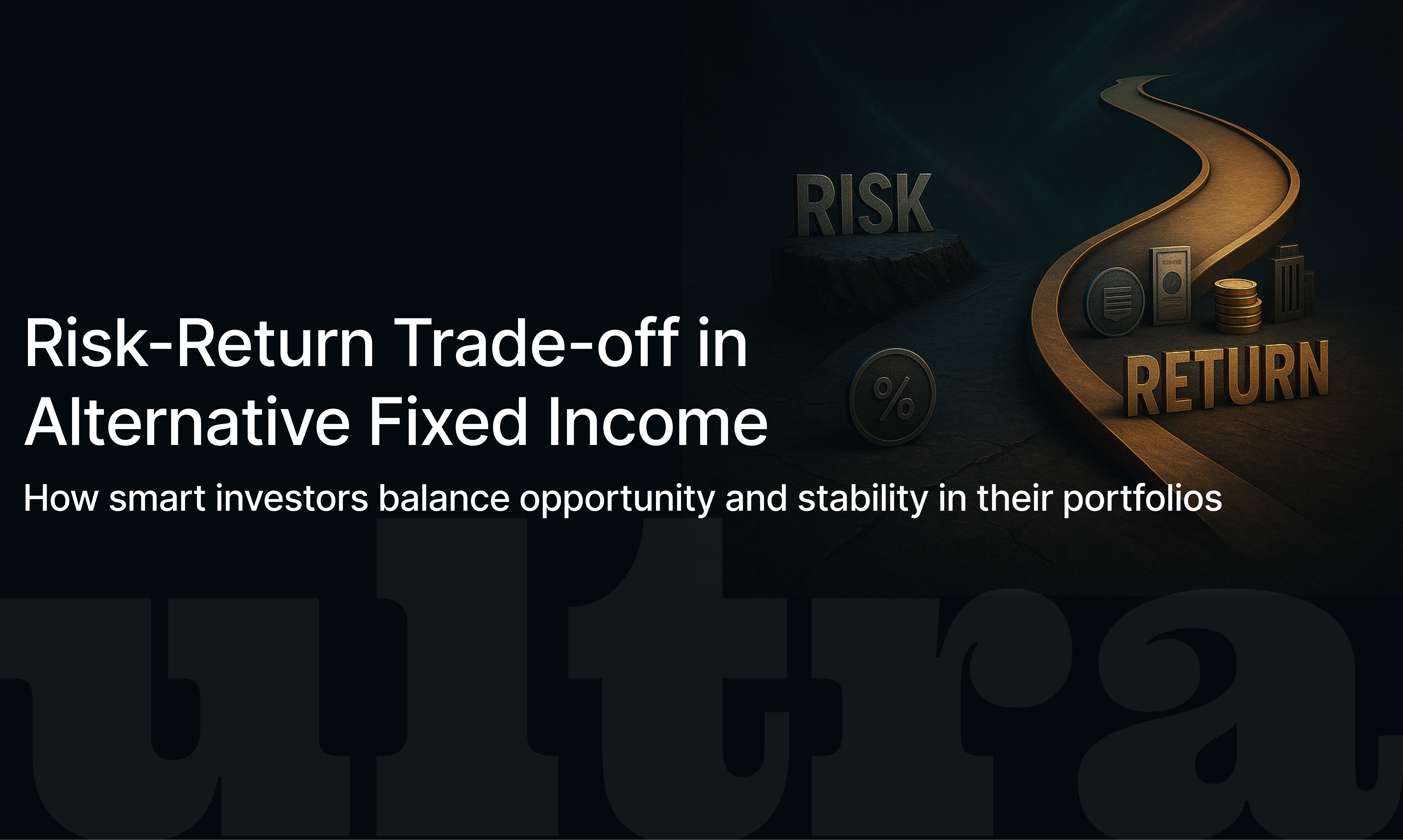
The risk-return trade-off refers to the relationship between the potential risk an investor takes and the expected return from an investment.
Low-risk investments (like government bonds or fixed deposits) typically offer lower returns.
High-risk investments (like private credit or venture debt) can yield higher returns but come with greater uncertainty.
For HNIs, striking the right balance between risk tolerance and return expectation is key to achieving long-term financial stability.
The Shifting Landscape of Fixed Income Investing
Traditional fixed income avenues — such as bank fixed deposits, public sector bonds, and debt mutual funds — are increasingly offering lower yields in a high-inflation environment. This has prompted HNIs to explore alternative fixed income options that provide enhanced returns without excessive volatility.
Alternative fixed income products often include:
Invoice discounting (short-term trade financing)
Asset leasing and supply chain finance
Private debt and non-convertible debentures (NCDs)
Structured credit and real estate debt
These products are designed to deliver superior yield potential, but they require investors to assess credit risk, liquidity, and duration more carefully.
Risk Factors in Alternative Fixed Income Investments
Before diving into higher-yielding opportunities, HNIs must understand the key risks involved:
1. Credit Risk
This is the risk of the borrower defaulting on payments. In private credit or invoice discounting, credit assessment of counterparties is crucial. Platforms like ultra perform rigorous due diligence to mitigate this risk.
2. Liquidity Risk
Unlike listed bonds or mutual funds, many alternative fixed income products are not easily tradable. Investors may need to stay invested until maturity to realize full returns.
3. Market and Interest Rate Risk
Interest rate fluctuations can influence bond and debt instrument prices. While short-term investments like invoice discounting are less sensitive to this, longer-term private debt may see valuation changes.
4. Operational and Legal Risk
Unclear legal documentation or operational inefficiencies can create hurdles in repayment. Choosing regulated and transparent platforms minimizes such risks.
Balancing Risk with Expected Return
| Investment Type | Risk Level | Return Potential (Annualized) | Liquidity |
|---|---|---|---|
| Fixed Deposits | Low | 5–7% | High |
| Listed Bonds | Moderate | 7–9% | Medium |
| Invoice Discounting | Moderate | 9–12% | Moderate |
| Private Debt / NCDs | Moderate to High | 10–14% | Low to Medium |
| Structured Debt / Credit | High | 12–16%+ | Low |
Why HNIs Prefer Alternative Fixed Income Investments
1. Higher Yield Potential
Alternative products often offer returns 2–3% higher than traditional debt, making them attractive for yield-seeking investors.
2. Customization and Flexibility
These investments can be structured to suit specific needs — such as duration, risk appetite, and cash flow requirements.
3. Reduced Correlation with Market Volatility
Alternative fixed income instruments are less correlated with equity market movements, providing stability during volatile periods.
4. Access Through Digital Platforms
With digital platforms like ultra, HNIs can easily access, evaluate, and invest in curated opportunities — backed by data insights, issuer analysis, and real-time reporting.
Strategies to Manage Risk Effectively
1. Diversify Across Issuers and Sectors
Avoid over-concentration in a single issuer or industry. Diversifying across multiple sectors such as infrastructure, logistics, or renewable energy can reduce exposure to sector-specific downturns.
2. Evaluate Creditworthiness
Review issuer ratings, financial statements, and repayment history before investing. Reputed platforms pre-screen opportunities for risk quality.
3. Match Investment Duration with Goals
Align short-term investments (like invoice discounting) with liquidity needs and long-term ones (like private credit) with wealth creation goals.
4. Reinvest Interest Income
Compounding returns by reinvesting interest payouts into similar instruments can enhance yield over time.
5. Use Professional Advisory
Working with wealth managers or investment platforms ensures better risk profiling and structured allocation.
How ultra Helps Balance Risk and Return
At ultra, HNIs gain access to a curated marketplace of alternative fixed income products — including private debt, invoice discounting, asset leasing, and structured notes.
The platform emphasizes:
Comprehensive credit evaluation and issuer screening
Transparent reporting and documentation
Diversified investment options across risk levels
Tech-enabled access for real-time portfolio insights
By combining data intelligence with risk management, ultra empowers investors to make informed decisions and balance their portfolio across risk-return dimensions.
Conclusion
For HNIs, the path to wealth preservation and growth lies in mastering the risk-return trade-off. While traditional fixed income options offer stability, alternative fixed income investments bring enhanced yield potential and strategic diversification.
By leveraging platforms like ultra, investors can navigate this trade-off effectively — optimizing returns without taking on unnecessary risk. The key lies in diversification, due diligence, and a disciplined approach to portfolio allocation.
FAQs
1. What does the risk-return trade-off mean in fixed income investing?
It refers to the balance between the level of risk an investor is willing to take and the expected return. Higher potential returns typically come with higher risks.
2. Are alternative fixed income products safe?
They can be safe if properly evaluated for creditworthiness and managed through trusted platforms like ultra that emphasize transparency and due diligence.
3. What are some popular alternative fixed income options for HNIs?
Popular options include invoice discounting, private credit, structured debt, and asset leasing.
4. How can HNIs manage risk in alternative investments?
By diversifying across issuers, conducting credit analysis, matching investment horizons, and working with regulated investment platforms.
5. Why are alternative fixed income products gaining popularity?
Because they offer higher yields, portfolio diversification, and resilience against market volatility compared to traditional instruments.
Recent articles
View all
IPO
Nityas Gems & Jewellery IPO Details: Date, Price, GMP, Review & How to Apply
A complete guide to Nityas Gems & Jewellery IPO 2026, covering issue size, GMP context, price band, lot size, company profile, financials, risks, valuation and application process.
Sachin Gadekar
·
05 Oct 2026

IPO
Orient Cables IPO Date, Price, GMP, Review & Details
A complete guide to Orient Cables IPO 2026, covering issue size, GMP context, price band, lot size, subscription status, company profile, financials, risks and application process.
Sachin Gadekar
·
30 Sep 2026

IPO
A-One Steels IPO Date, Price, GMP, Review & Details
A complete guide to A-One Steels IPO 2026, covering issue size, GMP context, price band, lot size, subscription status, company profile, financials, risks and application process.
Sachin Gadekar
·
29 Sep 2026

IPO
Moneyview IPO GMP Details: Date, Price Band, Subscription Status, Review & How to Apply
A complete guide to Moneyview IPO 2026, covering issue size, GMP context, price band, issue price, lot size, subscription status, company profile, financials, risks and application process.
Sachin Gadekar
·
28 Sep 2026